DJI Phantom 3

Hollywood's Next Hit Could Be Based on an NFT -- And You'd Never Know It


Hollywood's Next Hit Could Be Based on an NFT -- And You'd Never Know It

In 1994, True Lies was a massive hit, raking in almost $400 million at the box office. That makes sense: It starred Arnold Schwarzenegger, one of the most bankable stars in Hollywood history, and was helmed by James Cameron, fresh off directing Terminator 2.

But how many people watched La Totale, the French movie it was based on?

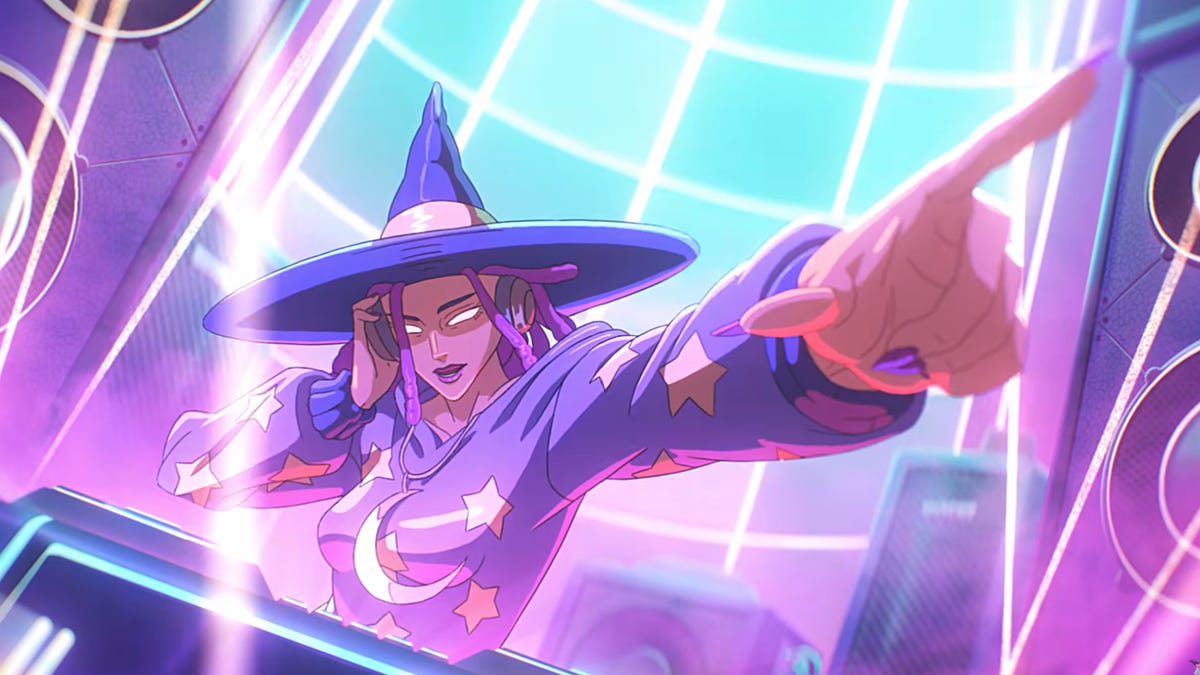
That's the question on John Wick creator Derek Kolstad's mind. In between writing Netflix's upcoming Splinter Cell show, Kolstad is penning an eight-episode anime show, based on Forgotten Runes Wizard's Cult.

If you've never heard of Forgotten Runes, that's probably because you don't spend your nights surfing NFT marketplace OpenSea. It's an NFT collection that launched last July and consists of just under 10,000 fantasy characters. The question is simple: Is it possible for a show based on NFTs to cross over to a mainstream audience that may not even know what those three letters stand for?

"There's real life and there's what Web3 is doing, and there's a divide between the two," Kolstad said in a recent Zoom interview. "You [need] to bridge the divide by just making a good thing, a good thing that makes people say, 'What is this? It's based on something? What's that?'"

NFT collections, like the Bored Ape Yacht Club, typically feature thousands of different characters, as well as a loose story that ties them together. But NFTs are polarizing. They've been enthusiastically adopted by some, but are despised by many. Those working in the industry are aware that interest is too limited to market NFT adaptations, like a TV show, based on its crypto credentials alone.

But that doesn't mean NFT characters, stories and franchises can't be fodder for an adaptation that goes mainstream. Forgotten Runes is one of many NFT brands hoping to jump from the blockchain to the big screen.

"The number of [NFT owners] in a single collection is usually around 5,000," said Bryce Anderson, production executive at Clubhouse Pictures, which helped produce I, Tonya and Birds of Prey. "If that's your audience, it's not enough to make a global brand. We talk about our TV shows, and it's 500,000 people per week or you get canceled. That's what you need."

It won't be easy. Much of the hype around NFTs was generated by the speculative bubble that enveloped the crypto market in 2021. The crash of crypto prices in recent months has sedated that speculative mania, dampening enthusiasm for NFTs. Despite the cold winds of "crypto winter," many creators are trying to prove that NFTs are here to stay.

Similar to how some developers and engineers left the Silicon Valley giants to join the crypto industry, renowned creatives are exploring NFTs. Most notable are the celebrities. Seth Green is working on a show that will star his Bored Ape Yacht Club NFT. Reese Witherspoon's production house is working on a film and TV universe for the World of Women NFT collection. Equally important are the artists and scriptwriters, who've come from companies like Pixar and Marvel.

"You never know what something's going to become," said Bearsnake, one of Forgotten Runes' founders. Bearsnake declined to give his real name but verified to CNET that he ran creative at an entertainment startup acquired by Disney. "Hello Kitty started as a vinyl coin purse. Did they know it was going to turn into... one of the biggest media franchises in the world? No, but it found an organic way to where it is now."

28 of the NFTs in Forgotten Runes Wizard's Cult, a collection of 9,995 pixelated NFTs. 

Forgotten Runes/OpenSea

Fund a show, own a character

For some, the goal is for a universe created from an NFT collection to break through the cryptographic ceiling and go mainstream. Others see NFTs more practically: as a way to help fund productions.

"The biggest barrier for any young filmmaker has been finance," said Spike Lee during a talk at the NFT.NYC conference in June. "Where are you gonna get the money?"

Lee says technology has helped decentralize filmmaking, as amateurs can now shoot and edit video on their phones and laptops. Funding, however, continues to bedevil up-and-coming artists. Lee hopes NFTs can change that. He's piloting a program at New York University, where he teaches filmmaking, that will allow his students to fund projects by issuing NFTs.

"Films are still going to be made by the studios, and I think that NFTs will fit in the independent cinema," Lee said.

At the center of the premise is intellectual property. Punters can invest in up-and-coming filmmakers and the characters they create, just like they can invest in startup companies. The more popular those characters become, in theory, the bigger the returns.

IP bleeds into the second proposed benefit of media creation via the blockchain. Buying an NFT often means buying the IP for the depicted character -- and the right to build on top of that IP by creating a backstory. Many hope this can change the way films and TV are written and created.

Take Forgotten Runes. Wizard's Cult is a collection of 9,995, each depicting a different fantasy character: mages, warriors, alchemists, clairvoyants and more. Those who own an NFT get access to the Book of Lore, wherein they can write an official backstory for their character. Once it's written, it can't be changed -- even if the NFT is sold to another person.

It sounds like a recipe for chaos -- the internet is undefeated at loading unsuspecting platforms with offensive content -- but the idea is that self-interest will prevail. Worthwhile characters can be chosen to appear in Forgotten Runes' upcoming anime. If it becomes a hit, the characters within, and their attached NFT, become more valuable.

Writing fan fiction is technically illegal, points out Bearsnake, as it violates copyright law. The proposition, made by many NFT collections, is that franchises can be built quicker by embracing the passion of fans rather than merely tolerating it.

"Some of my favorite pieces of literature of the last 10 years, like actual literature, is stuff people wrote on the internet, and released on the internet, for free," said Clubhouse Picture's Anderson. "That was their creative impulse, and I think [NFTs help find] a way to let that live in a more public way."

Anderson is cocreator of Runner, an upcoming NFT collection. Runner takes place on a planet called Omega and focuses on The Omega Race, a contest that determines who rules the whole planet. It's being penned by Blaise Hemingway who, through the Disney Animation Story Trust, helped write Frozen and Big Hero 6.

Runner is an upcoming NFT collection. It's founded by Bryce Anderson and Bryan Unkeless, both of Clubhouse Pictures. Between them, they've worked on films like The Hunger Games and I, Tonya.

Runner

To Hemingway, the idea of NFT holders being able to create official backstories for their characters reminded him of being a kid and creating storylines for his Star Wars figurines.

"There could be a character that appears on screen for two seconds in a cantina scene, but what's that character's story?" he said. "We're following the story of about 12 central characters, but there's an entire world that has parallel stories going on that intersect with this."

Hemingway and Anderson have plans to adapt Runner to other mediums, though none are concrete yet. A film or TV expression seems inevitable given the team's credentials: Working with Hemingway and Anderson are Bryan Unkeless, producer of the Hunger Games, and Cedric Nicolas-Troyan, director of Snow White and the Huntsman.

NFTs going pop

The business models of NFT collections -- the ones that have business models in the first place -- often rely on the ability to break out into mainstream culture. But breaking out requires quality products, and quality products take a lot of time and effort to make.

Forgotten Runes is among the more ambitious NFT groups. Beyond the anime show, there's a comic book series that had its first issue in June, plans for a tabletop game and, curiously, even a cookbook. A Forgotten Runes massively multiplayer online role-playing game, or MMORPG, is in development and is due for release early next year.

The idea of creating a franchise and expanding it into different mediums is as old as Disney, said Bearsnake. What's new with NFTs is a set of tools that allows fans to play a more crucial role in that process. Those tools, however, create problems as well as solutions. Creators need to make products with mainstream appeal but also placate NFT investors who are mostly speculators, more interested in short-term hype than long-term vision.

"The majority of people in the space are really in it for financial gain, and that's OK," said Bearsnake. "I think there's a lot of unrealistic expectations from a lot of the community to the founders, because not everybody understands what goes into just even making a comic book. Like, that was hard."

It's a difficult time to be branching out. The past few months have been tough on all things crypto. Ether, the currency behind most NFTs, is down over 50% since the year began. That's tanked not only NFT valuations -- Bored Ape Yacht Club NFTs are at about a third of their all-time-high -- but also mainstream interest in the arcane technology.

The circumstances for a blockchain blockbuster aren't the most auspicious, but NFT creators don't need to make the next True Lies. They just need to make the next La Totale.


Source

Tags:


Use Google Now to send messages with WhatsApp, Viber (and other apps)


Use Google Now to send messages with WhatsApp, Viber (and other apps)

Viber on Android. Nicole Cozma/CNET

When you're driving, you shouldn't be texting -- and it may even be illegal depending on where you live. We all know this, but sometimes it's hard to resist at a stoplight, or even when traffic is slow. Instead of risking an accident, it's a good idea to use a hands-free utility like Google Now to handle your messaging needs.

In the past you could use Google Now to send SMS, Hangouts and email. However, a recent update will allow you to use the service to send messages through WhatsApp, Viber, WeChat, Telegram and NextPlus. The process looks like this:

  • Say "Ok, Google," then wait for the app to start listening.
  • Follow up with "Send a [app name] message to [contact name] saying [your message]"
    Ex: "Send a Viber message to Jeff saying How are you?"
    Note: If you have multiple contacts with the same name, you may need to confirm which one you want to message.
viber-message.jpg
Send a Viber message with Google Now. Nicole Cozma/CNET
  • You will see the app icon appear on the information card with your message, and then you can confirm sending by saying yes or tapping the arrow button.

Which other apps would you like to see working with Google Now? Share your favorites in the comments.

(Via Google)


Source

Tags:


NFTs explained: Why people spend millions of dollars on JPEGs


NFTs explained: Why people spend millions of dollars on JPEGs

Take a quick look at the image to the right. What, if anything, could convince you that image is worth $9 million?

NFT of a person smoking and wearing glasses
Richerd/OpenSea

What you're looking at is an NFT, one of the first ever created. It's part of the CryptoPunks collection, a set of 10,000 NFTs released in 2017, a time when much of the world was still finding out what bitcoin is.

Most likely you've already rolled your eyes, either at the $9 million figure or at the very idea of NFTs themselves. The response to nonfungible tokens hasn't changed much since March when they first started exploding. The public at large has reflexively dismissed them as environmentally harmful scams. The bigger the sale, the more brazen the injustice. 

Which brings us back to the above pixelated chap. Its owner is Richerd, an affable Canadian software developer. He started building cryptocurrency software around 2013, but eventually tired of it. After discovering NFTs earlier this year, Richerd bought CryptoPunk #6046 on March 31 for $86,000 in what he said was the biggest purchase he'd ever made in his life.

Richerd, who has over 80,000 followers on Twitter, last month claimed that his CryptoPunk was priceless to him and wasn't for sale no matter the price. The very next day his determination was tested when an offer came through for 2,500 ether, or $9.5 million. It was made not because Richerd's CryptoPunk is worth that amount -- similar NFTs now go for about $400,000 -- but rather because his bluff was very publicly being called. It was a challenge, but it was still a legitimate offer. If Richerd clicked "accept", 2,500 ether would have flowed into his wallet.

Richerd rejected the offer. 

"Well, obviously, the day before I said 'I'm not selling it for any price,' so if I sell it for that price, I'd be going against my integrity," Richerd told me over a Zoom call. "On top of that, I've used this CryptoPunk as my profile pic, as my brand. Everyone knows that's me."

Not too long ago, Richerd's explanation would have sounded insane to me. How divorced from reality would someone need to be to offer eight figures on a picture that looks like a Fiverr job? How scandalously misguided would a person need to be to rebuff that offer? After I spent a few months researching and following NFTs, however, it doesn't surprise me in the slightest. In fact, it makes a whole lot of sense.

bored-apes-better

There are 10,000 NFTs in the Bored Ape Yacht Club collection. Here are three examples. The middle one is owned by Jimmy Fallon.

Yuga Labs

Bitcoin millionaires

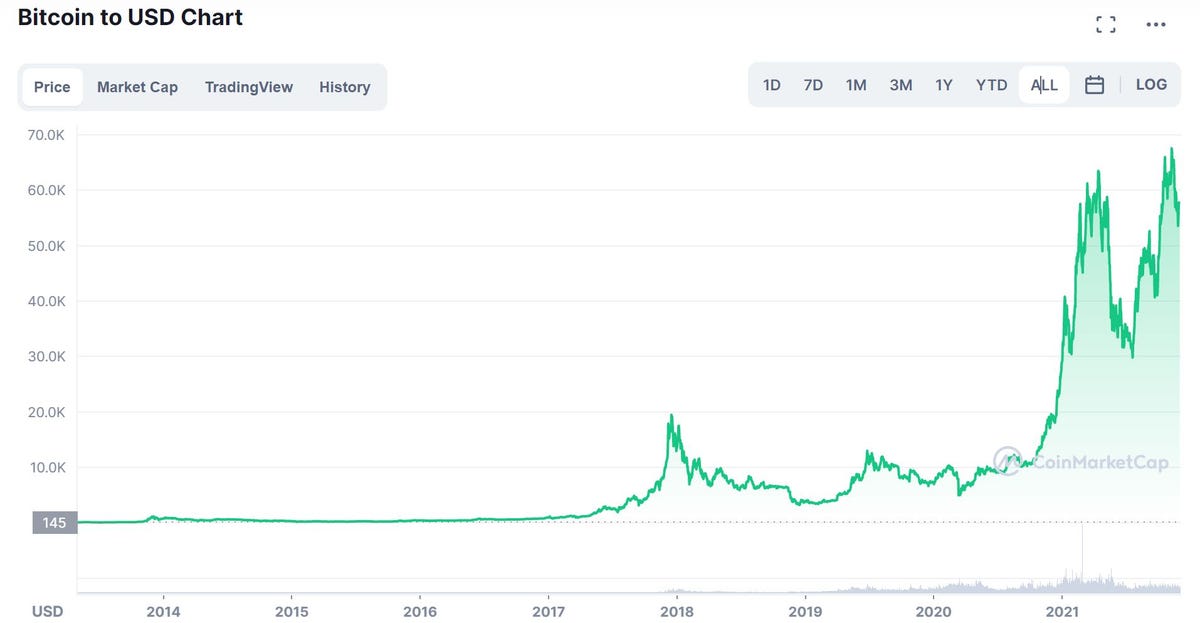
Here is one quick fact that explains why NFTs are bought for the equivalent of a CEO's salary: Bitcoin is estimated to have made over 100,000 millionaires. It's no surprise that NFTs became a phenomenon in March. That's when bitcoin hit $60,000, up over 500% from just six months prior. 

When you see a headline or a tweet about some preposterous sum being spent on an NFT, it's easy to become bewildered over how absurd that purchase would be for you. What's easy to forget is that very expensive things are almost exclusively bought by very rich people -- and very rich people spend a lot on status symbols. 

Take Bored Ape Yacht Club, for example. It's a collection of 10,000 ape NFTs, all with different traits that make some rarer than others. Rare ones have sold over for over a million bucks, but common variants go for around $200,000. (At the time of launch back in April, BAYC developers sold the NFTs for $190 each.) BAYC, owned by the likes of Steph Curry and Jimmy Fallon, is what you'd call a "profile pic collection." The main purpose of the images is to be used as your display photo on Discord, where most NFT business goes down, or on Twitter, Instagram or wherever else. 

To recap: $200,000 minimum for a profile picture. 

In isolation, that's insane. But place it on a spectrum of how wealthy people spend money, and it becomes less staggering. You can right click and save a JPEG, so why spend money on it? Well, you can buy a nice house in a safe neighborhood almost anywhere in the world for $1 million, yet celebrities regularly snap up $20 million mansions. You can find a fashionable dress for under $500, yet brands like Chanel build their business on selling ones for 20 times that amount.

Graph showing the rising value of bitcoin

Up to 100,000 people became millionaires when that green line shot skyward. 

coinmarketcap.com

We accept that rich folks buy extravagant items offline. Is it so inconceivable they would buy extravagant things online, too?

"In the real world, how do people flex their wealth?" said Alex Gedevani, an analyst at cryptocurrency research firm Delphi Digital. "It can be buying cars or watches. How scalable is that versus if I buy a CryptoPunk and use it as my profile picture?"

Obviously, status symbols aren't specific to the rich. All of us indulge in some way or another, be it buying a $20,000 new car when a $7,000 used vehicle will do, or buying a $30 T-shirt when Walmart sells basics for under $5. What most status symbols have in common is that they have a specific audience in mind. The banker sporting his Rolex and the chief executive stepping into her Bentley don't care that I think either of those purchases is excessive. They have a small but powerful group of people they're trying to influence. So, too, with NFTs. 

In the case of Richerd, he runs his own business, Manifold, where he helps show digital artists like Beeple how they can use blockchain technology to make art that could only exist as NFTs. Being a part of the most sought-after NFT collection helps in those circles. And when he says his brand is built on his Punk, he's not exaggerating -- a group of investors even named their organization after him.

"Anybody who owns a CryptoPunk believes certain things," Richerd explained. "Either you've been in the community for a long time so you believe in what these are, or you've paid a lot of money to get in, which shows conviction.

"I want to show my conviction. This is one of those projects that makes you put your money where your mouth is." 

A bit of trouble

NFTs are polarizing. There's a small group of people who believe in the underlying technology (tokens that prove ownership of a digital good), but there are many more who regard it as a hoax. Just as the second group struggles to see any value in NFTs, the first group can sometimes be defensive about the technology's imperfections.

And make no doubt about it, there are a lot of issues with NFTs. 

First is the confounding inaccessibility. There's a reason software developers tend to do well in crypto and NFT trading: Setting up blockchain wallets and other required digital apparatus is difficult. Even just buying and selling can be perilous. Send money to the wrong wallet address by accident, and it's gone forever.

Then there are the fees. Imagine you're interested in dipping your toes into nonfungible waters and you have $1,000 you're willing to lose. If you're minting a new NFT during a public sale you'll usually spend between $120 and $400. Not too bad -- until you factor in the transaction fees. Most NFTs are built on the ethereum blockchain, which is notoriously inefficient. The more people using ethereum, be it through trading altcoins or buying NFTs, the higher the fees. At a good time you'll spend about $100 per transaction, though double or triple that amount is common. Suddenly that $1,000 doesn't go very far. 

This is especially troublesome for NFTs, which are infamous for causing "gas wars." It's possible for 100,000 people to buy shiba inu coins at once, since there are a quadrillion in circulation. But when 10,000 people try to buy an NFT, it results in a massive spike in transaction costs as some users outbid each other to speed up their purchase. It may only last a minute or two, but a lot of damage can be done in that time. People spending over $10,000 on a transaction fee isn't rare. People losing $1,000 on a failed transaction isn't, either.

failed-txn.png

This is what it looks like when someone spends $4,000 on a failed transaction. It's rare, but not rare enough. 

Etherscan screenshot by Daniel Van Boom

Ethereum's inefficiency also contributes to the other major criticism of NFTs, the massive amount of energy they consume. Note that this is something of a semantic issue: NFTs aren't bad for the environment as much as ethereum is. Other networks, like Solana, use a fraction of the power. Ethereum developers are expected to implement an upgrade next year that will make mining it consume 1% the energy it currently does. At this moment though, while no one can say precisely how much energy ethereum consumes, we know it's a lot. (Bitcoin, despite getting all the headlines, is even less efficient than ethereum, which is why almost nothing is built on its blockchain.)

And finally, there's the fact that most people trading NFTs are doing so to make a profit. Scams are everywhere, and prices are volatile. Most of the people who create, buy and sell NFTs are ignorant or uninterested in the technology. If there is a technological leap taking place, it's likely to be obscured by the dizzying price movements.

"I'd call it a bubble," Gedvani said, "because the amount of speculators that are entering the market is outpacing genuine creators." 

But a bubble can pop and leave something better in its wake. Think of Pets.com. It had a peak valuation of $290 million in February 2000 but by November of that year, as the infamous dot-com bubble began to burst, it had already closed shop. It's used as a cautionary tale for speculative trading in bubbles. But the impulse to invest in Pets.com evidently ended up being justifiable. That particular venture was misguided, but the e-commerce trend it was flicking at was legitimate. Seven-figure pixel art may not be forever, but proof of digital ownership, which is what NFTs are really about, may be. 

A big 2022

Where NFTs will end up is anyone's guess -- and anyone who claims to know is probably trying to sell you something. What we do know is that the amount of people buying NFTs is almost definitely about to grow.

It's estimated that around 250,000 people trade NFTs each month on OpenSea, the biggest NFT marketplace. In the short term, CoinBase will soon open its own NFT marketplace, for which 2 million users are on the waiting list. Robinhood has similar plans.

More importantly, giant companies that already make money outside of the crypto space want in. Niantic, the company behind Pokemon Go, has just announced a game in which players can earn bitcoin. Twitter and the company formerly known as Facebook plan to integrate NFTs into their platforms, and Epic Games says it's open to doing so too. Envision a world where instead of buying skins in Fortnite, you buy an NFT for those skins that you own -- meaning you can trade it for outfits and weapons in other games, or sell it once you're done with it. (Epic said it won't integrate such a mechanic into Fortnite, but that may not stop competitors.) 

Richerd reckons the flood of people soon to enter the NFT marketplace will create a broader diversity of digital products sold for different audiences. Your neighbor might not want to spend $200 -- much less $200,000 -- on a profile picture, but maybe they'll be willing to spend $10 on a one-of-a-kind skin, or on a product in Facebook's Metaverse. But though the space may change, he remains confident that CryptoPunk #6046 is safe for a while yet. 

"Even if every NFT falls," he said, "CryptoPunks will be the last one."


Source

Tags:


Upgrade Your iPad Experience With $30 Off Apple Pencil 2


Upgrade Your iPad Experience With $30 Off Apple Pencil 2

Since its introduction, Apple's iPad has been an awesome and portable tool for creative types but its potential was unlocked when the Apple Pencil came along. The first-party Apple stylus pairs perfectly with the device and is great if you want to draw and sketch or just want an easy way to take some handwritten notes. Right now, you can even snag all-time low pricing on the Apple Pencil 2 at both Amazon and Best Buy. This deal brings the price down to just $99, a savings of $30 compared to what Apple sells it for.

The second-gen device works with a variety of modern iPad models, including iPad Pro, iPad Air and even the latest iPad mini. With precise tilt and pressure sensitivity plus a lag-free experience, you'll be able to paint, doodle, and write across a bunch of apps. 

When it's not in use, the Apple Pencil 2 attaches magnetically to the side of your iPad so it's always with you. Better yet, this is how it pairs and charges, so you never have to fiddle around with Bluetooth settings or worry about keeping it charged up. This is one of the best Apple Pencil deals we've seen to date, so now's the time to take the plunge if you've been holding out for a discount. 


Source

Tags:


2022 Buick Enclave Avenir Review: A Big Ol' Softie


2022 Buick Enclave Avenir Review: A Big Ol' Softie

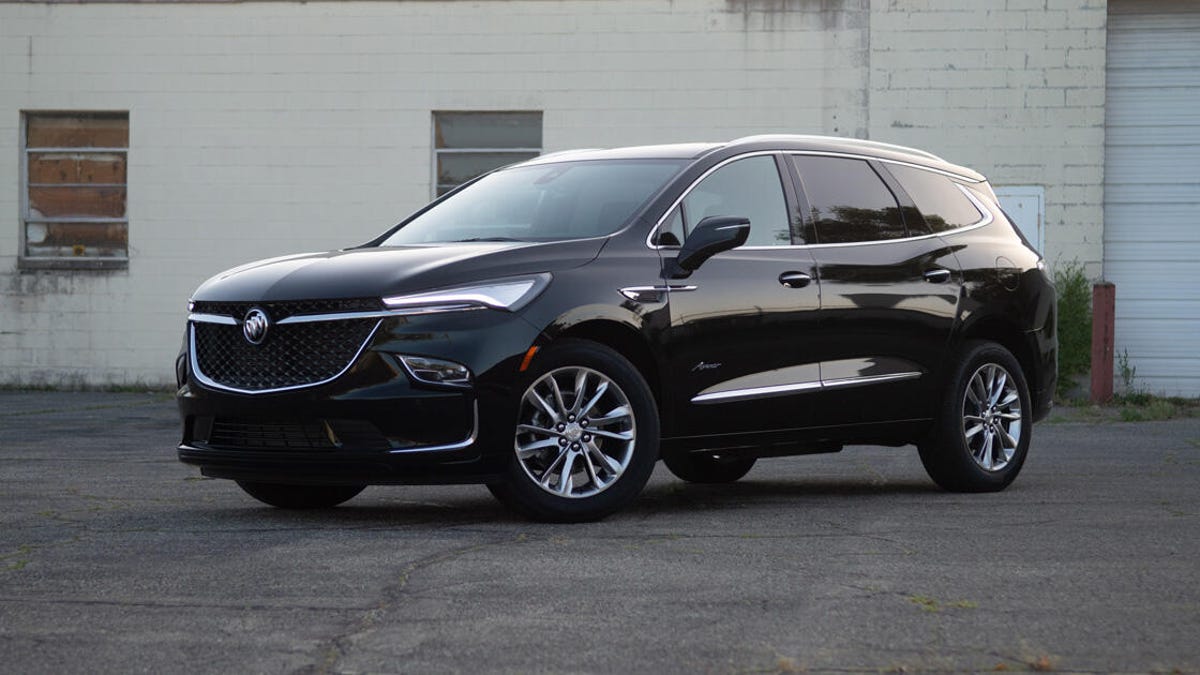
Buick is in a weird spot. The fancier, sportier shadow of Cadillac looms large over this brand, so in order to deliver a product unique enough to earn its own badge, Buick chose to lean in hard on softness, especially with its higher-end Avenir trims. The recently redesigned 2022 Enclave best exemplifies how Buick is positioning itself in the US, and while it's pretty darn boring, it's also pretty darn comfortable and decently well equipped.

The three-row family crossover shape isn't the most daring from the outset, and while the 2022 Enclave's exterior redesign does look fresher than before, it's still not turning too many heads. Swapping out the single-piece headlights for a dual-layer getup does really sharpen things up in the front, but if you strip the badges from the rear end, people could easily confuse it for a Mazda or any other mass-market family machine. The Avenir badges and unique grill help set it apart a bit, but really only from other Enclaves.

The interior has a few more ups than downs. The Enclave Avenir's dashboard is nicely designed, offering some interesting angles without being intrusive. The leather feels nice, but I wish the Avenir's matte wood trim was offered on more than just the door panels and center console; instead, the dash wears a swath of piano-black plastic that picks up smudges and feels a little cheap. Half the controls are parts-bin GM bits. The ugly gear lever is gone, and in its place is a nicer set of buttons that doesn't take long to get used to. The rear windows lack auto-up capability, a signature Detroit cost-cut that shouldn't really happen on a $60,000 SUV.

But even with those warts, practicality and comfort ooze out of every corner. The Enclave's front seats, which pack ventilation and massaging on my tester, are seriously comfortable. The center console is high, but it has a honkin' hidey-hole under the gear lever, in addition to a capacious cubby under the armrest, and the sizable door pockets can pick up whatever's left lying around. The second-row captain's chairs are just as cushy as the front seats, and even with the rails ratcheted as far forward as possible, there's still a surprising amount of room for a 6-foot beanpole like me. Moving the captain's chairs even a little bit gives the power-folding third row an impressive amount of legroom, and headroom is plenty suitable for adults. With 23.6 cubic feet of cargo space behind the third row, there's enough room to shove a family's worth of groceries or a few weekender bags, and stowing the way-backs opens up an impressive 57.7 cubes of storage.

The 2022 Buick Enclave Avenir's on-road character is probably best described as slow and steady, like every input is being fed through David Gilmour's delay pedal, or a bowl of molasses. Turn into a corner and the body takes a second to react with some roll. Lean onto the gas pedal and it takes a second for the 3.6-liter V6 to convert throttle position to motive force, although once the nine-speed transmission finally settles on a gear, the engine's 310 horsepower and 266 pound-feet of torque will be enough for most drivers. Step on the brake pedal and expect a bit of squish before speed begins to shed.

The Buick's V6 is plenty peppy, but electrification is still en route.

Andrew Krok/CNET

My tester packs Buick's $1,595 Avenir Technology Package, which feels like a mandatory addition. Along with fancier headlights, the upgrade includes an adaptive suspension that really ramps up the comfort factor. Nasty bits of road disappear underfoot, and all that's left is a soft ride that feels properly luxurious. There's a Sport mode that firms things up, but… come on, it's a Buick, nobody's taking this thing out to the switchbacks unless it's on the way to the golf course.

The Buick Enclave can be had with either front- or all-wheel drive, but AWD doesn't really affect fuel economy. FWD models are rated at 18 mpg city and 26 mpg highway, with AWD variants coming in 1 mpg lower in each scenario. A combined average of 20 mpg isn't exactly praiseworthy in 2022, but it's about on par with competitors like the Acura MDX (21 mpg combined) and Lincoln Aviator (20). Maintaining a light right foot on the highway helped me see 30 mpg for several minutes at a time, which is nice, but even mild electrification would be better.

Buick's infotainment system is more than fine, but as dashboards across the industry grow to contain ever-larger screens, this one feels a little lacking.

Andrew Krok/CNET

On the tech front, the 2022 Enclave has just about everything you could want, although it lacks any sort of real attention-getter. The standard 8-inch infotainment display runs a newer iteration of the Buick's interface, which is plenty fine and includes all the modern fripperies like a 4G LTE Wi-Fi hotspot and wireless Apple CarPlay and Android Auto, but the screen is a little small by modern standards (and based on the size of the dash surrounding it). All three rows offer a pair of USB ports, but only the front row gets a zippy USB-C. The Avenir also includes a head-up display that's nice and bright, in addition to a gauge cluster display that shows all the usual information about the vehicle and infotainment system.

Safety-wise, the Enclave Avenir comes with everything Buick can slap on its SUV, including automatic emergency braking, forward-collision warning, blind-spot monitoring, lane-keeping assist, adaptive cruise control, parking sensors, haptic seat feedback and a surround-view camera system. You know what it could use, though? Super Cruise. Too bad there isn't a single Buick that offers GM's limited handsfree tech, as its entire lineup predates the required electrical and data-processing upgrades to handle it.

Buick's ADAS is easy to use, it's just a shame GM couldn't find a way to make Super Cruise work on this generation of vehicles.

Andrew Krok/CNET

For a marque that isn't even at the top of its conglomerate's food chain, the 2022 Buick Enclave Avenir can be a pricey proposition. My AWD tester's sole upgrade is a $1,595 package that brings the base price from $58,295 to $59,890, including $1,195 for the mandatory destination charge. Fully loading up this bad boy can send the price closer to $65,000 territory. That puts it on par with a well-equipped Acura MDX Advance or Lincoln Aviator Reserve, both of which feel far more modern, and the latter can even pack a plug-in hybrid powertrain for some additional scratch. If you'd rather save some simoleons, a fully loaded Mazda CX-9 offers three rows of Nappa leather seats for about $50,000, and its engine is more potent, but you'll have to make do with Mazda's middling infotainment. Hell, if you don't need the third row, you're sitting in Mercedes-Benz GLE-Class territory at this price point, and that is a tough act to top.

The 2022 Buick Enclave Avenir is kind of stuck between a rock and a hard place. While it's done a commendable job carving out its own niche in GM's hierarchy by focusing on smoothness above all else, efforts that pay off in on-road placidity, it lacks any sort of stand-out factor that brings new customers through dealership doors. That might be enough for legacy buyers, but it may be insufficient against a wave of ever-more-impressive large SUVs.


Source

Tags:


QD-OLED TV: Samsung, Sony Take on LG With Quantum Dot Special Sauce


QD-OLED TV: Samsung, Sony Take on LG With Quantum Dot Special Sauce

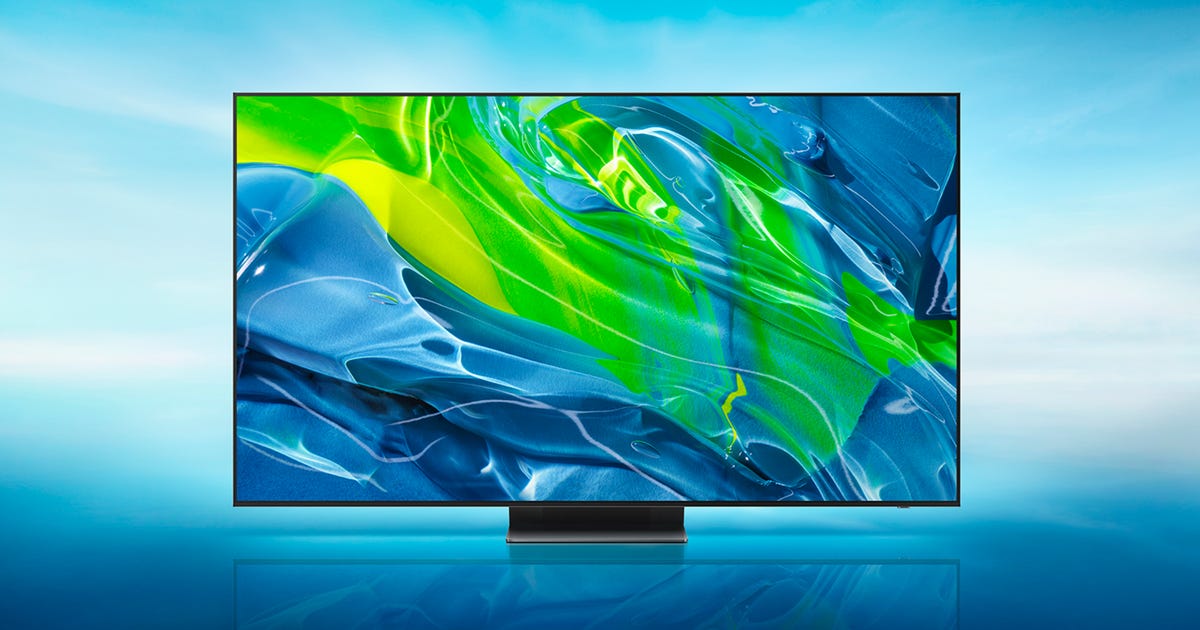
The best TVs you can buy use OLED screens and until now, LG Display has been the sole producer of every OLED television in the world. In 2022 a new kind of OLED TV technology, called QD-OLED, finally goes on sale. The technology debuts in new 55-inch and 65-inch TVs from Samsung and Sony, as well as a new monitor by Alienware. QD-OLED uses quantum dots in combination with organic light-emitting diodes, and it promises even better picture quality than traditional OLED TVs and monitors.

We already reviewed the Alienware monitor and liked it a lot, but we haven't had the chance to see the TVs beyond brief, early demos of prototype products. Samsung's QD-OLED TV, the QS95B, is available now and priced at $2,200 for the 55-inch and $3,000 for the 65-inch model, which is exactly the same as LG's best 2022 OLED TV, the G2 series. Meanwhile Sony is charging more for QD-OLED, $3,000 for the 55-inch and $4,000 for the 65-inch when they go on sale in June.

First things first: We won't know how these QD-OLED TVs really compare against LG OLEDs like the the C2 we recently reviewed, or to other OLED and non-OLED TVs, until we can test them in person. But they sure look promising. 

So what is QD-OLED, and why is it potentially better than traditional OLED and LED LCD? Read on to find out.

Today's TV tech: LCD, OLED and QLED

Right now there are two technologies most TV buyers can actually afford: LCD and OLED. LCD TVs are sometimes called "LED TVs" due to the tiny LEDs they use to create light. The image is created by a liquid crystal layer, just like LCD TVs from 20-plus years ago. Mini-LED TVs operate the same way, just with more LEDs in their backlights, while QLED TVs are basically LED LCD TVs with quantum dots.

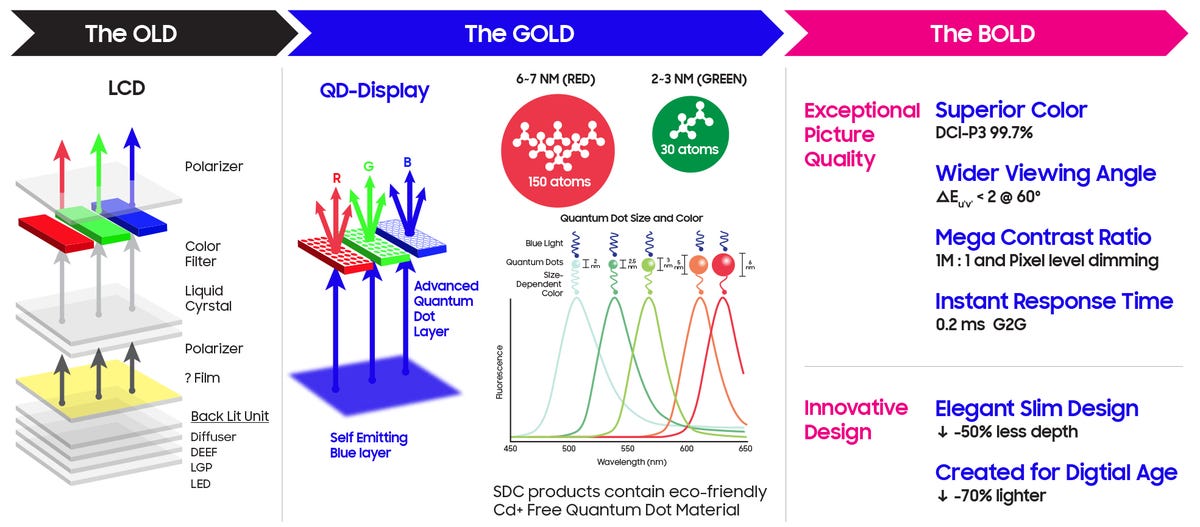
Samsung's chart showing different sizes of quantum dots emitting different colors

The size of the quantum dot determines what color it emits when supplied with energy. Currently that energy is supplied by blue LEDs or blue OLEDs.

Samsung

OLED is a newer technology. Each pixel emits its own light, created by a substance that glows when you give it energy. This substance includes the element carbon, hence the "organic" moniker. Since they're able to turn individual pixels off, to a perfect black, their contrast ratio and overall picture quality are typically better than any LCD.

One of the biggest improvements in LCD TV tech over the last few years is the inclusion of quantum dots. These microscopic spheres glow a specific color when excited by light. In the case of LCD TVs, blue LEDs supply all the blue light plus the energy to get red and green quantum dots to emit red and green light. This is what allows LCD TVs to have such extreme brightness and better color than LCD TVs of old. 

A comparison of the layers of LCD compared with those of QD-Display

The many layers of LCD (left) compared with the relatively few layers required by QD-Display (right). Among other benefits, even thinner TVs are possible.

Samsung

You can read more about the differences between these technologies in our comparison of LCD and OLED TV display technologies, but the short version is that LCD-based TVs tend to be brighter, while OLED TVs have better overall picture quality. There's also microLED, but microLED TVs are currently wall-size and absurdly expensive. They're not really competition for LCD, OLED or QD-OLED TVs, and likely won't be for the foreseeable future.

The layers required to make an image with different TV technologies. With LCD, the light and the image are created separately. With WOLED (LG's current tech), the "white" layer is actually blue and yellow. Color filters create red and green. 

With Samsung's new QD-OLED, only blue OLED material is used, with red and green created by quantum dots. (Click to enlarge)

Samsung

QD + OLED = 💖?

Combining the efficiency and color potential of quantum dots with the contrast ratio of OLED is basically the holy grail of current image quality. LCDs don't have the pixel-level contrast of OLED. Their backlights, even with mini-LED, are just too coarse. OLED TVs, while bright, don't have the extreme brightness potential of LCD. 

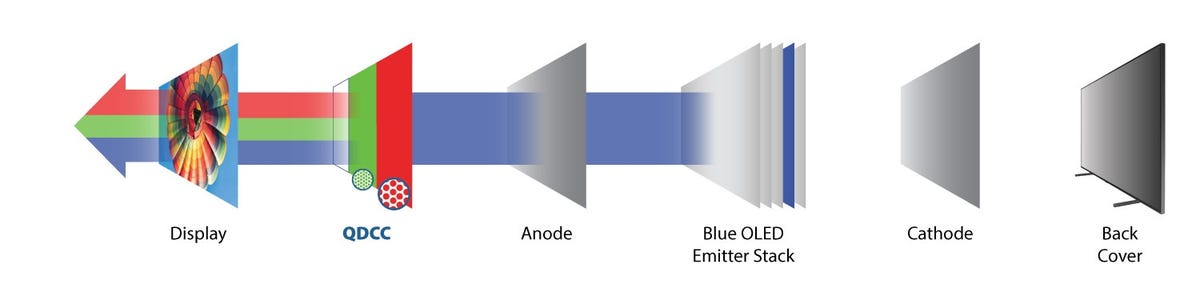
The layers of a QD-OLED display

The layers of a QD-OLED display.

Nanosys

QD-OLED potentially solves both these issues and could be greater than the sum of its parts. A blue OLED material creates, as with most LED LCDs, all the blue light. A quantum dot layer uses this blue light to then create green and red light. Quantum dots are nearly 100% efficient, so basically no energy is lost converting these colors. The current version of OLED uses color filters to create red, green and blue, essentially blocking a significant amount of the light potential created by the OLED material, so it's potentially less efficient.

The result could be greater brightness and color than with current versions of OLED, while keeping that technology's superlative contrast ratio.

A graphic showing the breakdown of QD-OLED technology
Samsung

What else we know about QD-OLED TVs right now

Aside from the basic technology above, we know a few details about the actual TVs and monitors hitting the market later this year. 

Samsung: QD-OLED panels are built by Samsung Display, a division of that mega conglomerate that manufactures displays. Samsung Electronics, the division that makes the TVs themselves, officially unveiled its TV in March 2020 after a tease at CES 2020. Called the QS95B series, Samsung touts improved brightness and color as well as the typical features of the company's 2022 TVs, such as revamped processing, HDMI 2.1 inputs, an improved smart TV system and a solar remote. The QS95B series is available for preorder now to ship in April.

SonyCalled the A95K series, it will also come in 55- and 65-inch sizes. Sony claims better color and improved viewing angles for this TV but told CNET's David Katzmaier not to expect a significant improvement in peak brightness with whites. It has 4K resolution, HDMI 2.1 inputs and a bunch of other features, like a built-in camera and remote finder. 

Sony AK95-series QD-OLED TV in an expensive-looking setting

Sony's AK95 series is a QD-OLED TV available for preorder in June in 55- and 65-inch sizes.

Sony

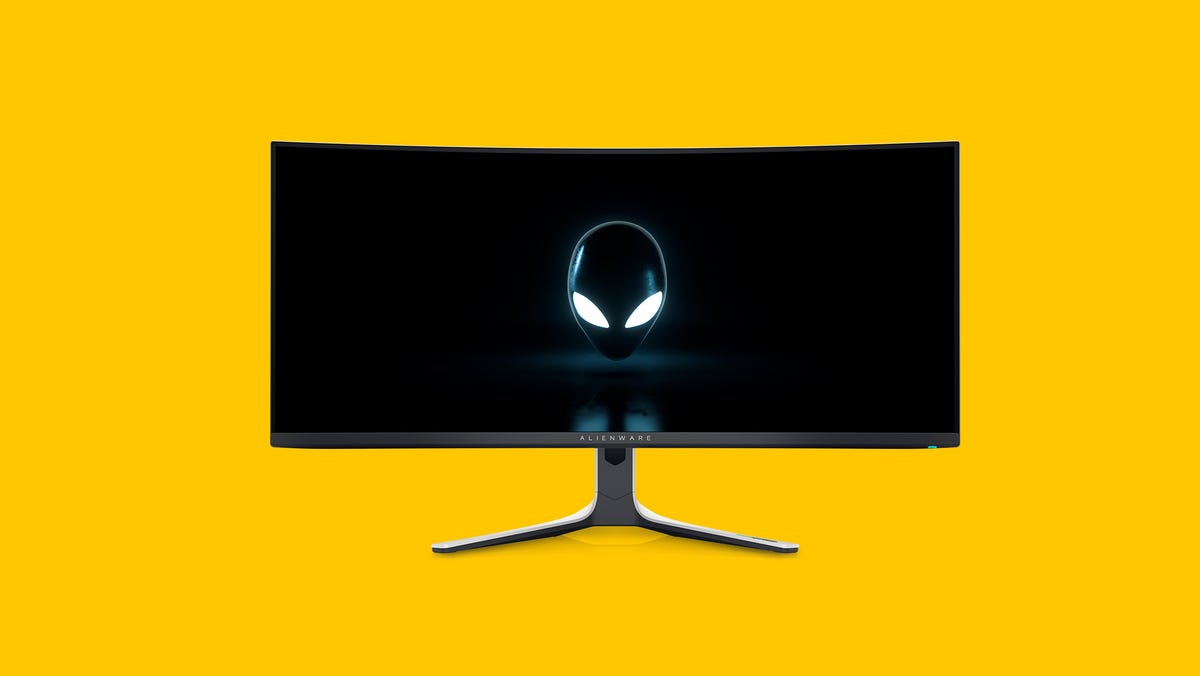
Alienware:The third manufacturer with QD-OLED has a curved 34-inch, 3,440x1,440-pixel monitor, model number AW3423DW. In case you're counting, the smallest OLED TV LG makes is 42 inches. CNET's Lori Grunin reviewed the monitor and lauded its performance for gaming as well as its color accuracy.

An Alienware QD-OLED monitor

The Alienware QD-OLED monitor costs $1,300.

Dell

Read moreAlienware 34-Inch QD-OLED Monitor Review: It Brings the Pretty

What we don't know about QD-OLED

We know the prices of these TVs, so the next biggest unanswered question is how good they will look compared with "vanilla" OLED TVs from LG and Sony. Samsung says that its QD-OLED will be brighter than OLED, with a better contrast than LCD. The latter is easy; all OLEDs have better contrast than all LCDs. How much brighter remains to be seen, literally and figuratively. LG promises its own improvements for 2022 OLEDs and beyond, so it's possible this brightness aspect won't be a huge factor.

Two additional improvements with QD-OLED are possible according to its proponents: off-axis and motion blur. Since QD-OLED lacks color filters, they will potentially look better when seen from the side than OLED, which already looks much better off-axis than LCD. So if you have a really wide sofa, people in the cheap seats won't have a worse picture than those sitting directly in front of the TV. From what Katzmaier saw in his demo of Sony, the off-axis improvement is real but not a huge deal

Motion blur is a bit of a rabbit hole, but due to how the current generation of OLED works, they still have motion blur. Samsung Display claims QD-OLED will have significantly less motion blur than LCD, though the company didn't say if it's better than LG's OLED. An ultrafast response time, plus extra brightness so you can use black frame insertion and still have a bright image, means it should be at least as good as regular OLED. 

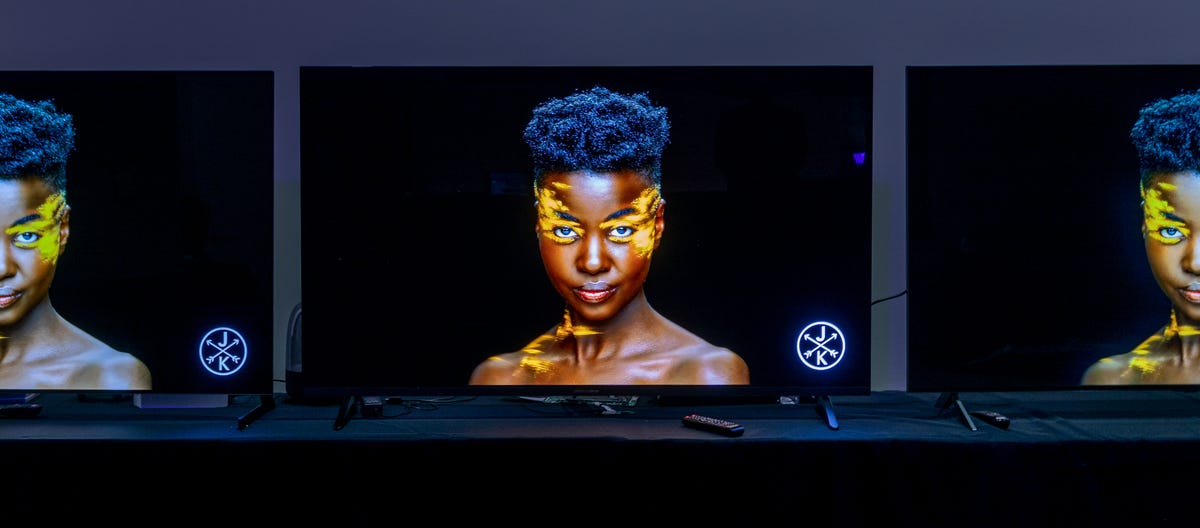
Samsung QD Display demo

A TV demonstrates Samsung's QD Display technology, which combines OLED elements with quantum dots to boost color and other image quality attributes.

Stephen Shankland/CNET

Then there's the question of color volume, which is something you're going to hear more and more about in the coming years. Basically, it's how much color there is in extremely bright parts of the image. One drawback of LG's OLED method is that to get the brightness desired by consumers, it uses an additional subpixel, white, in addition to red, green and blue (see image with LCD, WOLED and QD-OLED above). This technically has the effect of "washing out" extremely bright parts of the image. 

From what we've seen so far, QD-OLED could deliver improved color. The caveat is that we haven't actually had the chance to compare it with shipping products (as opposed to prototypes) using real-world video. With most real-world HDR TV shows and movies there really isn't that much color information in bright parts of the image. That's partly to do with the inability of most displays to do anything with it. But even if Hollywood were to color-grade more shows and movies with more bright-color data, we're still just talking about things like more yellow in the sun, more blue tint to headlights, and so on. It remains to be see how much different QD-OLED will look with those colors.

The future is now(ish)

In the end, how much better QD-OLED is than regular OLED doesn't actually matter. It's already the most important thing it could be: more OLED. Another company making OLED displays is by far the healthiest thing that could happen to the TV industry and for consumers. Pushing picture quality up and prices down has never been a bad thing.

For that matter, as someone who has always hated LCD, I think a future without that tired, Band-Aid-ed TV technology is a welcome one. But that might just be me.

We expect to get our hands on the first generation of QD-OLED displays later this year. Stay tuned.


As well as covering TV and other display tech, Geoff does photo tours of cool museums and locations around the world, including nuclear submarines, massive aircraft carriersmedieval castles, epic 10,000-mile road trips, and more. Check out Tech Treks for all his tours and adventures.

He also wrote a bestselling sci-fi novel about city-size submarines, along with a sequel. You can follow his adventures on Instagram and his YouTube channel.


Source

Tags:


Windows 10: Still seeing a printing error? Here's how to fix it


Windows 10: Still seeing a printing error? Here's how to fix it

If you're a Windows 10 user who has been facing an annoying error when trying to print items from certain apps. Microsoft has a workaround as it works on a resolution, which should be ready in the next week, the company wrote on a support page. 

After installing a March update, KB5000802, you might see an APC_INDEX_MISMATCH error with a blue screen when you try to print to certain printers from certain apps. The problem affects a subset of Type 3 printer drivers. To find out if your printer is impacted, follow these steps, according to Microsoft. You can also check out CNET's collection of tips for troubleshooting common Windows 10 problems

1. Press the Windows key+r or select Start and type run and select it.

2. Type printmanagement.msc and press enter or select the OK button.

3. If Print Management opens, continue to step 4. If you receive the error, Windows can not find 'printmanagement.msc'. then select Start and type manage optional features and select it. Select Add a Feature and type print, select the check box next to Print Management Console and select install. You will now need to start at step 1 again.

4. Expand Print Servers, expand your computer's name, and select Printers.

5. You can now see the Driver Type for each of your installed printer drivers.

Read more: How to download Windows 10 for free

If you are getting this error, here's how to fix it for now:

1. Go to Start > Settings, and search for Printers & scanners

2. Check that you have the driver that has the issue installed (for example, KX driver for Universal printing). 

3. Go to Start, and search for Command Prompt. Select Run as administrator

4. To check driver setting availability, next to Windows\system>, write the run DLL command: rundll32 printui.dll,PrintUIEntry /Xg /n "KX driver for Universal printing" (you'll need to replace KX driver for Universal printing with your driver name). Press enter. This will open the printer user interface dialog box. 

5. Check the Attributes field. If it does not say Direct, you'll have to fix it by closing out of the dialogue box, and running another command. Next to Windows\system>, type rundll32 printui.dll,PrintUIEntry /Xs /n "KX driver for Universal printing" attributes +direct (again, you'll need to replace that with the name of your driver). Press enter

6. Run the first command again by hitting the up arrow, and pressing enter. In the dialog box that pops up, you should see Direct under Attributes. 

This should mitigate the issue for 32 bit apps on a 64 bit OS. If you have a different setup, you'll have to follow different instructions, which you can find (along with those above) in a video walkthrough from Microsoft. 

For more, check out all the new features coming in the Windows 10 spring 2021 update, and tips to help you become a Windows pro


Source

Tags:

Search This Blog

Menu Halaman Statis

close