A MacBook Air is fine for sitting at a desk at home or in the office, but it's really a laptop that needs to be on the go with you to shine. So it came with me, to the coffee shop, on the subway, to the office and more.
4 of 16 Dan Ackerman/CNET
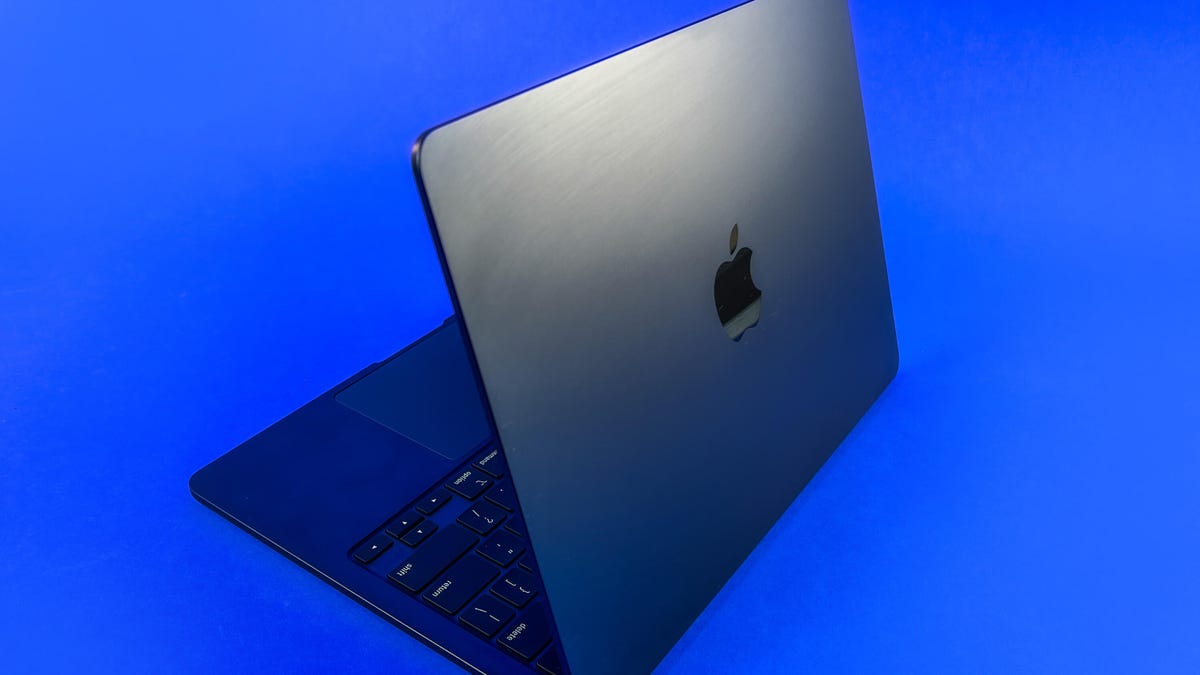
I could barely breathe on the midnight MacBook Air without leaving smudges and fingerprints all over it. It's a common issue with dark matte objects, and I had to give this laptop a thorough wipe down before snapping each photo.
5 of 16 Dan Ackerman/CNET
Apple's MacBook Air is a laptop that I've sometimes described over the years as "the most universally useful laptop you can buy."
6 of 16 Dan Ackerman/CNET
Thanks to a new design, larger display (13.6 versus 13.3 inches), faster M2 chip and long-awaited upgrade to a higher-res webcam, I feel comfortable keeping that "universally useful" title for the new 2022 version.
7 of 16 Dan Ackerman/CNET
At $1,199, the $200 increase over the traditional $999 MacBook Air starting price is a disappointment. The previous M1 Air, with an older design, remains available at $999, somewhat mitigating the price increase on the new version.
8 of 16 Dan Ackerman/CNET
The new Air's footprint is a hair smaller than before, and it feels slimmer. It's 11.3mm thick overall, while the previous design tapered thinner at the front, but grew to 16mm at its rear hinge. It's also a bit lighter, at 2.7 versus 2.8 pounds.
9 of 16 Dan Ackerman/CNET
The new Air is only slightly smaller and lighter than its predecessor, so don't expect a revelatory experience. But it's a great fit for my small travel bag, and I wouldn't object to taking it on a daily commute.
10 of 16 Dan Ackerman/CNET
The slightly larger screen, which measures 13.6 inches diagonally versus 13.3 inches, also aids visibility. Yes, I've gotten to the age where most of my Google Docs are at 125% by default, so a bigger screen definitely helps.
11 of 16 Dan Ackerman/CNET
However, keep in mind that the webcam knocks a little notch into the screen, much as it does on the iPhone and some MacBook Pro models.
12 of 16 Dan Ackerman/CNET
The 1080hp camera in the M2 MacBook Air (left) has better resolution and image processing compared to the 720p webcam in the M1 Air (right).
13 of 16 Dan Ackerman/CNET
The Air now gets the updated MagSafe 3 power connection found on the 14/16-inch Pro (and absent from the M2 13-inch MacBook Pro).
14 of 16 Dan Ackerman/CNET
The new 35-watt power adapter is pleasantly compact and includes two USB-C ports (one for the power cable and one extra). But it's $20 extra on the least expensive M2 configuration.
15 of 16 Dan Ackerman/CNET
Besides the MagSafe connection, it includes two USB-C/Thunderbolt ports and, yes, a headphone jack.
16 of 16 Dan Ackerman/CNET
There are a lot of different MacBook models, prices and specs to keep track of. To sum it up, the key reasons you're going to prefer the new Air over the previous model are:
Tiny Solar-Powered Sensors Float on the Wind to Gather Environmental Data
Tiny Solar-Powered Sensors Float on the Wind to Gather Environmental Data
As we face ever-increasing ecological challenges, gathering environmental data will be important in the development of technology that can help heal the natural world.
Researchers at the University of Washington have a new tool they hope can aid in this effort: tiny battery-free sensors that can be dispersed in the wind via drones and gather environmental data over large areas.
The inspiration for these sensors is the dandelion seed.
A sensor sits atop a dandelion, the plant whose wind-surfing seeds inspired its design.
CNET
The electronics that gather the data and transmit it wirelessly sit on a plastic disc that's laser-cut into a shape designed to be carried by the wind and also land with the solar panels that power the device face up.
Vikram Iyer, an assistant professor at UW, said that the devices are small and light enough that a drone can carry 1,000 of them.
Here are the sensor's electronics and plastic disc that carries it in the wind.
CNET
Researchers from UW said they are working to make these types of electronic devices more sustainable and are investigating ways to change the shape of the device as it falls to give greater control over where it lands.
To see these dandelion-inspired sensors up close and dropped from a drone, check out the video above of our trip to the lab.
Samsung's Z Flip 3 and Z Fold 3 sales dwarf previous foldable demand
Samsung's Z Flip 3 and Z Fold 3 sales dwarf previous foldable demand
Samsung's new Z Flip 3 and Z Fold 3 are more popular than their predecessors -- but the South Korean electronics giant isn't giving specific sales data.
The company on Monday said demand for its newest devices "continues to exceed expectations." In the first month, Samsung sold more foldables in the US than in the prior two years, it said in a newsroom post shared ahead of the announcement. US consumers bought five times more Galaxy Z Fold 3 units than last year's Z Fold 2, while they scooped up 40 times more Z Flip 3 units than the earlier Z Flip 5G.
Samsung declined to provide actual figures, which means it's difficult to gauge just how high the actual sales are. In August, it said that "preorder volume" for the new devices was already "outpacing total sales for Galaxy Z devices to date in 2021" -- without giving any specific figures.
Samsung likely sold about 1.02 million foldables in 2019 and 2020 combined in the US, Strategy Analytics said.
The global numbers aren't much higher. The research firm estimates that consumers bought only 730,000 foldables across the world in 2019, with about 82% of them coming from Samsung. The following year, vendors sold 2.2 million foldables, with 2 million of them made by Samsung, Strategy Analytics said. In the first half of 2021, Samsung likely sold about 2.3 million foldables around the globe, Strategy Analytics estimated. That brings Samsung's total global sales before its latest models to roughly 4.9 million. In August, it estimated that Samsung would sell 5.2 million foldables this year.
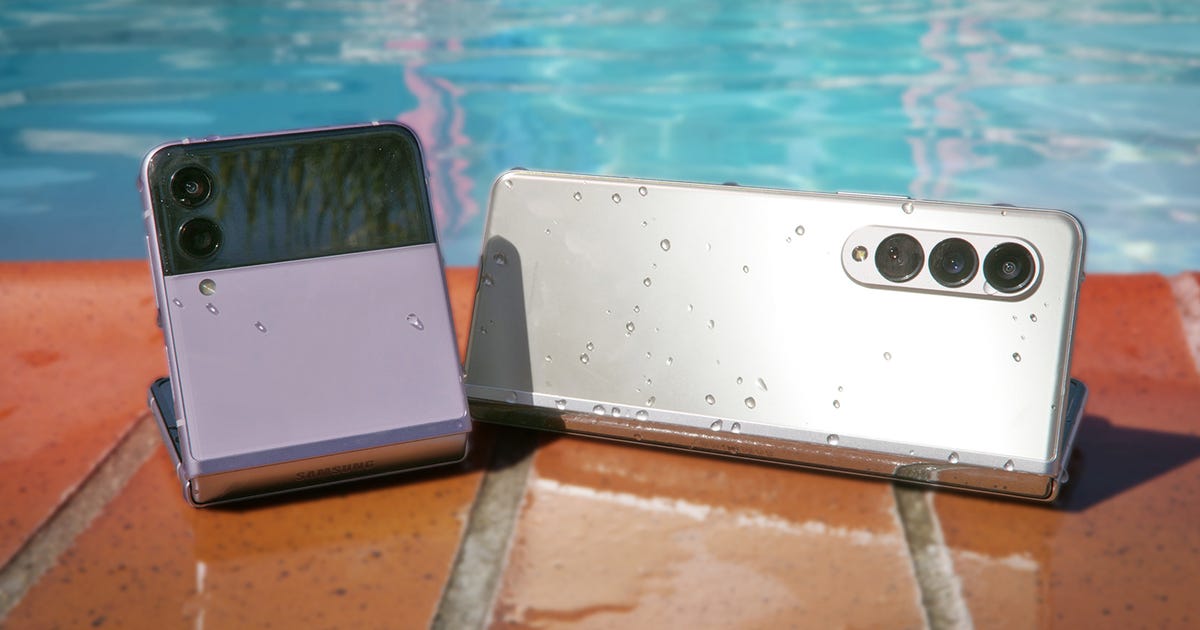
Samsung introduced its $1,000 Galaxy Z Flip 3 and $1,800 Galaxy Z Fold 3 in August during a virtual Unpacked event. In virtually every way, Samsung sought to address the problems found in its earlier foldables, ranging from worries about the screens being too delicate to criticism that only tech ultra-fans could afford their steep prices.
The company on Monday published a new video showing how it tests its foldables, including putting them in an environmental chamber, looking at water resistant and S Pen usability, and folding them enough times to be sure they'll outlast 200,000 fold -- or around five years of use if folded and unfolded 100 times a day. Tests for the Z Flip 3 and Z Fold 3 "reflect actual user patterns in real-world scenarios such as folding and unfolding using both hands," Samsung said.
While the improved durability has likely made consumers more willing to try foldables, the lower prices have probably been another major factor in making them more attractive to would-be buyers. By starting this year's foldables lineup at $1,000 -- nearly $400 less than last year's original Z Flip and the same price as Apple's iPhone 13 Pro -- Samsung's aiming to make its foldables mainstream.
That's particularly true of the Z Flip 3, which CNET's Patrick Holland called a "scene-stealer" and said "might be the first foldable phone aimed at a mass audience that has a chance of living up to such hype." The device features a compact clamshell design that shields the inner display, while the Z Fold 3 expands outward from a phone into a tablet and comes with S Pen support for the first time.
Samsung has been trying to make foldables popular for years. The company has incorporated the screens in its highest-end products since 2019, but early models didn't attract many buyers. Early flaws in the initial Galaxy Fold's display raised doubts that foldables were strong enough to withstand daily use, let alone a rainstorm or a fall from a nightstand. And prices, which reached as high as $2,000 for last year's Z Fold 2, were aimed more at one-percenters than at typical smartphone buyers. The durability and pricing questions prevented most consumers from buying foldables, particularly in the midst of the global COVID-19 pandemic.
Vivo X50 Pro review: A solid all-rounder for camera lovers
Vivo X50 Pro review: A solid all-rounder for camera lovers
The Vivo X50 Pro is a midrange phone on the higher end of that spectrum and has many of the trappings of an enticing flagship. Starting at approximately $670, you get a crystalline screen, 5G, a powerful battery, a speedy display and fast charging. But the phone also has a camera feature that undeniably distinguishes it from its rivals. The X50 Pro is the world's first mass-produced phone with a built-in gimbal camera system that allows you to capture smooth, fast-action video with the click of a button. Out of Vivo's trio of X50 handsets -- which the Chinese phone-maker is marketing as a professional photography flagship -- the X50 Pro is the only one to boast this futuristic feature. But Vivo did make a few compromises. For instance, it lacks stereo speakers (a big drawback for music lovers like myself) and it isn't water resistant, which many phones of this class are. It also has a midrange processor (Snapdragon 765G) instead of the most adva nced chipset available.
If you're not fussed about shooting action video, you're better off buying Vivo's base X50 or the OnePlus Nord. Both have comparable specs but don't charge a premium for advanced video gimbals and hardware. The X50 and Nord feature a quad-camera system led by a 48-megapixel shooter, the same chipset and a fast display, but are nearly $100 to $200 cheaper respectively. But if being splash-proof is important to you, consider the iPhone 11 ($500 at Best Buy).
Vivo doesn't currently have plans to officially release the phone in the US. But X50 phones have been released in parts of Asia and Europe, so they'll be reasonably easy to import. Pricing also varies based on country with prices trending higher in Western countries. In India, the base variant (with 8GB RAM and 128GB storage) starts at 49,990 rupees (approximately $670, £510 or AU$930), while in Eastern Europe it starts at the equivalent of $780.
Vivo's X50 Pro features a 6.5-inch AMOLED display.
Sareena Dayaram/CNET
The X50 Pro's gimbal camera delivers
The X50 Pro has multiple rear cameras. The entire setup uses a gimbal-like system and a combination of optical image stabilization and electronic image stabilization to produce incredibly stable video. Vivo says its gimbal system reduces shakiness by up to three times compared to traditional stabilization technology, thanks to a "double ball structure" that allows it to rotate on three axes.
I captured a bunch of video in different lighting conditions to see how well the X50 Pro stacked up against another phone known for its video-camera prowess, the iPhone 11 Pro Max. In short, the X50 Pro performed very well. When I recorded video while walking in daylight and panning the cameras from side to side, I didn't see much of a difference between the two phones. Both captured stable footage without any obvious jerkiness.
The differences were noticeable, however, when running, especially in darker conditions. Although the X50 Pro's output was steady and seamless, there were several times when the camera went out of focus and blurred slightly.The iPhone 11 Pro Max's footage, on the other hand, always remained in focus but was extremely shaky. In the end, I preferred video from the X50 Pro because it was easier for me to watch stable video with occasional blurs rather than jerky footage. Apart from video, another use-case for the gimbal system is taking photos while zooming. I was able to more easily capture some great photos zoomed in because of the stability it provided.
Bottom line: The X50 Pro's gimbal-style camera is impressive and generally delivers what it promises. But it cannot replace a full-sized gimbal -- it is built into a phone after all. And while its technology is unique, its videos aren't earth-shatteringly better than, say, what you get on the pricier iPhone 11 Pro Max.
The X50 Pro's design is slender and classic
Though its design isn't wholly unique, the Vivo's X50 Pro is still a sleek phone with a classic aesthetic. I prefer designs like this because they're more enduring rather than envelope-pushing trends that seem to fade away (remember pop-up selfie cameras?). The X50 Pro has a spacious 6.56-inch curved display with a discreet hole-punch selfie camera. On the back there's a larger than average rectangular protrusion that's home to a rear quad-camera module and the phone's headline gimbal feature.
The X50 Pro comes in gray, which I love. Its subtle sheen adds to the phone's premium look. Overall the X50 Pro is neither heavy or exceptionally lightweight, but it is relatively slim, which allows me to type out emails and messages using one hand.
The X50 Pro's screen has a higher 90Hz refresh rate than most phones, which have 60Hz displays. It offers a silky smooth experience, which I really like, though it's not as high as the 120Hz screens on the OnePlus 8 Pro and Galaxy S20.
Vivo's rear camera setup is headlined by a 48-megapixel shooter.
Sareena Dayaram/CNET
The X50 Pro's multiple cameras have range
In addition to the phone's main 48-megapixel sensor, there are two telephoto shooters and an 8-megapixel ultrawide-angle lens. These multiple cameras offer plenty of variety and range in terms of photographic possibilities, which I really appreciate. For example, the ultrawide camera has a 120-degree field of view, while the periscope zoom camera can zoom in on an object up to 60x.
In general, the X50 Pro captured crisp and vibrant photos that captured my surroundings wonderfully and with accurate colors. But in certain lighting conditions, during sunset for example, photos were more saturated and punched-up in the X50 Pro than the iPhone 11 Pro. Whichever photo you prefer is likely a matter of personal preference, but you can see the difference for yourself in the photos below. Keep in mind that the monitor you're viewing these pictures on has an affect as well.
The Vivo X50 Pro captured a fiery yellow-orange sunset (left), while the photograph taken by the iPhone XS Max (right) was more true to life.
Sareena Dayaram/CNET
This photo was taken indoors with the default lens. As you can see, there was natural light pouring through the windows and it wasn't the easiest lighting conditions for the camera to work with, but the image came out well.
Sareena Dayaram/CNET
This image was taken using the default shooter and is more saturated in the photo than it was in real life.
Sareena Dayaram/CNET
This image was taken at night using the camera's dedicated Night Mode setting.
Sareena Dayaram/CNET
The phone's 60x zoom, known as "Hyper Zoom," doesn't close in as intimately as the Galaxy S20 Ultra's 100x "Space Zoom," but I was still blown away by the sheer power of it. Photos were blurry, but they still retained detail that I couldn't see with my own eyes. And when I didn't need to zoom that far, I was also able to take sharp and detailed images at 5x optical zoom, which few phones have.
Vivo's X50 Pro has range. Using its 60x hyper zoom, I was able to zoom into the sign on the hotel on the opposite side of the harbor. I couldn't see the sign with my naked eye and did not know it existed till I zoomed in with the phone.
Sareena Dayaram/CNET
This image was taken on default settings (1x).
Sareena Dayaram/CNET
Zooming in 5x.
Sareena Dayaram/CNET
Zooming in 10x.
Sareena Dayaram/CNET
The four zoom modes side by side.
Sareena Dayaram/CNET
The phone's ultrawide lens captured sprawling landscapes and sunsets. Colors, however, weren't as true to life as they appeared when I took pictures with the X50 Pro's other lenses in most lighting conditions. For some reason, blues were darker on images taken with the ultrawide lens. This isn't a major flaw, but color accuracy is super important to photographers, and they're who Vivo is actively courting with this phone.
X50 Pro's software features and UI
The X50 Pro runs FunTouch OS 10.5 on top of Android 10. It's a clean interface that's easy to use. There was some bloatware, but most of it could be turned off and it didn't bother me much. The X50 Pro also comes with dark mode, an always-on display option and an app drawer. It also has circular icons, which I prefer to the rigidness of square ones.
Like most Android 10 phones, you'll use swiping gesture controls to navigate through the phone. But the phone does have some unintuitive controls of its own. In the early days of my reviewing the X50 Pro, for example, I accidentally hung up on a bunch of incoming calls. That's because to answer a call you need to swipe down as opposed to up, which is the more common direction on Android phones.
X50 Pro battery and performance
The X50 Pro's battery comfortably lasted me throughout the day with mild usage. That means I used it for light gameplay, reading the news on various apps, answering emails, scanning my social media account and chatting with loved ones on WhatsApp. When I continuously played an HD video on Airplane mode for battery tests, the phone lasted 15 hours, 22 minutes at 50% brightness.
When it did eventually run out of juice, it took the phone between 52 to 73 minutes to reach a full charge using the bundled 33-watt flash charger (during the three times that I tested it). That's a pretty good time -- most premium phones take about 90 minutes to fully charge. By comparison, Apple says the fast charger that comes with its iPhone 11 Pro can hit a 50% charge in 30 minutes. Fast charging is super handy, especially for those occasions when I'm about to leave my apartment and I realize my phone is almost dead.
The phone's Snapdragon 765G processor (the G stands for gaming BTW) is a lower-cost option for phone-makers to equip their phones with 5G. It isn't as powerful as the Snapdragon 865 chipset (as seen in the OnePlus 8 Pro and the Galaxy S20 line), but the 765G provided more than enough power for all my processing needs. The X50 Pro stacked up well in benchmark tests against other phones equipped with the same chip like the OnePlus Nord and LG Velvet. And when I played more demanding, graphics-intensive games such as PUBG, I didn't notice any lags or stuttering. The gaming experience was immersive and graphics were crisp.
Lenovo IdeaPad Slim 7i Pro (14-inch) review: Premium laptop at a midrange price
Lenovo IdeaPad Slim 7i Pro (14-inch) review: Premium laptop at a midrange price
Lenovo's IdeaPad Slim 7i Pro gets better the more you use it. Frankly, when I first unboxed it I found the laptop to be pretty unremarkable. It's Lenovo's first laptop to ship with Windows 11 but otherwise, it doesn't really have any big attention-grabbing features. The 14-inch laptop is thin, light and has a full metal chassis -- premium but it doesn't stand out. There's no big performance story: It's respectable but not extraordinary (though battery life is long at nearly 12 hours). Of course, there's nothing wrong with just being all-around good.
But after using the Slim 7i Pro for a little while and putting a few of its somewhat hidden features to work, the little laptop's value is clearer. With this laptop, you're getting the experience of a higher-end model -- the look, feel and upscale features -- but at a more affordable price (even if that price isn't exactly low).
Like
Higher-end design, features at a more affordable price
Multiple voice assistant options
Don't Like
Cluttered with pitches for optional services, software
No physical webcam shutter
Starting at around $1,000 , the Slim 7i Pro is not cheap but it does offer components and features you'd normally pay a few hundred dollars more to get. The configuration I tested sells for $1,200 at Costco and is maxed out with an 11th-gen Core i7 processor, 16GB of memory and a 1TB SSD. It also has a bright, beautiful 2.8K-resolution touchscreen with a 90Hz refresh rate. A similar configuration of the Slim 7i Pro in the UK sells for £999 and AU$1,599 in Australia.
Lenovo IdeaPad Slim 7i Pro (14-inch)
Price as reviewed
$1,200
Display size/resolution
14-inch 2880 x 1800 touch display
CPU
3.3GHz Intel Core i7-11370H
Memory
16GB 4267MHz LPDDR4X (soldered)
Graphics
128MB Intel Iris Xe Graphics
Ports
USB 4.0/Thunderbolt 4 Type-C (x2), USB 3.2 Gen 1 Type-A, combo headphone jack
Storage
1TB PCIe SSD
Networking
802.11ax (Wi-Fi 6), Bluetooth 5.1
Operating system
Windows 11 Home (21H1)
What's so Pro about it
Putting Pro in the name of a laptop model means different things to different people. In this case, it seems that it means moving a notch up from the regular IdeaPad Slim 7 in almost every way. The Slim 7i Pro (the letter i is for the Intel processor) has better components, a higher-quality display and some future-proofing tech, as well as some features to improve your work experience. Plus, the laptop is pretty sharp and won't look out of place in a business meeting.
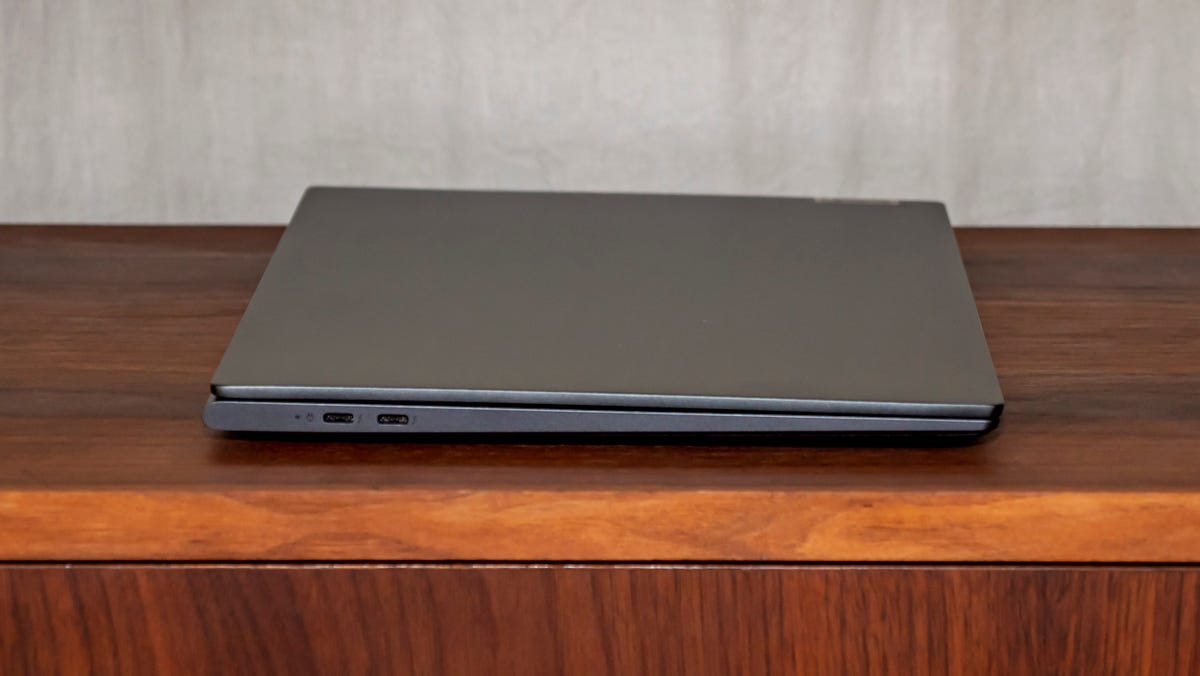
Both of the Slim 7i Pro's USB-C ports are on the left side.
Josh Goldman/CNET
The 14-inch display, for instance, covers 100% sRGB, 80% P3, 78% Adobe RGB and 74% NTSC color gamuts. It hits a brightness of 400 nits. All good things for work, entertainment and basic content creation. The taller 16:10 ratio gives you more vertical room for work, too. And the 90Hz refresh rate smooths out the look of video and games.
With two Thunderbolt 4 USB-C ports on the left side, you're covered for everything from charging and high-speed data transfers to connecting multiple external monitors. It would be nice if they were split between the left and right sides for greater flexibility, though. Wireless is ready for the future as well with Wi-Fi 6 and Bluetooth 5.1.
Above the display, there's a serviceable 720p webcam paired with an IR camera and dual far-field microphones. The IR camera is for signing in with facial recognition. But what's even more interesting is the laptop has presence detection, a feature found on ThinkPad business laptops.
The Slim 7i Pro's cameras can automatically lock and unlock the laptop.
Josh Goldman/CNET
If you walk away from the laptop, it will automatically lock itself down. When you return, the Slim 7i Pro senses your presence and starts looking for your face to unlock it instantly. The feature can even be used to pause video playing on your display when you leave and resume when you return when using certain players like VLC.
What Lenovo did remove is the sliding physical shutter for the webcam to help with privacy. That's a step back, but you can use Lenovo's Vantage software toolbar to quickly kill the webcam and mic, as well as change fan and system control modes, adjust battery and charging performance and even turn on and off the keyboard backlight. You can also do some of these things and much more with your voice.
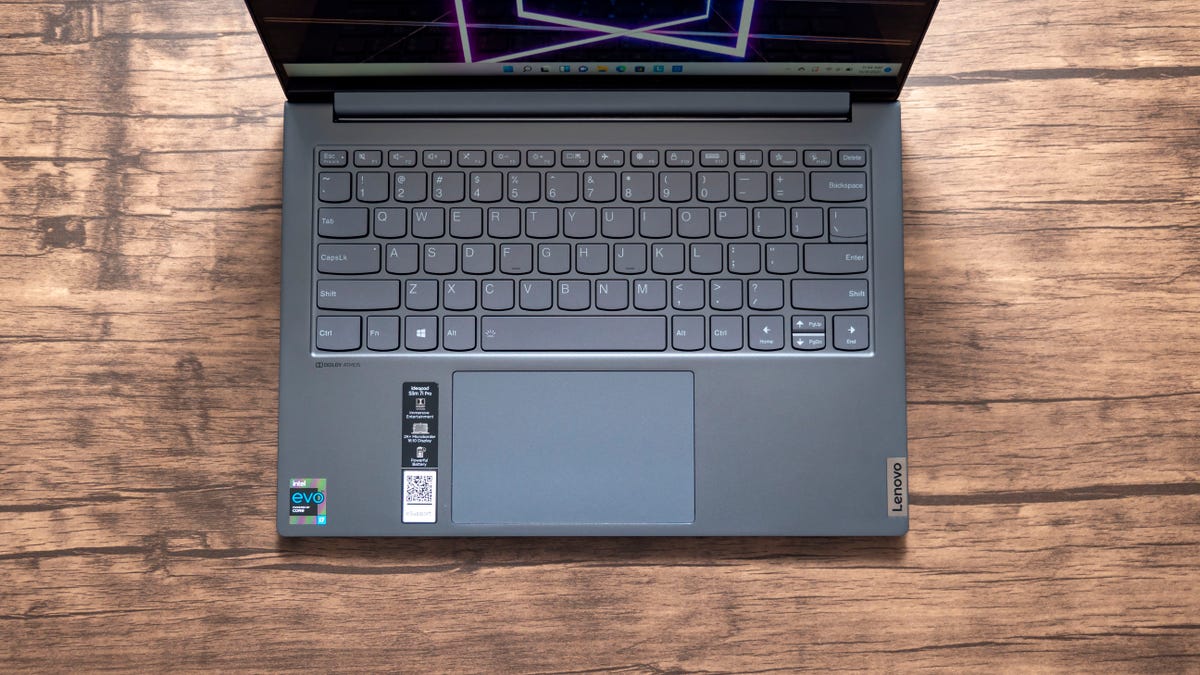
The keyboard and touchpad are both excellent.
Josh Goldman/CNET
The laptop is preinstalled with Lenovo Voice, which lets you control the laptop and change settings with voice commands. There's a long list of options from controlling screen brightness and volume to opening the calculator app to disabling the webcam. It also has translation and voice-to-text features. And if you want to use your voice for more, the laptop is preinstalled with Amazon Alexa services and Microsoft Cortana. This is why those dual far-field mics are nice to have, along with better conference calls.
Aside from the Lenovo Vantage and Lenovo Voice apps, there's surprisingly little preinstalled bloatware on the laptop, but be prepared to get partner software pitches anyway. Yes, Vantage is where you'll find all the controls for turning on and off the extra features on the Slim 7i Pro, but it's also the company's avenue for pitching you on various partner services. Things like SurfEasy VPN, McAfee Live Safe, DashLane password manager and Lenovo's own Smart Performance service for $30 a year, which scans your PC and fixes any issues it finds. This is also where you'll get offers for extended warranties for the laptop and battery. It's annoying but I suppose it's better than having all of it preinstalled.
A headphone jack, USB-A port and power button are on the right side.
Josh Goldman/CNET
At the end of the day, the Lenovo IdeaPad Slim 7i Pro's charm is that it's a really good clamshell laptop for people who need just that. it looks good, if a little bland. It has an excellent display and the components are top-notch for its class. Plus the Thunderbolt 4 and Wi-Fi 6 mean there's some future proofing for connections. Add in the fun extras like presence detection and voice commands, especially nice if you're a heavy Alexa user already and you've got a premium laptop experience at a more midrange price.
Geekbench 5 (multicore)
Microsoft Surface Laptop 4
HP Pavilion Aero 13 (13-be0097nr)
Dell XPS 13 OLED (9310)
Lenovo IdeaPad Slim 7i Pro
Note:
Longer bars indicate better performance
Cinebench R23 CPU (multicore)
HP Pavilion Aero 13 (13-be0097nr)
Lenovo IdeaPad Slim 7i Pro
Dell XPS 13 OLED (9310)
Note:
Longer bars indicate better performance
PCMark 10 Pro Edition
HP Pavilion Aero 13 (13-be0097nr)
Lenovo IdeaPad Slim 7i Pro
Dell XPS 13 OLED (9310)
Microsoft Surface Laptop 4
Note:
Longer bars indicate better performance
Streaming video playback battery drain test (minutes)
Lenovo IdeaPad Slim 7i Pro
Microsoft Surface Laptop 4
HP Pavilion Aero 13 (13-be0097nr)
Dell XPS 13 OLED (9310)
Note:
Longer bars indicate better performance
System Configurations
Lenovo IdeaPad Slim 7i Pro
Microsoft Windows 11 Home (64-bit); 3.3GHz Intel Core i7-11370H; 16GB 4.27GHz LPDDR4X; 128MB Intel Iris Xe; 1TB SSD
HP Pavilion Aero 13 (13-be0097nr)
Microsoft Windows 10 Home (64-bit); 1.9GHz AMD Ryzen 7 5800U; 16GB DDR4 SDRAM 3.2GHz; 512MB AMD Radeon; 512GB SSD
Framework Laptop
Microsoft Windows 10 Pro (64-bit); 3GHz Intel Core i7-1185G7; 32GB DDR4 SDRAM 3.2GHz; 128MB Intel Iris Xe; 512GB SSD
Microsoft Surface Laptop 4
Microsoft Windows 10 Home (64-bit); 2GHz AMD Ryzen 7 4980U; 16GB DDR4 SDRAM 4.27GHz; 512MB AMD Radeon Vega 8; 512GB SSD
Razer Book 13
Microsoft Windows 10 Home (64-bit); 2.8GHz Intel Core i7-1155G7; 16GB DDR4 SDRAM 4.27GHz; 128MB Intel Iris Xe; 256GB SSD
Dell XPS 13 OLED (9310)
Microsoft Windows 10 Pro (64-bit); 3GHz Intel Core i7-1185G7; 16GB DDR4 SDRAM 4.27GHz; 128MB Intel Iris Xe; 512GB SSD
Verizon gets its first 5G laptop in Lenovo's Flex 5G
Verizon gets its first 5G laptop in Lenovo's Flex 5G
Lenovo's first 5G-capable PC is ready to ship, with Verizon users able to get it on June 18.
First announced back at CES in January, the $1,400 Flex 5G will hit Verizon's website later this week marking the first time a US carrier is selling a laptop capable of tapping into 5G wireless networks.
The two-in-one computer features a 14-inch full HD touchscreen display that is capable of 400 nits of brightness, weighs just under three pounds (1.35 kg) and runs Windows 10 off of Qualcomm's 8cx computing platform with 8GB of RAM and 256GB of storage. As with other Lenovo PCs, the Flex 5G can be used as a traditional laptop, or with the screen folded all the way back to become a tablet.
Other specs include a 720p HD webcam with infrared for logging in through Windows Hello, two USB 3.1 Type-C ports as well as a 3.5mm headphone jack. Lenovo claims the PC is capable of getting 24 hours of battery life on a single charge. Bluetooth 5.0 is available, but there's no support for the new Wi-Fi 6 standard.
A one-year subscription to Microsoft 365 Personal, which includes Microsoft Office and 1TB of OneDrive cloud storage, is included with each Flex 5G purchase from either Lenovo.com or Verizon.
The Lenovo Flex 5G in "tent" mode.
Lenovo
The Flex 5G is capable of tapping into the carrier's existing millimeter-wave 5G network that is active in parts of 35 cities around the country. As with other recent Verizon 5G devices, it will also be able to use Verizon's new, wider-ranging low-band 5G network when it goes live later this year.
Beyond needing to be in a city with 5G, those looking to take advantage of the faster connectivity will need to be on Verizon's new 5G Ultra Wideband Connected Device Plan. The plan runs $30 per month for those who already have wireless service through Verizon or $90 per month for those without.
As part of the plan, you'll be able to get unlimited 5G millimeter-wave data, hotspot and 4K streaming on the laptop when in an area that has a millimeter-wave signal (what Verizon calls "ultra wideband").
When on 4G LTE, the plan will offer unlimited 4G LTE data (with 15GB available before the risk of being slowed down in areas of "congestion"), 15GB of 4G LTE hotspot (with unlimited data available thereafter at significantly slower speeds of 600Kbps) and 720p video streaming.
4G LTE-only plans are also available, including an option to add it to your existing plan.
Known internationally as the Yoga 5G, the computer will be sold by other wireless carriers including EE in the UK, Sunrise in Switzerland and CMCC in China later this year.