Google Pixel 7 Pro Leak Shows Punchhole Camera, S22 Ultra-Like Display
Google Pixel 7 Pro Leak Shows Punchhole Camera, S22 Ultra-Like Display
A new leak gives us what could be a first look at the Google Pixel 7 Pro, the rumored successor to the acclaimed Pixel 6 Pro. On Wednesday, reliable leaker @OnLeaks tweeted that he sent renders of the upcoming phone to Indian tech site Smartprix.
With a curved OLED display around 6.8 inches, the rumored design resembles that of Samsung's new Galaxy S22 Ultra. The images show a punchhole front camera and three back cameras.
Read More: Google Pixel 6 Vs. 6 Pro Vs. Pixel 5 Vs. 5A
The rumor from Smartprix puts the Pixel Pro 7's thickness at 8.7mm, which is just below the S22 Ultra's 8.9mm and above the iPhone 13 Pro's 7.65mm. However, the back cameras are shown lined up on a protruding bump, which would technically bring the phone's thickness to 11.2mm.
For now, the specs are still rumored and Google has yet to confirm the phone. It could be announced in October, when Google typically announces its new Pixels.
Google did not immediately respond to a request for comment.
Save up to 58% on Toys for Learning With This Back to School Sale
Save up to 58% on Toys for Learning With This Back to School Sale
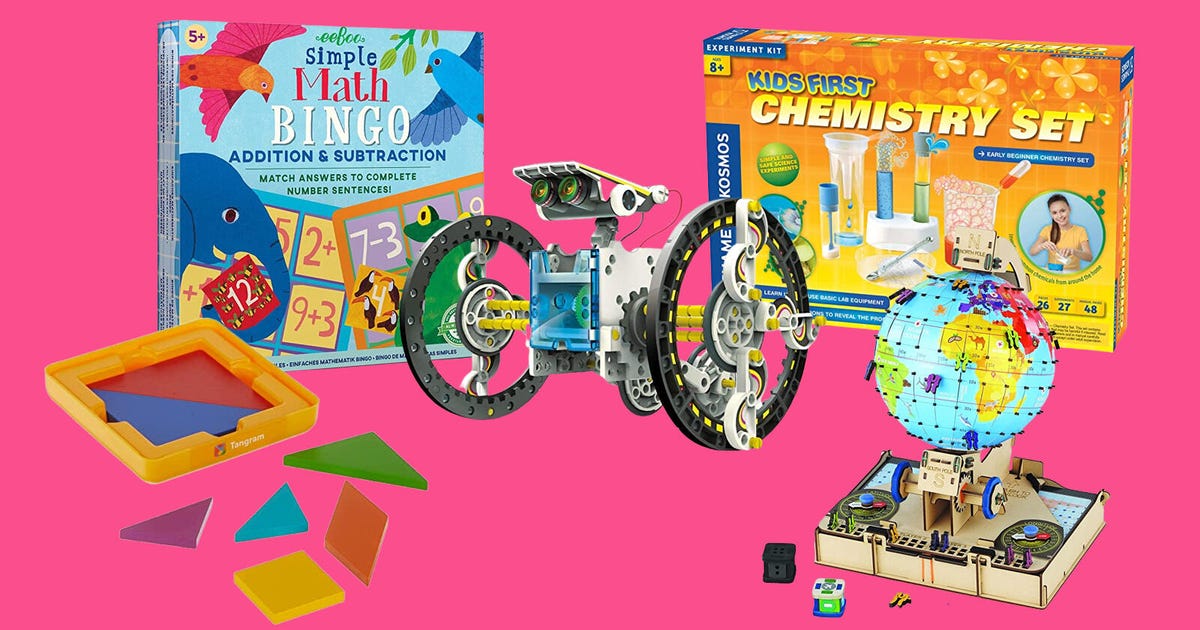
It's back-to-school season and that means a ton of educational items, including toys, are on sale. These educational toys are designed with exploration in mind to help children learn about science, math and other subjects in a fun and engaging way.
Amazon has toys discounted by up to 58% from Osmo, National Geographic, Snap Circuits and more. There are more than 80 toys on sale today. These offers end tonight.
If you want to incorporate tech into your child's playtime, consider games from Osmo. The games require an Apple iPad or Amazon Fire tablet, but the idea is that children will interact with handheld pieces to learn about shapes, colors, letter formation, phonics and more while watching them come alive on the screen. The Little Genius starter kit is for ages 3 to 5 and is discounted by $40 today, bringing the price down to $80. There's also a Creative starter kit for ages 5 to 10 that focuses on drawing and word problems. It's 50% off, bringing the price to $35.
The Smartivity Globe Explorer is a STEM learning toy designed for kids ages 8 and up that gives kids the opportunity to build their own globe, putting the wooden model together piece by piece and explore the concepts of geography, language, culture, art, trade and more along the way. There's even a free Globe Explorer app to allow kids to discover more about certain locations once it's assembled. It normally costs $53, but you can snag it for $28 right now.
For older kids, you can grab the Thames and Kosmos Physics Pro 2.0 science kit. It is designed for kids ages 10 and up, and it comes with 31 experiments to help pre-teens explore mechanical engineering though models and devices such as wind tunnels, hydraulic lifts and more. This $100 kit is marked down by 43% right now, bringing the price to $57. Through the experiments and models, kids will be introduced to advanced topics including fluid dynamics, energy, oscillation and pneumatics.
There are lots of other options, too, including this Butterfly Garden kit for $30 that includes live caterpillars that you and your children can watch grow and transform into butterflies, this build-it-yourself interactive AI robot for $32, this Motors and Generators science kit for $18 and the 3D Ubongo geometric puzzle game for $25. Check out the entire sale selection at Amazon to find the perfect fit for your child's age and interests.
Facebook CEO Mark Zuckerberg wields so much power that even one of the social network's co-founders thinks it's both "unprecedented" and "un-American."
Chris Hughes, who co-founded Facebook with Zuckerberg while they were students at Harvard, called for the social network to be broken up in an op-ed published Thursday by The New York Times. "I'm angry that his focus on growth led him to sacrifice security and civility for clicks," Hughes wrote, referring to Facebook's boss and major shareholder. "I'm disappointed in myself and the early Facebook team for not thinking more about how the News Feed algorithm could change our culture, influence elections and empower nationalist leaders."
Facebook's rapid growth has been fueled by acquisitions, including Instagram and WhatsApp, a messaging service. Critics and experts say Facebook simply purchased its competition, rather than innovating to meet the challenges they posed.
"Their whole business model is to identify potential threats and then buy them or beat them in some way," said Stephen Diamond, an associate professor of law at Santa Clara University School of Law.
And Facebook has been called out for not doing enough to combat election meddling, misinformation and hate speech. Its enormous power, critics argue, needs to be kept in check. Facebook doesn't want to spin off Instagram and WhatsApp.
Here's what you need to know:
Who wants Facebook broken up? Why?
Calls to break up Facebook aren't new. But it is startling to hear one of the company's co-founders call for such an extreme measure. Hughes argues that Zuckerberg holds so much power that even the company's board of directors can't keep him accountable. Zuckerberg controls around 60 percent of Facebook's voting shares, which means the board technically can't fire him even if he messes up.
Hughes isn't alone. Advocacy groups, including the Electronic Privacy Information Center, Color of Change and Common Sense Media, have previously asked the Federal Trade Commission, the agency that enforces antitrust law, to make Instagram and WhatsApp separate companies. A split would also make it easier for other social media companies to compete with Facebook, the organizations argue.
In addition, a group called Freedom from Facebook has called on the FTC to force Facebook to spin off its Messenger service too.
Sen. Elizabeth Warren, a Democrat from Massachusetts who's also a presidential candidate, is among the lawmakers who want to break up Facebook, as well as other tech giants, including Google and Amazon.
How would Facebook be broken up?
One way to break up Facebook would be for the federal government to file a lawsuit against the company, arguing it stifles competition. That could prompt a negotiation between the parties that could lead to Facebook agreeing to make itself smaller.
Another alternative would be for Congress to pass a law covering tech monopolies. Warren has proposed such a law, which would require tech platforms that take in $25 billion or more in sales to "structurally separate" their products. Amazon, for example, would have to spin off its house brand Amazon Basics. Warren said that if she won the presidential election her administration would also appoint regulators to unwind the mergers of Instagram and WhatsApp from Facebook.
What does Facebook think about the idea?
Facebook has pushed back, arguing that breaking up the company wouldn't hold the social network more accountable for its actions. Instead, Facebook has called for more internet regulation around harmful content, election integrity, privacy and data portability.
"Accountability of tech companies can only be achieved through the painstaking introduction of new rules for the internet," Nick Clegg, Facebook's vice president of global affairs and communications, said in a statement Thursday. The social network also said that having Instagram and WhatsApp under Facebook helps them fight spam, election meddling and crime. Facebook says it has plenty of competition, pointing to YouTube, Snapchat, iMessage and WeChat, among others.
Clegg touched on all those points in a Saturday editorial in The New York Times.
Have tech companies been broken up in the past?
Yes, but it's unusual. In 1974, the US Department of Justice filed an antitrust lawsuit against AT&T but the matter wasn't settled until eight years later. The telephone company was required to spin off two-thirds of its assets into separate companies, according to a 1982 article from The Washington Post. The government has also tried to break up Microsoft and in 2000 a US federal judge ordered that the tech giant split into two companies. Microsoft appealed and the decision was reversed.
What would this mean for users of Facebook?
Facebook is trying to integrate its messaging services so users of Facebook, Instagram and WhatsApp can send messages to one another without switching apps. Splitting up the companies might prevent that from happening.
Those who want the government to break Facebook up argue the move would fuel more competition among social media companies, which could mean more options for consumers. About 2.7 billion people use Facebook, Instagram, WhatsApp or Messenger every month.
Diamond said that breaking up Facebook could also lead to the company stepping up its privacy efforts to match its social media competitors.
What are the chances this happens?
The FTC declined to comment on whether it's looking to break up Facebook. But if history is any indication, it would be a rare move.
"I doubt there is sufficient political momentum to break up Facebook," Diamond said. "I'm skeptical, even though I think there might be good reasons to do it."
Originally published May 10, 5:40 a.m. PT. Update, May 11: Adds mention of Facebook VP Nick Clegg's Saturday editorial in the Times.
Apple's MacBook Pro Models With M1 Pro Chip Hit New Lows, With Up to $350 Off
Apple's MacBook Pro Models With M1 Pro Chip Hit New Lows, With Up to $350 Off
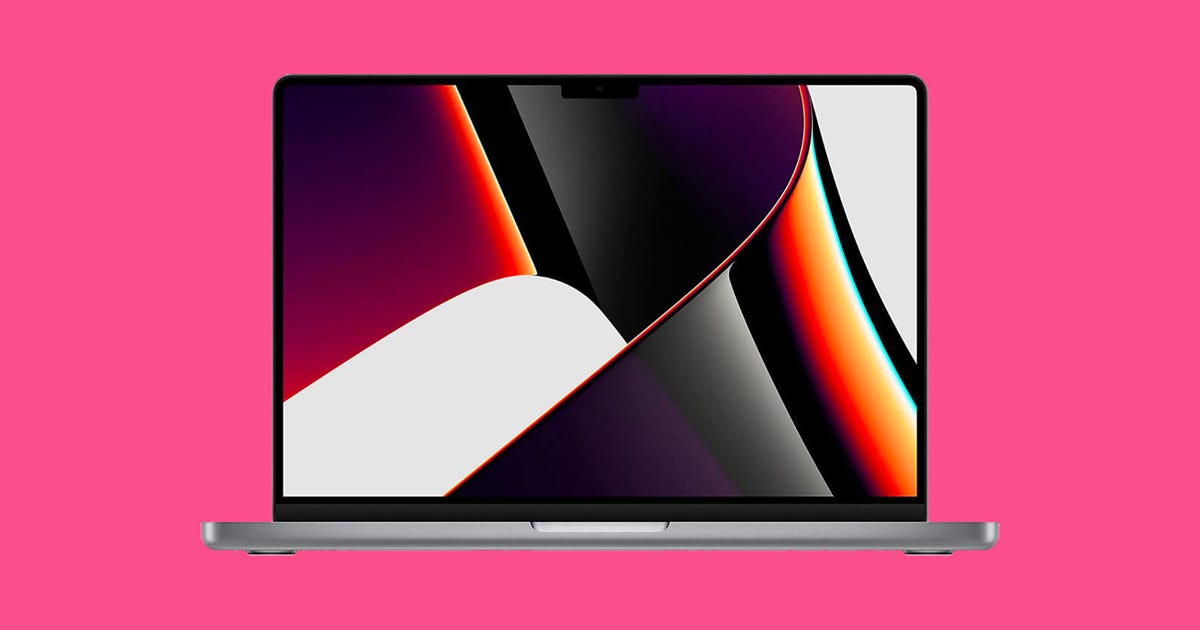
If you've been holding out for a steep discount on Apple's top-tier MacBook Pro models, your patience is being rewarded today with some of the best MacBook deals we've seen to date. Apple's MacBook Pro models with its powerful M1 Pro chip have had prices slashed at Best Buy with as much as $350 taken off their regular prices. The My Best Buy member-exclusive markdowns apply to both 14-inch and 16-inch versions and make for the lowest prices ever on these machines.
If you want Apple's largest laptop, the 16-inch MacBook Pro is the very fellow. It packs in a gorgeous 16.2-inch Liquid Retina XDR display with ProMotion and 1,600 nits of peak brightness. Inside, the devices are powered by Apple's M1 Pro chip with a 10‑core CPU, 16‑core GPU and 16GB of RAM. Both the 512GB and 1TB configurations are discounted by $350 at Best Buy right now -- a better price than during Prime Day earlier this month.
On the smaller side, the more portable 14-inch MacBook Pro is available for as little as $1,699 at Best Buy, which is $300 off. That's the lowest we've seen this machine go and the 1TB configuration is discounted by even more at $350 off. Both machines are also running Apple's M1 Pro chip with 16GB of RAM.
There's no telling how long these deals will last, so it's best to place your order as soon as possible if you want to get in on the current savings. As mentioned, the full discount on each laptop is exclusively available to My Best Buy members, though it's free to sign up for a membership, making it well worth doing. If you're not seeing the full savings, make sure you're logged in with your My Best Buy account.
Tesla Has a Dedicated Lane at a US-Mexico Border Crossing, Report Says
Tesla Has a Dedicated Lane at a US-Mexico Border Crossing, Report Says
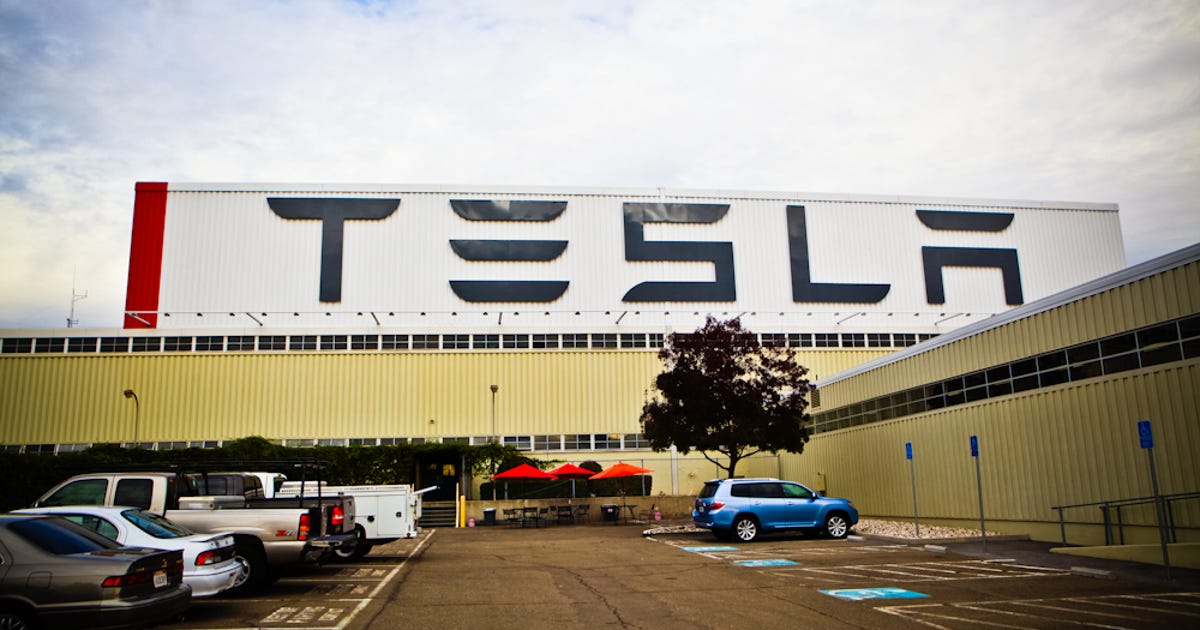
If you go from the US to Mexico through Texas, you might see a familiar logo over a traffic lane at the border crossing. According to Bloomberg, there's now a dedicated Tesla lane at a US-Mexico border crossing a few miles from Laredo, Texas.
Bloomberg reports that Elon Musk's firm struck a deal with one of Mexico's most pro-business states, but the details of the deal are unclear.
"It was a simple incentive," Ivan Rivas, the economy minister of Nuevo Leon, told Bloomberg. "What we want is a crossing that's much more expedited and efficient. And maybe there will be a lane for other companies in the future like there is for Tesla."
Rivas said the lane, located at the Colombia Solidarity checkpoint, will help Tesla suppliers quicken their crossing between the US and Mexico.
The Colombia Solidarity checkpoint is one of the less popular crossing stations, according to Bloomberg. The rules for the lane, like who handles paperwork for it, are unclear at this time.
Tesla didn't immediately respond to CNET's request for comment.
Tesla moved from Palo Alto, California, to Austin, Texas, in Dec. 2021. Musk moved the company from California in response to spats with local government over COVID-19 protocols in the US in 2020.
Dell XPS 13 (winter 2013) review: Still can't touch this sleek ultrabook
Dell XPS 13 (winter 2013) review: Still can't touch this sleek ultrabook
A little over a year ago, Dell debuted a then-quite-impressive little 13-inch laptop called the XPS 13. Aimed at the part of the business market that's become increasingly enamored of the MacBook Air and Windows ultrabooks, the XPS 13 was technically geared toward business customers, but with lots of stylistic flourishes and compact appeal. It was like a Windows MacBook Air, but with less impressive battery life. We called it the "Dellbook Air."
The XPS 13 is back for a second go in 2013, but it doesn't seem to have gotten the "Windows 8 touch" memo. Yes, it now has third-gen Intel Core i5/i7 processors, two USB 3.0 ports, and a higher-resolution 1080p screen. But a touch display? No.
Last year, we said this about the XPS 13's main drawbacks: "A limited port selection doesn't include HDMI or an SD card slot; the display should be better; and battery life falls behind other slim laptops." The new XPS 13 adds a fancy 1080p screen and gains a little more battery life, but that screen option will cost you: the 1080p version costs $1,299.
Sarah Tew / CNET
Can you live without touch on a laptop? Do you like the idea of a tweaked version of last year's XPS 13 in the current laptop world? There's really nothing wrong with what this new Dell XPS 13 brings to the table, but it's expensive, a bit heavy compared with other ultrabooks, and it lacks touch, which should be a major consideration when moving to Windows 8. Call it an old-fashioned ultrabook.
Price as reviewed / starting price
$1,599 / $999
Processor
1.9GHz Intel Core i7-3517U
Memory
8GB, 1,600MHz DDR3
Hard drive
256GB SSD
Chipset
Intel QS67
Graphics
Intel HD4000
Operating system
Windows 8
Dimensions (WD)
12.4x8.1 inches
Height
0.24-0.71 inch
Screen size (diagonal)
13.3 inches
System weight / Weight with AC adapter
3.0 pounds / 3.6 pounds
Category
13-inch
The Dell XPS 13 might have been one of the best-designed Dells since the Adamo. Soft-touch finishes, an elegant keyboard, sleek metal, and solid construction give instantly strong first impressions. The new XPS 13 isn't much different, and it still presents itself well.
Sarah Tew/CNET
Its footprint is smaller than a 13-inch MacBook Air, giving it something of the feel of a 12-inch laptop. The narrower footprint feels right, and the keyboard hasn't been compromised. A magnetic hinge opens smoothly, and the lid has just enough bezel to provide finger room to open and close, while maxing out screen real estate.
Did I say the XPS 13 seemed heavy and thick? Maybe that's unfair. It actually weighs an even 3 pounds, which is lighter than the 13-inch Air. It's 0.71 inch thick at its thickest point, tapering down to the other end. That's certainly slim and light enough for a 13-inch ultrabook, but the XPS 13 may be a psychological victim of its own small (for a 13-inch) footprint. It feels almost like an 11-inch Air in terms of dimensions, but the 11-inch Air is indeed lighter.
Sarah Tew/CNET
Lining up the new XPS 13 with last year's, you wouldn't be able to tell the difference. So, our opinion stays the same, cosmetically: the backlit keyboard is comfortable and spacious, and the multitouch clickable touch pad has ample finger room.
Sarah Tew/CNET
Ah, but now the spectre of Windows 8 casts its shadow. Windows 8 is a touch-oriented OS. It's arguably not necessary, but you'll miss it on many of Microsoft's native apps. That touch pad is your lone tool to interface via touch at all, and in this case, it's just not as responsive as better versions out there. In particular, off-edge swipe gestures, which can be used to bring up Windows 8 functions, are hard to pull off.
Sarah Tew/CNET
The best -- and worst -- new feature of this XPS 13 is its 13-inch 1080p Gorilla Glass-covered display: it's crisp, bright, vivid, and looks great at all angles. It's a big step up compared to the average laptop, and better than the display on the MacBook Air. But not all XPS 13 models have it: step-down versions have 1,366x768-pixel displays, which I didn't test. That 1080p on a 13-inch screen used to look crammed, but the nice thing about Windows 8 is that its new tile interface and full-screen apps generally take advantage of higher-res smaller screens in ways that don't shrink and cram text and buttons down like Windows 7 did. It's a better experience.
But, I'll say it once again: there's no touch screen. I harp on that because this is a $1,600 computer, and there are touch ultrabooks out there for half that price. That may not matter to some people, but in the Windows 8 world, ultrabooks are routinely getting touch-screen makeovers without great cost. Top-end laptops are starting to have touch by default. The Dell XPS 13's lack of touch just feels like an oversight. At this price, it should at least have a touch-screen option. In a Windows 8 world, touch is just too potentially useful to completely ignore.
The 0.9-megapixel Webcam takes grainy pictures, and isn't as good as others I've seen.
Dell XPS 13 (2013)
Average for category [13-inch]
Video
Mini DisplayPort
HDMI or DisplayPort
Audio
Stereo speakers, combo headphone/microphone jack
Stereo speakers, headphone/microphone jacks
Data
2 USB 3.0
2 USB 3.0, 1 USB 2.0, SD card reader
Networking
802.11n Wi-Fi, Bluetooth
Ethernet, 802.11n Wi-Fi, Bluetooth
Optical drive
None
DVD burner
Ports, configurations, performance The ports are sparse indeed on the XPS 13: two USB 3.0 ports and a Mini DisplayPort. No HDMI, no Ethernet, not even an SD card slot. I can forgive the first two, but not the third. There's plenty of room.
Sarah Tew/CNET
This XPS 13 review unit is the highest-end model, the surf-and-turf of Dell's fleet: Intel Core i7 processor, 8GB of RAM, 256GB SSD, 1080p display, for $1,599. The lowest-end XPS 13 starts at $999, and has more-standard specs: Core i5, 4GB of RAM, 128GB SSD, but only a 1,366x768-pixel display. You can mix and match specs to some degree, but for 1080p you have to step up to a $1,299 model with 4GB RAM and a 128GB SSD. Sure, that sort of matches a MacBook Air, but it's hard to swallow for a PC -- especially one that lacks a touch screen.
The Core i7-3537 CPU is a little faster than the Core i7-3517 in the step-down 720p models, and handled as well as you'd expect a top-end, third-gen Intel ultrabook processor to perform. It's one of the fastest we've tested in our benchmarks, but not by a huge degree. You're still stuck with Intel HD 4000 graphics, which are fine for most purposes but, at this price, fall short of serious PC graphics power.
Sarah Tew/CNET
Battery life, warranty The killer differentiator in a lot of superportable ultrabooks often comes down to battery life. The original XPS 13 in 2012 was a disappointment, getting a little under 5 hours. The new XPS 13 does a little better, scoring 5 hours and 31 minutes in our video playback battery drain test. An extra 40 minutes is nice, but it doesn't quite match up to the 6-plus hours a lot of top-end ultrabooks can achieve.
Dell offers a one-year warranty with at-home service (after remote diagnosis) with the XPS 13, plus a year of 24-7 "premium" phone support (1-877-717-3355). This can be upgraded in various ways on Dell's Web site: $199 to extend to three years, or up to $349 for additional accidental damage protection and LoJack.
Sarah Tew/CNET
Conclusion: A great laptop...for 2012 The Dell XPS 13 is a slightly fancier version of last year's Dellbook Air: compact, functional, and upgraded with an excellent display. But its price -- and its lack of touch-screen options -- leave it as a product I'd have some reservations recommending for everyone. It feels like last year's product in a 2013 Windows 8 world that's moved on from basic ultrabooks -- or, at this price, one that at least includes touch. You might not need a touch screen, but believe me, at this price Dell should be including one. When it does, the XPS 13 might once again be a serious contender for best Windows 8 ultrabook.
Nvidia's Grace AI chip leaves Intel processors behind
Nvidia's Grace AI chip leaves Intel processors behind
Nvidia has a new chip in the works for boosting artificial intelligence and other high-performance computing work: Grace, a design slated to arrive in mammoth supercomputers in 2023. Instead of accelerating conventional Intel-powered servers, though, the design includes its own built-in Arm processors.
Nvidia's current brainiest chip, the A100, is typically yoked to Intel Xeon processors. Nvidia chips do the grunt work, but Intel chips oversee it. With Grace, named after pioneering programmer Grace Hopper, the company opted to embed several Arm Neoverse processor cores within the chip to speed up processing, said Paresh Kharya, an Nvidia senior director. The chip news arrived at Nvidia's GTC 2021 conference this week.
The new chip should let AI customers run computing tasks that are vastly more complex than is possible with today's chip designs, a step toward the general artificial intelligence that is the holy grail of today's machine learning research, said Cambrian AI Researach analyst Karl Freund in a blog post.
The design illustrates Nvidia's dramatic ascent -- and Intel's struggles. Even decades of dominance in technology don't guarantee success when the rules of computing are constantly being rewritten. Your laptop likely comes with an Intel chip, but an Nvidia chip was more likely responsible for important AI work like filtering spam, improving image quality or recognizing your voice when you call your bank.
Not so many years ago, Nvidia was just a component supplier, a designer of graphics chips called GPUs to boost PC performance. Intel's family of processors, or perhaps compatible rival AMD chips, shouldered most of the computing work. Intel, though, has struggled in recent years to keep pace with chip miniaturization and to capitalize on the exploding use of AI.
The result: Nvidia's market capitalization vaulted over Intel's, reaching $357 billion compared with Intel's $278 billion. Much of the growth has been propelled by the fact that GPUs also turned out to be pretty good at AI work, specifically the computationally intense training process that builds the models that later run in data centers, PCs and phones.
Also in the ascendant is Arm, which licenses the chip designs and technology that power every smartphone, new M1-based Apple Macs and the world's fastest supercomputer. Nvidia is seeking to acquire Arm for $40 billion, a move some rivals like Qualcomm object to. Grace's integrated Arm chips let Nvidia read data from memory many times faster than with current designs, the company said.
Nvidia's Selene machine, currently the world's fifth-fastest supercomputer, pairs A100 chips with AMD Epyc CPUs. A 2023 Grace-based machine called Alps at Switzerland's National Supercomputing Center should be seven times faster, Kharya said. The Los Alamos National Laboratory in the US also will buy a Grace-powered supercomputer.
Under new Chief Executive Pat Gelsinger, Intel is working to reclaim its manufacturing lead, planning to tap into others' manufacturing abilities while it works on miniaturizing its circuitry inscribing technology.
Intel is building AI abilities into its main processors while working on dedicated hardware, too. It folded its Nervana chips operation, but its Habana AI acceleration processors are still under active development.
One hot area for AI chips is autonomous vehicles, whose self-driving algorithms rely on processing in camera imagery and other sensor data. It's a core focus for Nvidia AI chip work, for example with its Orin chip scheduled to debut in 2022 vehicles.
Nvidia CEO Jensen Huang announced new processors for AI, graphics and supercomputing at the company's GTC event.
Screenshot by Stephen Shankland/CNET
At GTC, Nvidia announced a new chip called Atlan with quadruple the performance. It should arrive in 2025 vehicles, said Danny Shapiro, Nvidia's senior director of automotive work. Like Orin and Grace, Atlan relies on Arm cores, too.
Nvidia also announced a grander autonomous vehicle technology package called Hyperion 8. It combines two Orin processors with a host of sensors: eight exterior cameras, four exterior wider-angle fisheye cameras, three interior cameras, nine radar scanners and one lidar 3D scanner. The technology should arrive later in 2021.
Nvidia extended a partnership with Volvo, the companies said. Volvo plans to use Orin chips in its next-generation vehicles.
Intel has its own autonomous vehicle division, Mobileye. Tesla develops its own AI chips for its cars.