DJI Phantom 3

2024 Hyundai Ioniq 6 Prototype First Drive Review: Replicating Success


2024 Hyundai Ioniq 6 Prototype First Drive Review: Replicating Success

Hyundai scored a home run with the Ioniq 5, and it's looking to replicate that success with the new Ioniq 6. This streamlined sedan is a stark contrast to the boxy cyberpunk aesthetic of the Ioniq 5, but both ride on the same modular electric platform and share powertrains, tech features and lots of futuristic design details. After getting some time behind the wheel of an Ioniq 6 prototype in South Korea last month, there's a lot to look forward to.

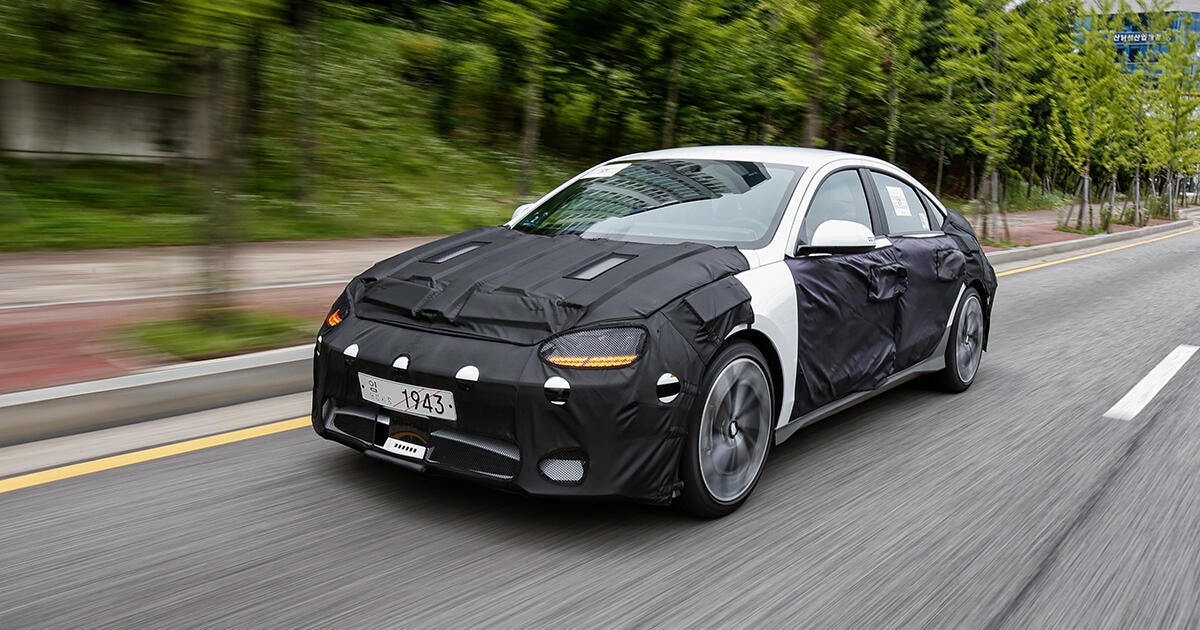
While the heavy camouflage might make this Ioniq 6 look like a rougher test mule, the car is a nearly production-level validation prototype that's just being used for final tweaks. The interior is completely uncovered, and build quality and fit and finish are pretty stellar. This particular Ioniq 6 is a rear-wheel-drive model in the highest trim level, with a 77.4-kilowatt-hour battery pack and a single electric motor putting out about 225 horsepower and 258 pound-feet of torque. Hyundai labeled this test drive as an "energy efficiency experience," likely to highlight the Ioniq 6's super-low drag coefficient of 0.21, which should result in a range exceeding 350 miles, but the route amounted to about 30 minutes of driving on the nice country roads near Hyundai's Namyang R&D center.

All that cladding is hiding a pair of big spoilers.

Hyundai

Despite its 20-inch wheels, the Ioniq 6's ride quality is superb -- even better than the Ioniq 5's. The Ioniq 6 is great at soaking up big potholes and rough road surfaces, and the cabin is Mercedes S-Class-level quiet. It feels like there's less body roll than in the Ioniq 5, too, and the steering rack is quick and direct, if a little numb. The single-motor setup feels plenty quick off the line and at passing speeds, and Hyundai's adjustable regenerative braking offers great one-pedal driving. Overall, the Ioniq 6 has all the inherent dynamic goodness of the Ioniq 5 but with a more planted, slightly sportier character.

Later, I'm able to try out a dual-motor Ioniq 6 on Hyundai's test track, which has the same 320 hp and 446 lb.-ft. as the Ioniq 5. Hyundai quotes a 0-to-62-mph time of 5.1 seconds for the all-wheel-drive model, though it feels even quicker than that in reality. Aside from the quicker acceleration, this more-powerful Ioniq 6 feels pretty much the same dynamically as the rear-drive model; there's really no bad egg here. While nothing has been confirmed yet, it seems like a sure bet that an Ioniq 6 N will emerge within the next couple of years, using a 577-hp setup previewed by the RN22e concept car.

The Ioniq 6 shares much of its dashboard with the Ioniq 5, using a pair of 12.3-inch screens sitting atop some slim air vents and a digital climate control panel with only a few physical buttons. But instead of a large empty space below and a movable center console and armrest setup like on the 5, the 6 has a tall, fixed center console bridge that connects to the dash. The console has a set of cup holders, ample storage space, a wireless charging pad and enough room for a large bag underneath. Frequently touched areas like the dashboard and center console have nicely padded surfaces, and even the cheaper plastics on lower sections of the cabin have interesting graining patterns and don't feel flimsy.

The Ioniq 6's interior is fab.

Hyundai

Hyundai moved the window switches and door lock buttons from the door panels to the center console, which frees up the doors to get a unique design. The armrest portion appears to float off the door panel itself, with the only adornment being a large metal speaker grille, and the main panel has a cool ribbed texture to it. Diffused ambient lighting wonderfully reflects from the doors -- the main panel in one color and the lower storage pocket in another -- that's even visible in the daytime. The rear doors are slightly less cool and have their window and lock switches on them, but the rad lighting is found back there as well.

Despite the Ioniq 6's sloping roofline there's a lot of interior space, even in the back. At 5 feet, 9 inches tall, I have plenty of headroom, and rear legroom rivals much larger luxury sedans. The Ioniq 6's seats are plenty comfortable, and the driver's chair has a max recline mode that will be great for charging sessions. Hyundai is also working on a number of in-car accessories for the Ioniq 6, including a fold-out table with a bunch of USB-C ports. There's only a small cargo space in the frunk, but there's room for two sets of golf clubs under the traditional sedan trunk lid.

Hyundai has yet to announce pricing or specs for the US-market Ioniq 6, and obviously half an hour in the car isn't enough to form a full opinion, but this new EV is seriously promising. It takes everything fantastic about the Ioniq 5 and puts it in a package that's more appealing to many consumers, and the Ioniq 6 will be more efficient to boot.


Editors' note: Travel costs related to this story were covered by the manufacturer, which is common in the auto industry. The judgments and opinions of CNET Cars' staff are our own and we do not accept paid editorial content.


Source

Tags:


Facebook Suspends Rules to Allow Some Calls for Violence Against Russian Invaders


Facebook Suspends Rules to Allow Some Calls for Violence Against Russian Invaders

What's happening

Facebook's parent company Meta said it's temporarily allowing some violent content against Russian invaders, making an unusual exemption to its rules against hate speech.

Why it matters

The move is already escalating tensions between Meta and Russia. Roskomnadzor, the country's telecommunications agency, said Friday it's restricting Instagram, a photo-and-video service owned by Meta. Russia's Investigative Committee is opening a criminal investigation against Meta.

What's next

Russia might take more actions against Meta as it moves forward with the criminal case against the social media giant. The company also owns messaging app WhatsApp though no restrictions against that service have been announced.

Facebook parent company Meta is setting aside its rules and allowing some violent speech against Russian invaders, saying it views these remarks as political speech. 

"As a result of the Russian invasion of Ukraine we have temporarily made allowances for forms of political expression that would normally violate our rules like violent speech such as 'death to the Russian invaders.' We still won't allow credible calls for violence against Russian civilians," Meta spokesman Andy Stone said in a tweet Thursday.

The rare exemption to the company's rules against hate speech, which bars people from posting content targeting a group of people, including violent content, shows how the world's largest social network is moderating content about Russia's invasion of Ukraine. The move, though, is already escalating tensions between Meta and the Russian government. 

Russia's Investigative Committee said in a statement Friday that it's opened a criminal case against Meta for allegedly violating the criminal code of the Russian Federation that bars public calls for extremist activities and assistance in terrorist activities. 

"As part of the criminal case, the necessary investigative measures are being carried out to give a legal evaluation to actions of Andy Stone and other employees of the American corporation," the committee, which reports to Russia President Vladimir Putin, said in the statement. 

Facebook has been facing a greater number of calls to crack down more heavily on propaganda and misinformation. Last week, Russia said it was blocking the social network after Facebook started to make content from Russian state-controlled media tougher to find on its platform and tapped third party fact-checkers to debunk false claims. On Friday, Russia's telecommunications regulator, Roskomnadzor, said in a statement that the Prosecutor General's Office of Russia demanded that the agency also restrict access to Meta-owned photo-and-video service Instagram. Roskomnadzor said the restrictions will take effect March 14 to allow users to transfer their photos and videos to other social networks and notify their followers and contacts. 

Nick Clegg, who leads global affairs at Meta, said in a statement Friday that the company's policies are "focused on protecting people's rights to speech as an expression of self-defense in reaction to a military invasion of their country." He added that Meta is applying the exemption only in Ukraine and that it made the decision because of "extraordinary and unprecedented circumstances."

"We have no quarrel with the Russian people. There is no change at all in our policies on hate speech as far as the Russian people are concerned. We will not tolerate Russophobia or any kind of discrimination, harassment or violence towards Russians on our platform," Clegg said.

The Russian Embassy in the US also responded to Thursday's decision, saying Meta's actions were equivalent to a declaration of information war against Russia, according to a report by Russian state-operated news agency Novosti. In a post on Twitter, the embassy called on US authorities to "stop the extremist activities of Meta."

For years, Facebook has also grappled with criticism that its rules are enforced unevenly. The company created a semi-independent oversight board to weigh in on its toughest content moderation decisions. 

Reuters, which first reported the policy change, said that in certain countries, including Russia, Ukraine and Poland, the social media giant is also allowing some posts that call for death to Russian President Vladimir Putin or Belarusian President Alexander Lukashenko. The changes also apply to Instagram. 

Citing internal emails, Reuters said that calls for death won't be allowed if they contain other targets or include "two indicators of credibility" such as the location or method of death. The posts must also be about the invasion of Ukraine. Calls for violence against Russian soldiers will also be allowed in Armenia, Azerbaijan, Estonia, Georgia, Hungary, Latvia, Lithuania, Poland, Romania, Russia, Slovakia and Ukraine, Reuters reported.

Also Thursday, Facebook and Twitter removed posts from Russia's embassy in the UK over false claims surrounding the bombing of a maternity hospital in the Ukraine city of Mariupol on Wednesday.

At least one child and two adults were killed at the hospital and another 17 were injured, Ukraine officials have said.

Meta didn't immediately answer questions about how long it expects the exemption will be in place or the number of posts that may be impacted. 

Meta hasn't released data about how many Facebook and Instagram users are in Russia. App analytics firm Sensor Tower estimates that since 2014 Instagram has been installed 166 million times from Google Play and the Apple App Store in Russia. Facebook in Russia has an estimated 56.2 million installs. Sensor Tower says that based on that data, Russia is the fifth largest market for Instagram and the 20th largest market for Facebook.


Source

Tags:


New M2 MacBook Pros to Enter Production Soon, Analyst Predicts


New M2 MacBook Pros to Enter Production Soon, Analyst Predicts

Apple will include its new M2 processor in upcoming 14-inch and 16-inch models of the MacBook Pro, which will hit production in the coming weeks, Ming-Chi Kuo, an Apple analyst known for his reliable predictions, said Monday.

Apple revealed the M2 chip at WWDC in June, saying the new chip would be an upgrade from the M1, which marked a new era for the company as it transitioned away from Intel processors for its computers. So far, Apple has released its 13-inch MacBook and MacBook Air using the newest chip, but it didn't provide details on when its larger MacBook Pros with the M2 processor would start rolling out. 

Kuo tweeted that production will happen in the fourth quarter of 2022. But it's not clear if he's referring to Apple's fiscal fourth quarter that ends in September -- or to chipmaker Taiwan Semiconductor Manufacturing Company's fourth quarter that ends in December. In July, a Bloomberg newsletter predicted that the new MacBooks would launch in fall 2022 or spring 2023, as reported by 9to5Mac. 

The M2 processor is 18% faster than the M1 while not affecting battery life. The M2 also features a memory boost of 24GB, up from 16GB. 

Apple's next event is set for Sept. 7 , which may be when the company shows off the larger MacBook Pros and the iPhone 14

Apple didn't respond to a request for comment.

§

Apple has set the date for its latest iPhone's debut. The new device, which is expected to be called the iPhone 14 and include an always-on display, will be unveiled on Sept. 7 at 10 a.m. PT (1 p.m. ET). Rumors suggest the new iPhone lineup will nix the Mini in favor of a new Max model, joining the rumored iPhone 14 Pro and iPhone 14 Pro Max, and potentially increase the price by about $100 over last year's. Apple may also have plans to excise the iPhone 14's notch in favor of a hole-and-pill-shaped front camera, at least for the Pro models. 

In addition to the iPhone 14, Apple's may also use the event to unveil the Apple Watch Series 8, which will reportedly look similar to last year's model but have more health features such as a fever sensor, as well as improved durability.

The tech giant has invited press to its Apple Park headquarters in California for the event, though it'll also offer a livestream on Apple.com and other streaming services. As is typical, Apple didn't say much in its invitation about its upcoming iPhone event. The invitation shows an Apple logo seemingly set in a night sky, suggesting potential camera improvements or last year's rumored satellite emergency calling. The image looks like something we might see from the James Webb Space Telescope, whose stunning photos have already begun changing how we see the cosmos since first being released earlier this summer. In its announcement, Apple included the teaser words "Far out." 

Read more: How to Watch the iPhone 14, Apple Watch Series 8 Launch

The new features for both the iPhone 14 and Apple Watch 8 may help Apple stand out from Samsung and other device makers during what is expected to be heightened competition this year. People have been cutting back on tech purchases, leading to surprisingly low sales reports from chipmaker Intel, as well as sudden ad business shortfalls for Google parent Alphabet and Facebook parent Meta. And they're not alone.

Our collective confidence in the economy has fallen through the floor, thanks to the ongoing coronavirus pandemic mixed with continual inflation and a looming recession. One survey from the University of Michigan found that consumer sentiment is at its lowest point in at least 70 years.

That means Apple will have to fight even harder to win over new iPhone owners. Samsung, for its part, made Apple's job a little easier by announcing its flagship Galaxy Z Fold 4 and Galaxy Z Flip 4 at their standard prices of $1,800 and $1,000, respectively, earlier this month. It also raised the prices of its Galaxy Watch 5 and Galaxy Buds 2 Pro by $30 apiece. 

Apple so far isn't acting worried. Over the past couple of years, Apple's notched its biggest revenue and profits each holiday shopping season, largely on the popularity of 2021's iPhone 13 and 2020's iPhone 12. Apple CEO Tim Cook has previously cited the advanced cameras, long battery life and well-regarded software as reasons people continue choosing iPhones. But he also said that 5G, the super-fast wireless technology Apple began using two years ago, is likely to push even more people to upgrade.

"5G has been an accelerant," he said when speaking to investors on a conference call last month. He added that although the technology is spreading through some places, like China, the EU and US, other parts of the world haven't begun using it as much. And so as 5G expands, he said, "I think there's reason to be optimistic."

While the iPhone will be a key product we see at Apple's event this year, and likely what most people focus their attention on, the company's expected to have other devices to show off. Those include new Mac computers with upgraded chips and new iPads.


Source

Tags:


Oppo Watch is a Google-powered Apple Watch-alike with a battery boost


Oppo Watch is a Google-powered Apple Watch-alike with a battery boost

Lots of smartwatches try to look like the Apple Watch. But the Oppo Watch is so similar-looking from a casual distance, it's uncanny. Oppo's first smartwatch was unveiled earlier this year, but the addition of Google Wear OS is new, along with its eSIM support for LTE data. The Oppo Watch is available internationally starting today, but there's no word yet on when it will arrive in the US.

The Oppo Watch could be one of the most interesting new Google Wear OS watches in some time. First off, eSIM support isn't that common on other Wear OS watches and needed for using your watch away from your phone. (Vodafone, Orange and Celron are the three announced carriers supporting Oppo Watch so far). Also, while this watch doesn't have the newest Qualcomm Snapdragon Wear processor, it does have dual chips that enable it to work in both normal and low-power states for extended battery life.

That's the big leap here. According to Oppo, the watch will last up to 21 days running off its lower-power Ambiq Apollo3 chip, or a couple of days using its Snapdragon Wear 3500 chip. The Ambiq Apollo3 chip can handle fitness and sleep tracking and still show the time and basic info: I wore a watch running the Apollo3, the self-powered Matrix PowerWatch 2, last year.

oppo-watch-46mm-9

The battery life on Oppo Watch could be a standout for Wear OS watches.

Oppo

While the Oppo Watch totally looks like an Apple Watch from a distance, there are some subtle design differences. The Oppo Watch's AMOLED display is also a squircle, but curved at the edges.The Oppo Watch sizes are 41 or 46mm (1.61 or 1.91 inches), with display brightness up to 1,000 nits, but only the 46mm one comes in an LTE option. Apple Watch screens are 40mm and 44mm. The watch is made of 6000-series aluminum alloy, with a plastic and ceramic back and very Apple Watch-like fluororubber watch straps. The 46mm Oppo Watch is 5ATM water resistant, but the 41mm model is only water-safe to 3ATM. All models have GPS, Glonass and support for Google Pay.

This watch likely won't fix the many weird problems of Google Wear OS, like a still not fully-fleshed-out-feeling fitness ecosystem and Assistant features that aren't as good as they should be, but it might make the experience better. Oppo has its own fitness tracking dashboard that aims to look more streamlined: it's reminiscent of a Fitbit or Samsung Galaxy Watch Active readout. The watch faces and app interface are also different and not exactly the same as the typical WearOS experience. Again, I haven't worn one yet, or tried one, but when I do I'll be able to understand it a bit more.

I haven't worn the Oppo Watch yet, but I'm looking forward to a test-drive soon. Its extended battery life for sleep tracking is exactly the sort of thing the Apple Watch still lacks, but may hopefully add in a future version. For Android phone owners, there are already plenty of watch options: lots of Wear OS watches, Samsung's watches, Fitbit and Garmin. Whether or not Oppo Watch helps out the Wear OS watch landscape remains to be seen.


Source

Tags:


Apple Watch 'Pro' Rumored to Feature Bigger Display, Body Temperature Sensor


Apple Watch 'Pro' Rumored to Feature Bigger Display, Body Temperature Sensor

Apple is expected to unveil three versions of its smartwatch this fall: the new SE, Series 8 and a high-end model, called the Apple Watch "Pro." The latter will feature a major redesign, longer battery life and a body temperature sensor, among other upgrades, according to a Sunday report from Bloomberg's Mark Gurman. 

Gurman says the high-end Apple Watch's screen will be 7% larger than the standard model and sport a fresh design that is an "evolution of the current rectangular shape" without being circular. The Apple Watch "Pro" is also rumored to feature a more durable titanium body. 

As for health features, the high-end Apple Watch is said to have a body temperature sensor. A previous report from Bloomberg suggests the sensor will be able to detect fevers and tell you when to check with a dedicated thermometer or consult a doctor. 

The Apple Watch "Pro" may offer longer battery life, as well. Gurman suggests the high-end Apple Watch will support multiple day uses on a single charge through a new low-power mode. 

Apple has yet to announce a release date for its upcoming Apple Watch, but rumors point to a fall launch alongside the iPhone 14 and AirPods Pro 2. 

Apple didn't immediately respond to a request for comment. 


Source

Tags:


2023 Honda CR-V Teased Ahead of Summer Debut


2023 Honda CR-V Teased Ahead of Summer Debut

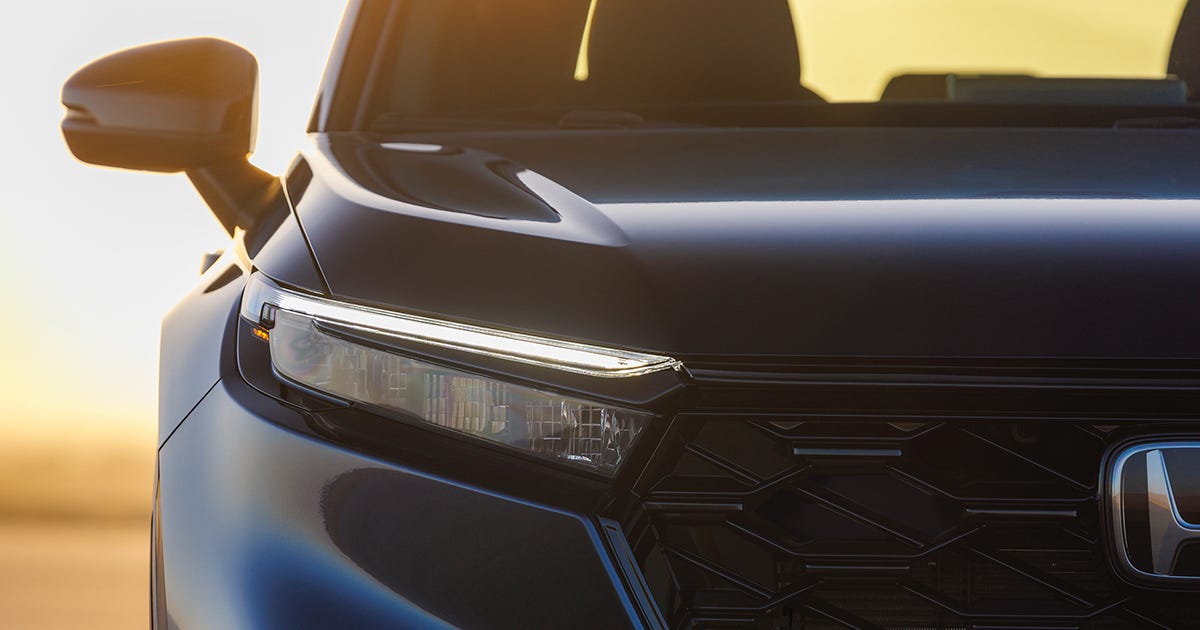
There's a brand-new Honda CR-V coming this year, and the automaker gave us our first glimpse of the redesigned crossover on Tuesday ahead of its official debut this summer.

What do we know about the new CR-V? Not much. The teaser images show an SUV that's much more stylish than before, with slim LED headlamps and -- if you click through to the gallery -- a more stylized lower fascia. Around back, the 2023 CR-V will keep the SUV's usual vertical lighting elements, in addition to slim horizontal lamps. We can also see a hybrid badge, confirming Honda will continue to offer the CR-V with a gasoline-electric powertrain.

The CR-V comes during what Honda calls its "Year of the SUV." The company is also planning to reveal the totally new HR-V this year, which will continue to slot below the CR-V in Honda's lineup.

It's unclear exactly when Honda will show the new CR-V this summer, but we expect more details to trickle out between now and then.


Source

Tags:


You Can Now Listen to Apple Music on Waze Audio Player


You Can Now Listen to Apple Music on Waze Audio Player

Waze said Tuesday that the navigation app has integrated Apple Music into its Waze Audio Player. The new integration allows users to access "90 million songs, tens of thousands of curated playlists, Apple Music Radio and more," according to a blog post. 

Adding Apple Music to the Waze Audio Player enables drivers listen to music and receive navigation without having to switch between apps, limiting potential distractions inside the vehicle. Or as the Waze blog puts it, the Apple Music integration is so you can "keep your eyes on the road while enjoying the ride."

To access Apple Music via the Waze app, tap the music note icon on the home screen. Apple Music should now show as an option if your phone is logged into an Apple Music account.

With the integration, Apple Music joins a number of other music services already compatible with the app, including YouTube Music, Spotify, Pandora and iHeartRadio. In addition to integrating music services into the app, other recent Waze updates have included an upgraded color palette, a new logo and a "Moods" feature that lets users show how they're feeling about their travels.

Waze didn't immediate respond to a request for additional comment.


Source

Tags:

Search This Blog

Menu Halaman Statis

close