DJI Phantom 3

Motorola Razr 2020 review: The iconic flip phone has done it again, this time with 5G


Motorola Razr 2020 review: The iconic flip phone has done it again, this time with 5G

The new Motorola Razr 2020 addresses most of the issues I had with the Razr (2019) that came out in February. Overall it's a better phone. The new Razr gets a slew of upgraded specs, but lacks the top of the line ones found in the Motorola Edge Plus and Samsung Galaxy Note 20 Ultra. But neither of those phones can fold into something incredibly small.

With the Razr you're paying $1,400 (£1,399, which is about AU$2,470) for a foldable screen. And that's important to remember because there isn't wireless charging or a high refresh rate display, or a gigantic battery or IP-rated water and dust resistance, or a headphone jack or headphones or the most powerful Snapdragon processor. If you want to fold a 6.2-inch phone into something the size of a small drink coaster in 2020, you're going to pay a lot of money. 

The Razr's refined foldable flip phone feels fantastic to use. With the new cameras, addition of support for 5G and all the useful enhancements to the external display, the Razr feels like a "normal" phone that can do "normal" everyday stuff with its "anything but normal" foldable build. If I were to compare the Razr to a car, it would be a fun two-seat convertible.

But not everything is rosy with this new Razr. The speaker in the chin is OK, but doesn't produce great-sounding audio at louder volumes. The glass on the back of my review unit has accumulated a few scuffs over 10 days. They're barely visible, but they're there. A case could have prevented these and Motorola will sell a nifty $50 case for the Razr.

Also, when I opened and closed my 2019 Razr review unit in February it made this weird loud squeak. For the most part, this new one didn't. I say for the most part because when I was filming the unboxing video for the Razr, I didn't hear a squeak. But when reviewing the footage, one of my video producers noticed that my mic picked up a small squeak.

Aside from the squeak (more on that below) my experience overall has been good with the new Raz. I have to give Motorola a ton of credit for all the changes and implementations they made.

As far as the price, this isn't a phone for everyone, especially with the financial hardship so many people are enduring right now. If you were seriously considering the Motorola Razr (2019) and didn't get it and you have the cash, you should consider this version. It's a refinement in nearly every way over that phone. But know that you're paying a lot of money for a phone that folds in half.
p1001248

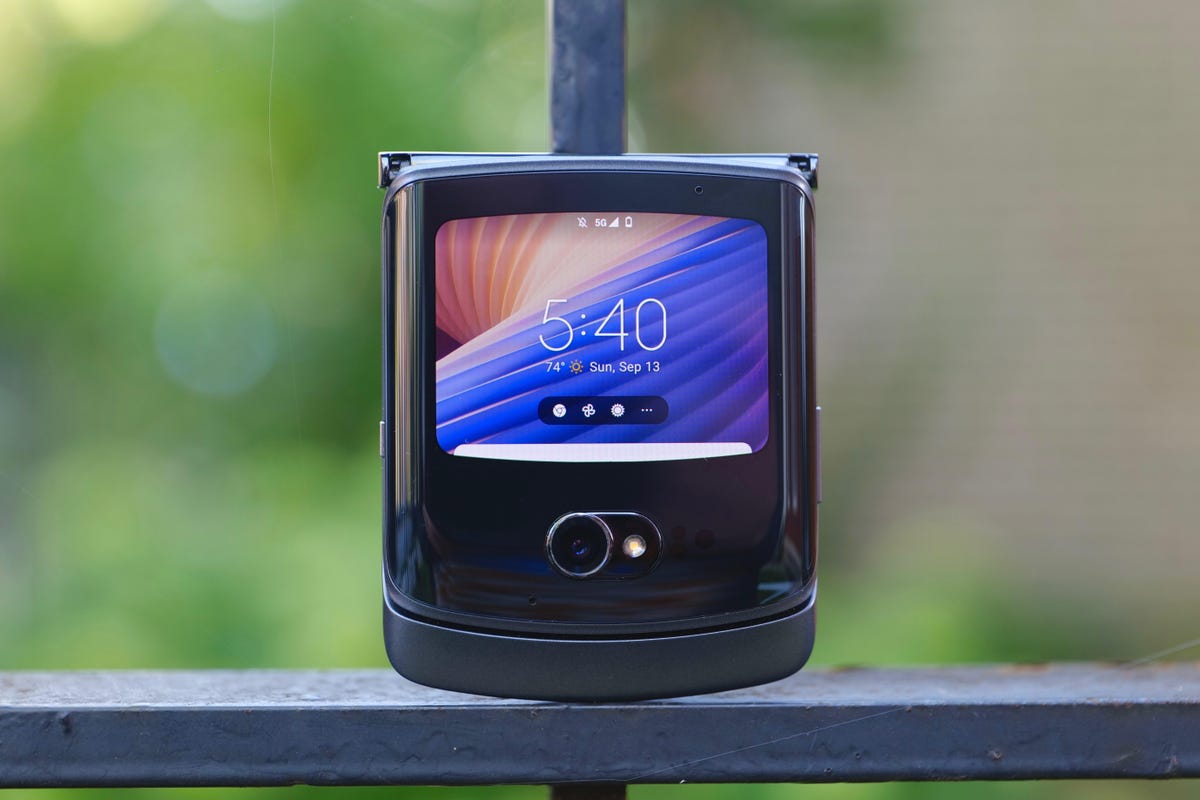
The body of the new Razr is made of aluminum and Gorilla Glass 5.

Patrick Holland/CNET

The new Razr's aluminum and Gorilla Glass 5 body feels solid

During my time with the new Razr, I used it like a regular phone. I didn't feel the need to be careful with it. I wiped the foldable screen on my jeans. I keep the phone in my pocket or in my bag.

Some of that assurance comes from its build. When you close the phone, the sides sit flush, encompassing and protecting the display. But some of that is my perception. I want to be confident that if the Razr is in a pocket with my house keys, that it won't get destroyed. That confidence and trust is huge, and I didn't feel that all-the-time when I reviewed the 2019 Razr. 

The new Razr is built from aluminum and Gorilla Glass 5 and feels solid compared to the prototype feel of the February version. Also that plastic back is gone!

To reinforce the phone's robustness, Motorola invited me to visit one of their testing labs and see one of the 40 different testing machines it uses to test the Razr (wearing a mask and socially distanced, of course). I got to see a machine that folds the Razr in half to simulate years of use in just a matter of days. The idea is most people will never fold this phone enough to hit Motorola's 200,000-fold lifespan.

Read more: Motorola claims the Razr can fold 200,000 times. We get a peek at how the phone is tested

moto-fold-machine-2-2

This is one of four new Motorola Razr phones on a machine that opens and closes it once every four seconds. Over the course of 10 days the phones will be folded 200,000 times.

Patrick Holland/CNET

My time with the Razr has largely been squeak-free… until Friday. I don't know if it's the humidity or what, but there's a little squeak anytime I open or close it. The only time I don't hear it is when I flick the Razr open one-handed. The squeak isn't as loud as the 2019 Razr. But when I hear it, I feel conflicted. I feel disappointed.

I asked a friend how they felt about the squeak and they said it didn't bother them. I guess when it comes to screen notches, foldable screen creases and now foldable phone squeaks, some of you will get used to these things while others will be wildly annoyed. 

I should add that the squeak comes from the hinge mechanism, but doesn't indicate any mechanical problems.

Quick View display separates the Razr from the Galaxy Z Flip 5G

Perhaps my favorite feature is the Quick View display which got a lot more useful with the new Razr. Fundamentally this is where the Razr and the Galaxy Z Flip couldn't be more different. There are basically three modes to the outside display: The first is a Peek Display mode that lets you see notifications just by pressing and holding on an icon. The next is like a Peek Display plus mode where you can press and hold an icon, then swipe up to reveal multiple notifications and respond to them. The keyboard basically takes up the entire screen, but after a few uses I got better at typing on it.

But it's the third mode -- let's call it mini-Android mode -- where the true power of the Quick View display gets unleashed. When the Razr is closed and unlocked, you can swipe down to get to the control panel, swipe up to see something similar to the notification shade, swipe to the left to go to the camera and swipe right to see a grid of apps and swipe to the right again, to see contact favorites.
pubg-1

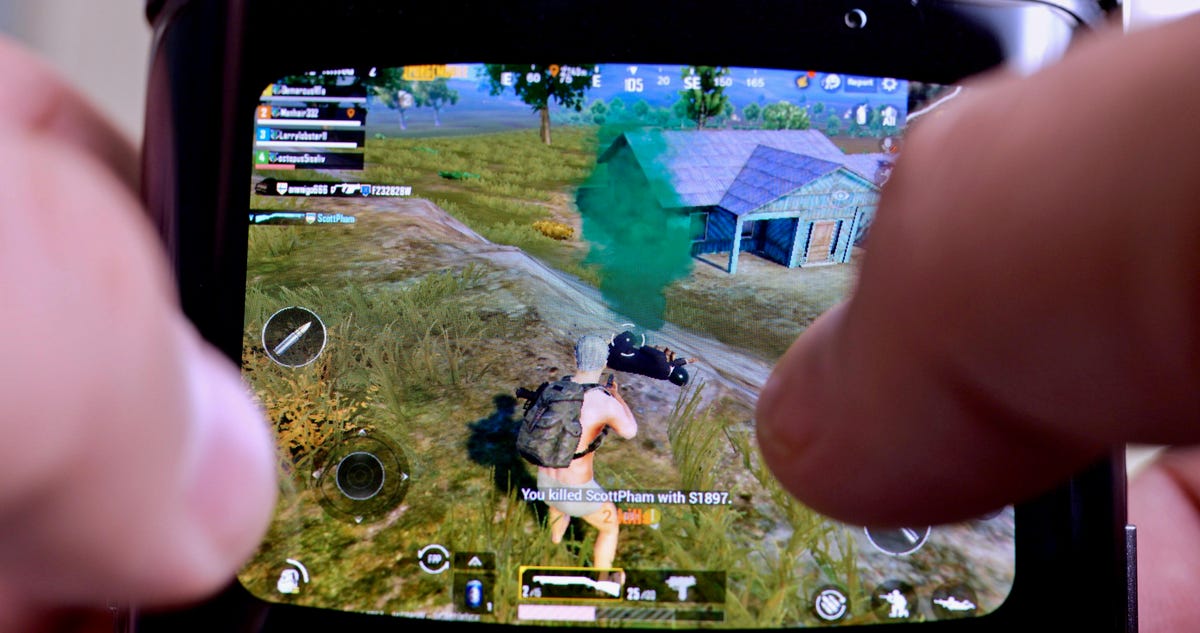
The Quick View display on the Razr is officially the smallest screen I've ever played PUBG Mobile on.

Patrick Holland/CNET

The phone can curate a list of apps that work well on the smaller external screen. Apps like Gmail, YouTube and Messages can be used complete with a mini keyboard. Also, you can go back and forth between the Quick View display and the interior display and pick right up where you were at.

You can also do what I did and go into the Manage apps setting and turn on unlimited which allowed me to try pretty much any app I wanted on the Quick View display. So I decided to try PUBG Mobile. I could barely make out the controls, but it is possible to play PUBG on the Quick View display. I also played Alto's Odyssey and Super Mario Run. Not every app is optimized for that small of a display. But this iteration of the Quick View display marks an enormous step in the right direction for Motorola.

Razr has a new 48-megapixel main camera

Then there are the cameras both of which got a solid upgrade. The selfie camera atop the internal display is much better and works great for Zoom meetings and taking selfies. Though video recording on the selfie camera does top out at 1080p.

The exterior camera has 48-megapixels and uses pixel-binning to create good 12-megapixel photos. This camera is much better than the 2019 Razr. And thanks to the optical image stabilization and a time-of-flight sensor, I got an acceptable rate of in-focus and sharp photos.

img-20200906-184552121-hdr

The HDR mode works rather well without it being too heavy-handed. It kept the faded blue of the pickup just right.

Patrick Holland/CNET

img-20200904-081912617

This was taken with the digital zoom at 2x. It's remarkable the detail it was able to capture. It also shows off the lens' natural bokeh.

Patrick Holland/CNET

img-20200906-184001294-hdr-1

Here's another photo where the Razr went into HDR mode.

Patrick Holland/CNET

img-20200904-080646635-hdr-1

This is a selfie I took with the exterior 48-megapixel camera with the phone closed.

Patrick Holland/CNET

But the Razr's cameras are not on the same level as the iPhone 11 or Google Pixel 4A. Unless Motorola added a Note 20 Ultra-sized camera bump onto the Razr (please don't do that) there is only such room for a sensor and lens inside something this small.

Low-light and zoomed in photos are soft and look like a painting because of noise reduction. There is a Night Vision mode that can help, but I find it works best in medium-to-low lighting versus situations where it's dark.

img-20200906-184947118

Here is a 5x digital zoom of the John Hancock building off in the distance. The details are definitely soft.

Patrick Holland/CNET

img-20200911-201209695-hdr

This photo was taken in the regular photo mode.

Patrick Holland/CNET

img-20200911-201204569

This photo was taken with Night Vision. This is the best Night Vision photo I took with the Razr. That said, the sky looks painted on.

Patrick Holland/CNET

The main camera also shoots 4K video and the quality is decent. Video definitely doesn't have the same dynamic range as photos and suffers from image noise and artifacts. But I'm happy with the clips I was able to record. Check some out video clips I shot below:

OK battery life, sub-6 5G and Snapdragon 765G

Motorola claims a benefit of using the Quick View display more is it doesn't tax battery life as bad as using the main display. And that's good news. In my use, the new Razr gets me barely through a day. I typically find myself topping off at dinner time. And that's while I'm connected to 5G. I'm getting about 7 hours, 30 minutes of screen-on time and in a test with continuous video playback on Airplane mode the Razr lasted 15 hours, 53 minutes, that's 1 hour, 50 minutes more than the 2019 Razr lasted in the same test. And that's 53 minutes more than the Galaxy Z Flip.

The new Razr has a larger battery than the 2019 Razr and some of that is to compensate for use on 5G, which can eat up battery life. The Razr can work on sub-6 flavors of 5G like on AT&T and T-Mobile. I've been testing this Razr on T-Mobile's 5G here in Chicago. Sometimes I get speeds over 100Mbps for downloads (that's outdoors) and other times I get speeds that are 4.55Mbps (that's also outdoors). Both of those results were well within the 5G coverage on T-Mobile's map and speaks more to T-Mobile's 5G network than it does the phone.

Powering all this is 8GB of RAM and a Snapdragon 765G processor. There will be some who will write the new Razr off because it doesn't have a Snapdragon 865 processor. But as we've seen in other Android phones this year, the 765G is a solid processor. In the Razr, it handled gaming, videos, photo edits, multitasking really well. And in benchmark tests, the Razr scored right on par with the LG Velvet.

3DMark Slingshot Unlimited

Motorola Razr (2020)

Motorola Razr (2019)

Samsung Galaxy Z Flip

Note:

Longer bars indicate better performance

Geekbench v.5.0 single-core

Note:

Longer bars indicate better performance

Geekbench v.5.0 multicore

Motorola Razr (2020)

Motorola Razr (2019)

Samsung Galaxy Z Flip

Note:

Longer bars indicate better performance

Even with all these improvements, it's hard to recommend a $1,400 especially one that is still very much a concept waiting to live up to its hype in the real world. The same can be said about the Galaxy Z Flip 5G. That said, I'm excited for Motorola and hope they make as big a step forward with the next Razr as the company did with this one.

Motorola Razr (2020) specs verus Motorola Razr (2019), Samsung Galaxy Z Flip, Samsung Galaxy Z Fold 2


Motorola Razr (2020) Motorola Razr (2019) Samsung Galaxy Z Flip Samsung Galaxy Z Fold 2
Display size, resolution Internal: 6.2-inch, foldable pOLED; 2,142x876p pixels (21:9) / External: 2.7-inch glass OLED, 800x600-pixels (4:3) Internal: 6.2-inch, foldable pOLED; 2,142x876p pixels (21:9) / External: 2.7-inch glass OLED, 800x600-pixels (4:3) Internal: 6.7-inch FHD+ Dynamic AMOLED; 2,636x1,080-pixels / External: 1.1-inch Super AMOLED; 300x112-pixels External 6.2-inch Dynamic AMOLED; Internal: 7.6-inch Dynamic AMOLED; External: 2260 x 816 pixels Internal: 2208 x 1768
Pixel density 373ppi (internal screen) 373ppi (internal screen) 425ppi (internal) / 303ppi (external) 386ppi + 373ppi
Dimensions (Inches) Folded: 2.86x3.61x0.63 in, Unfolded: 2.86x6.66x0.31 in Unfolded: 6.8x2.8x0.28 in / Folded: 3.7x2.8x0.55 in Folded: 2.99x3.44x0.62 ~ 0.68 in / Unfolded: 2.99x6.59x0.27 ~0.28 in Folded: 2.67x6.26x0.6 in (Hinge) ~ 0.54 in(Sagging), Unfolded: 5.04x6.26x0.27 in(Frame) ~ 0.23 in(Screen)
Dimensions (Millimeters) Folded: 72.6x91.7x16mm, Unfolded: 72.6 x 169.2 x 7.9mm Unfolded: 172x7 2x6.9mm / Folded: 94x72x14mm Folded: 73.6x87.4x15.4 ~17.3 mm / Unfolded: 73.6x167.3x6.9 ~ 7.2 mm Folded: 68.0x159.2x16.8mm (Hinge) ~ 13.8mm(Sagging), Unfolded: 128.2x159.2x6.9mm(Frame) ~ 6.0mm(Screen)
Weight (Ounces, Grams) 6.77 oz; 192g 7.2 oz; 205g 6.46 oz; 183g 9.95 oz; 282 grams
Mobile software Android 10 Android 9 Pie Android 10 Android 10
Camera 48-megapixel (exterior) 16-megapixel external (f/1.7, dual pixel AF), 5-megapixel internal 12-megapixel (wide-angle), 12-megapixel (ultra wide-angle) 12-megapixel (main) + 12-megapixel (wide angle) + 12 megapixel (telephoto)
Front-facing camera 20-megapixel (interior) Same as main 16-megapixel external 10-megapixel 10-megapixel, 10-megapixel
Video capture 4K 4K 4K 4K
Processor Qualcomm Snapdragon 765G Qualcomm Snapdragon 710 Qualcomm Snapdragon 855 Plus Snapdragon 865 Plus
Storage 256GB 128GB 256GB 256GB
RAM 8GB 6GB 8GB 12GBRAM
Expandable storage No None None No
Battery 2,800 mAh 2,510 mAh 3,300 mAh 4,500 mAh
Fingerprint sensor Back Below screen Power button Side
Connector USB-C USB-C USB-C USB-C
Headphone jack No No No No
Special features 5G enabled, Foldable display, Dual SIM, Time of flight sensor, OIS exterior camera, splashproof Foldable display, eSIM, Motorola gestures, splashproof Foldable display; wireless PowerShare; wireless charging; fast charging 5G enabled, Foldable display, 120Hz refresh rate, wireless charging support,
Price off-contract (USD) $1,400 $1,499 $1,380 $2,000
Price (GBP) £1,399 £1,000 £1,300 £1,799
Price (AUD) Converts to AU$2,470 AU$1,799 AU$1,999 AU$2,999

Originally published Sept. 14


Source

Tags:


Samsung The Frame on sale: Wall-art TV gets Black Friday pricing of up to $800 off


Samsung The Frame on sale: Wall-art TV gets Black Friday pricing of up to $800 off

Samsung's The Frame looks like no other TV. Its ultrathin screen can double as a place to display digital art and measures just 24.9mm thick, similar to a typical picture frame. By subscribing to Samsung's Art Store for $5 per month, users can gain access to over 1,400 pieces of art to show on the screen. Design-conscious buyers might also enjoy the 6GB of on-board storage, which is enough to hold approximately 1,200 ultra high resolution photos -- and that includes your own pictures, too. 

The TV includes 4K resolution, QLED tech with quantum dots and Samsung's dual LED backlight structure, as well as the company's full smart-TV streaming suite.

samsung-the-frame-2018-on-wall
Samsung

The Frame TV of varying sizes -- from 32 to 75 inches -- has large discounts at Amazon. Few TVs offer the unique elegance of the Frame, and some buyers may value its style over image quality. Even with the sale prices you'll pay a steep premium for The Frame's unique look. 

Read more: Best TV deals for Black Friday 2021 so far

One non-Frame equivalent is the Samsung Q60A series, which has similar picture quality and costs about $300 less at the 55-inch size. Other TVs also cost less and have better image quality. For example, the Vizio M-7 Series Quantum achieves superior picture quality using full-array local dimming -- a feature these Samsung TVs lack -- and costs $430 less than The Frame at 55 inches.


Source

Tags:


Snapchat Spectacles, glasses with a camera, coming this fall


Snapchat Spectacles, glasses with a camera, coming this fall

The camera built into Snapchat's

The camera built into Snapchat's "Spectacles" lets you shoot video that shows the world from your point of view.

Spectacles.com

Like to view the world through Snapchat-colored glasses? You'll soon be able to do that for real.

The millennial-friendly messaging service plus social network plus video hub is set to release "Spectacles," its own smart glasses. The specs shoot first-person video clips, or Snaps, that you can transfer directly to the Snapchat app.

The company, which has also renamed itself Snap Inc. to reflect its expansion into consumer hardware, touted the new product Saturday by way of a fashion-friendly website called, appropriately enough, Spectacles.com. It also posted a statement on the new site Snap.com.

"We've created one of the smallest wireless video cameras in the world," the post says, "capable of taking a day's worth of Snaps on a single charge, and we integrated it seamlessly into a fun pair of sunglasses."

Both sites say the specs will arrive "soon." In an article published late Friday by The Wall Street Journal, Snap Inc. CEO Evan Spiegel said the glasses would be available in the fall.

The move is the latest in the continuous effort by tech companies to see into the future and stake out new territory as they jostle for customers and try to keep each other at bay.

Social-media juggernaut Facebook failed to acquire Snapchat three years ago and has watched as the upstart and its video Snaps (until now shot only with smartphones) have seized the imagination of the younger crowd. That's one of the reasons -- along with live-streaming products like Twitter's Periscope -- behind Facebook's strong move into video with its Facebook Live feature. Among other things, the Spectacles product adds another element to the video equation.

Snapchat's $130 camera-toting glasses will come in three colors: coral, teal and black.

Snapchat's $130 camera-toting glasses will come in three colors: coral, teal and black.

Spectacles.com

The specs can record up to 10 seconds of video from the wearer's perspective. Each tap of a button mounted on the frames records another clip, while a ring of tiny lights lets people know you're recording. The camera-glasses use a 115-degree-angle lens that resembles the human eye's natural field of view, the Journal said.

"Spectacles connect directly to Snapchat via Bluetooth or Wi-Fi and transfer your Memories directly into the app in our brand new circular video format [which] plays full screen on any device, in any orientation," Snap Inc. said on its site.

The glasses, which can be recharged in their case, will come in one size and be available on a limited basis. They'll come in three colors -- black, teal and coral -- and, according to the Journal, will cost $129.99 (roughly £100, AU$170).

"We're going to take a slow approach to rolling them out," Spiegel told the paper. "It's about us figuring out if it fits into people's lives and seeing how they like it."

A video ad on the Spectacles site shows a posse of happy millennials enjoying an endless summer to a Beach Boys-y soundtrack -- all while storing up the good vibes via clips shot with the specs.

"Imagine one of your favorite memories," the Snap.com post reads. "What if you could go back and see that memory the way you experienced it?"

The unveiling of the product confirms speculation that followed the leak of a different ad for the glasses, obtained by Business Insider on Friday from a YouTube tipster. It also follows plenty of scuttlebutt about the project.

In 2014, Snapchat bought Vergence Labs, a startup that makes Google Glass-like eyewear that records video of what the wearer sees. In 2015, Snapchat began building Snapchat Research, a team composed of scientists and software engineers specializing in computer vision and machine learning.

In March, CNET's Sean Hollister reported that Snapchat was recruiting hardware experts for a stealthy new project. The social-media firm has never produced physical gear, unless you count merchandise like beach towels and backpacks. It does, however, already count nearly a dozen wearable-technology vets among its ranks.

In addition, Spiegel had been spotted in public wearing prototypes specs.

On any given day, Snapchat reaches 41 percent of all 18- to 34-year-olds in the United States, according to the company.

That's a lot of young consumers that could sport new specs.

First published, September 23, 5:45 p.m. PT.
Update, 8:15 p.m.: Adds information on Snapchat CEO Evan Spiegel's confirmation of Spectacles.
Update, September 24, 9:22 a.m., 12:38 p.m.: Recasts top of story, with material from Snap.com and Spectacles.com websites.


Source

Tags:


Intel Tries Cashing In on Cryptocurrency Mining Despite Environmental Problems


Intel Tries Cashing In on Cryptocurrency Mining Despite Environmental Problems

Intel later this year will begin selling a chip customized to mine bitcoin and other cryptocurrencies, the company said Friday. Initial customers include payment processor Block (formerly Square) and two mining companies, Argo Blockchain and Griid Infrastructure.

It's a major bet for the company on a technology that could change finance and, with a cryptocurrency-related idea called NFTs, alter how we own digital assets. Cryptocurrencies and NFTs are plagued by fraud and theft problems, but Intel hopes to address another major drawback, their extraordinarily large energy consumption.

With cryptocurrencies, mining is a computationally taxing process that records transactions onto a widely shared database called the blockchain. The first miner to solve a complex computing problem is rewarded with newly minted cryptocurrency. That means there's a strong incentive to have the most powerful machines -- and also the most efficient, since electrical power costs are heavy.

One of Intel's top rivals, graphics-chip maker Nvidia, has profited handsomely from cryptocurrency mining. Indeed, miners' appetite for its graphics processing units (GPUs) has made it hard for gamers to find graphics cards. But major suppliers of cryptocurrency mining hardware, like Goldshell, MicroBT and Bitmain, use processors called application specific integrated circuits (ASICs) customized for mining.

Cryptocurrency mining uses gargantuan quantities of power , with a current estimated rate of 125 terawatt hours per year, according to an estimate by Cambridge University's Bitcoin Electricity Consumption Index. For comparison, that's as much as the 2020 electricity consumption of Norway, a nation with 5.5 million people, according to the Energy Information Administration (EIA).

And that doesn't even include mining other cryptocurrencies like ether and dogecoin.

Intel hopes its chip will help with the energy consumption problem.

"We are mindful that some blockchains require an enormous amount of computing power, which unfortunately translates to an immense amount of energy," said Raja Koduri, the senior vice president in charge of Intel's Accelerated Computing Systems and Graphics Group, in a blog post. "Our customers are asking for scalable and sustainable solutions, which is why we are focusing our efforts on realizing the full potential of blockchain by developing the most energy-efficient computing technologies at scale."

An efficiency boost may help miners cut costs and reduce power consumption that worsens global climate crisis problems and deprives others of affordable power. But don't expect a radical improvement in the environmental impact of mining.

That's because cryptocurrency's prevailing "proof of work" approach means the difficulty of the computing problem miners must solve increases as more computing horsepower arrives to solve it. That's in stark contrast to conventional computing, where power and efficiency gains means computers can deliver better video game graphics, tackle new challenges like artificial intelligence, and expand to new markets like smartwatches.

And ASICs by their nature are designed for a specific purpose, which in the case of cryptocurrency miners means they're useless once they're superseded by new models. Right now bitcoin mining generates electronic waste at a rate of 31,000 tons per year, according to Digiconomist's Bitcoin E-waste Monitor.


Source

Tags:


OnePlus 10 Pro, finally out in China, is a strong contender as a top phone of 2022


OnePlus 10 Pro, finally out in China, is a strong contender as a top phone of 2022

After drip-feeding out details about its new flagship phone over the last week, OnePlus has finally revealed the OnePlus 10 Pro in China.

Even now, there are still a few things left to mystery, such as its launch price when it goes on sale in China on Jan. 13 or when it will be available elsewhere. (OnePlus has only said it will launch globally later in 2022.) But what we do know is that with powerful specs and sharp cameras, the OnePlus 10 Pro could be one of the top phones released in 2022. 

The details OnePlus dropped up until now confirmed that the OnePlus 10 Pro would pack the new Snapdragon 8 Gen 1 chipset and run on the company's OxygenOS 12 (based on Android 12), which folds in "feature-rich" parts of Oppo's ColorOS for the first time. 

That's still true and we now know the phone will pack the Snapdragon X65 modem, which supports more 5G networks, frequencies and bandwidths along with increasing the maximum download speeds to 10Gbps. While you probably won't hit that cap with today's carriers, the new X65 should provide faster and more consistent 5G speeds. The OnePlus 10 Pro also will have up to 12GB of LPDDR5 RAM and up to 256GB of UFS 3.1 storage, which are the same specs as last year's OnePlus 9 Pro.

The 6.7-inch OLED display is the same size as its predecessor's. It has a maximum 120Hz refresh rate that makes browsing the internet or gaming very smooth, though it adaptively cranks the rate down to even 1Hz (or one frame per second) during low-demand tasks to save battery life. The phone comes in two colors: a seafoam Forest Green and matte Volcanic Black.

OnePlus has confirmed that its new phone will inherit last year's rear camera setup, too: a 48-megapixel main camera, an 8-megapixel telephoto camera and a 50-megapixel ultrawide camera with a maximum 150-degree field of view. The 10 Pro will get an improved 32-megapixel camera, which should take sharper photos than the 16-megapixel selfie camera on its predecessor.

As the second generation of OnePlus phones to have Hasselblad-tuned cameras, the OnePlus 10 Pro's photo capabilities have been refined in a handful of ways. First is an improved Pro Mode that takes photos in 12-bit RAW Plus, a new format that combines the rich data capture of RAW with on-device image processing to give shots more accurate colors. When taking more casual photos, all three rear cameras have 10-bit color for over 1 billion possible hues.

Hasselblad's influence can also be seen in Master Mode, which offers three filters tuned by professional photographers and artists that making shooting fashion, wildlife and urban spaces look more stylized and unique. For video, the new Movie Mode lets you tweak settings like ISO, shutter speed and white balance even while recording for tight control on focus and lighting.

The 10 Pro's 5,000mAh battery is the biggest on a flagship OnePlus phone yet, but it's the 80-watt wired charging that will make it stand out from the competition. The company claims it will bring the phone from 1% up to full charge in a very specific 32 minutes. The phone also supports up to 50-watt wireless charging, which will recharge a similarly nearly dead phone in 47 minutes, OnePlus estimates.

On paper, the OnePlus 10 Pro seems like it will be a strong contender among the best phones in 2022, though we'll have to wait until we can test it at an undetermined later date for an as-yet-unannounced price.


Source

Tags:


The Best Printers, According to the CNET Staff Who Use Them


The Best Printers, According to the CNET Staff Who Use Them

Despite the modern reliance on the cloud, many of us still need to make physical copies of our paperwork. Important documents need copies, physical pictures need to be scanned and labels need to be created. The only way to do those things is to have a printer you have easy access to.

While CNET Labs test a whole new range of printers, we've put together a list of printers the CNET staff use at home and at the office and the reasons why they chose that particular model. These have not been formally tested to destruction, but are used in the way most people do.

Epson

A printer is one of those things that I don't use often, and when I do need to use it, I hope that it works. I've gone through several printers in recent years, because every time I want to use it the ink is dried out or something else needs to be fixed. I was looking for a low-maintenance option that had affordable ink replacements, and that's where I came across this Epson model.

It's an all-in-one unit, so I can still scan documents to my PC when needed, but the best part is that I've yet to find the ink dried up when I wanted to use it. It also prints reliably for small and medium jobs. The ink isn't expensive, and you can buy an XL version of the cartridge which offers 2.5x the capacity for a little extra money. Overall, it's a great printer if you don't need to print tons of pages in a short period of time (because it's a little slow) but still want something that won't make you go broke when you need new color or black ink.

-- Jared DiPane

Epson

The big selling point of the EcoTank line is that it does away with cartridges. Even if you only print a couple of times a week, it's worth the extra cost. My family prints more than that and we're still on the original ink refills that came with the printer after years of use. The 3750 model was replaced by the 3850 in September 2021 but they're essentially the same printer. 

Because it's a lower-end model in the line, the printer isn't a speed demon with color prints and its tray holds only 250 sheets. It doesn't have a touchscreen, just a small display and navigation buttons that aren't backlit. But it has all the other features I'd expect from a compact all-in-one for a small office or home office: You get wired and wireless connections with mobile printing, an auto-document feeder and automatic two-sided printing. Print quality is respectable, too. It excels on black-and-white documents but it's OK for photos as well. 

-- Josh Goldman

Brother

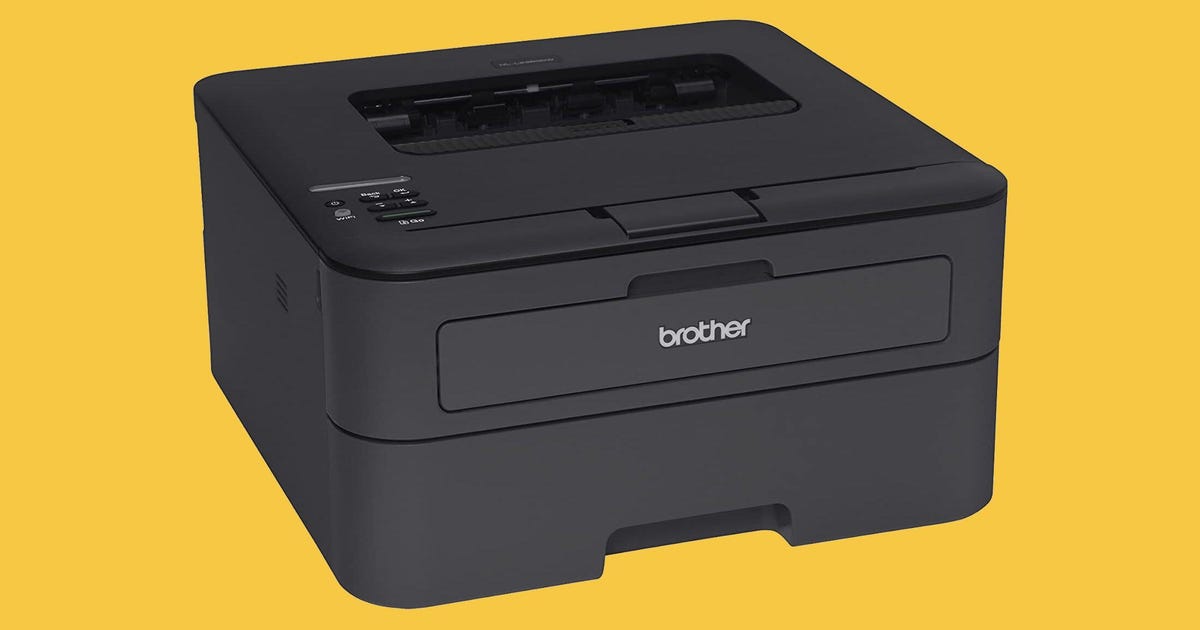
I've had this printer for at least five years and it's been solid. Unlike some other printers I've had, it rarely gets disconnected from the Wi-Fi network so my whole family can easily print stuff from their various computers and phones without me having to troubleshoot the connection. Printing is fast and since its laser ink isn't expensive per sheet. I'm fine with black and white and the few times I need color I'll print at the local drugstore.

The one downside is that double-sided printing always jams the feed so I have to take it apart, pull out the paper and restart the job. Sometimes the software seems to select double-sided on its own and I discover the hard way, but once I change back to single-sided (which is what we use most of the time) it's all good. 

-- David Katzmaier

HP

My wife loves to make stickers using our HP Envy and the Cricut Explore 3. The Envy has excellent color saturation, especially on the glossy sticker paper she uses. It also has the added bonus of being a scanner, which is especially helpful to scan all our mortgage documents while we move house.

The biggest selling point though is the two-year supply of new inks. Running out of ink is the worst part of using a printer at home, but HP's replacement service takes away that hassle. It's worth the money just for that.

-- James Bricknell

Brother

I have to make an absurd amount of labels for our son's Tupperware, school items, folders, cooking products, and so on. This makes it so easy. There are different fonts, sizes and styles to choose from. 

The keyboard is dreamy and a far cry from the old-school turnstile. I also love the built-in cutting function. Gone are the days of needing scissors when you're done. 

-- Danielle Ramirez

HP

Full disclosure: I was the guy who proudly kept his home printer-free while using the office printer for those once- or twice-a-month necessities. Then came the pandemic, and I found myself in need of shipping labels and other documents at home. This tiny HP LaserJet fits perfectly on the bookshelf in my equally tiny Brooklyn apartment, and it reliably prints from PCs, Macs, Chromebooks and smartphones, all over Wi-Fi.

The 2022 model (M110w) is nearly identical to my 2020-era unit (M15w), but take note: The "cheaper" M110we seems to require a subscription to HP's cloud-ink solution, so go with the pricier model if you want to avoid an always-on connection. Also, this laser printer is black-and-white only, but that's a feature for me, not a bug.

-- John P. Falcone 

Other articles from the CNET team


Source

Tags:

Search This Blog

Menu Halaman Statis

close