DJI Phantom 3

If You Only Have a Few PTO Days Left, Here's When to Use Them


If You Only Have a Few PTO Days Left, Here's When to Use Them

It's late December. You're marathon-watching holiday movies (or that buzzy Netflix show you've had on the back burner); munching on cookie after sprinkle-covered cookie; enjoying quality time with your grandma or your favorite cousin. And it's all stress free, because you've secured 10 peaceful, uninterrupted days away from work. 

That seems to be the idea behind a TikTok that popped up on my For You page last week, recommending a way to spend your paid time off for an extended break at the end of this year. A user named Chelsea brings attention to how Christmas Day 2022 and New Year's Day 2023 fall on a Sunday, and the federal holidays will be observed on the following Mondays.

"If you take off [Dec.] 27, 28, 29, 30, that's four days of PTO, but you will end up with a 10-day holiday from the 24th to [Jan.] 2," user @chelseazeferina, who's 32 and works in marketing, said in the video. "You're welcome."

On federal holidays like Memorial Day, Independence Day, Christmas and New Years Day, non-essential US government employees are given the day off and most government offices are closed, according to FederalPay.org, a non-governmental portal built by federal employees. Employees regularly scheduled to work on a federal holiday get paid time off.

While private companies and US states aren't required to observe federal holidays, many private businesses, as well as most state and local governments, close their doors on these days, according to the portal. In data collected by the National Compensation Survey in 2018, 97% of private industry workers received Christmas Day as a paid holiday, while 90% got New Year's Day off.

A 10-day break sounds like something worth considering. I sure could use a stretch of time to finally binge all five seasons of Breaking Bad (and forge some lasting memories with friends and family, of course). But when I ventured to the comments on the TikTok video, I found many countering the idea that Dec. 27-30 is the perfect time to take off and asserting that PTO would be better spent elsewhere.

"Never take that week off," one user wrote. "Slowest time ever."

"Oh god no," wrote another. "It's relaxing without dealing with everyone in the office. Perfect time to organize, clear out emails, files, etc." 

Of course, how you choose to use your hard-earned PTO is up to you. The TikTok user replied to a comment, sharing her intentions with the post: "The reason why I posted is [because] I was trying to figure out how to maximize time spent [with] family around the holidays and realized how much time I could get with only taking four days off."


Source

Tags:


Are You Using Netflix's Secret Menu? Here's Where to Find It


Are You Using Netflix's Secret Menu? Here's Where to Find It

If you find yourself spending more time scrolling through Netflix than watching movies and TV, there's a better way. You don't have to be stuck at the mercy of the algorithm or the newish two-thumbs-up like option. If you're sick of seeing the same list of TV shows and movies you may like based on your profile and what you've watched before, you know it's not the best way to find something new to watch quickly, or any other niche genres you might be interested in.

CNET Tech Tips logo

But there's a secret trick for filtering Netflix's library by genre to find exactly what you're browsing for: Netflix codes. These codes each correspond to a different genre, which the algorithm uses to categorize and serve up recommendations. Instead of passively accepting the algorithm's picks, learn how to use Netflix codes to find your own next binge-watch.

Read more: How to Turn Off Netflix's Pesky Autoplay Trailers

What are Netflix codes?

Netflix codes, though not a new discovery, are based on a number system the service uses to categorize films and shows by genre and subgenre. Netflix said in August that it has about 30,000 codes. Note that codes can only be used on Netflix's website and not in its apps. 

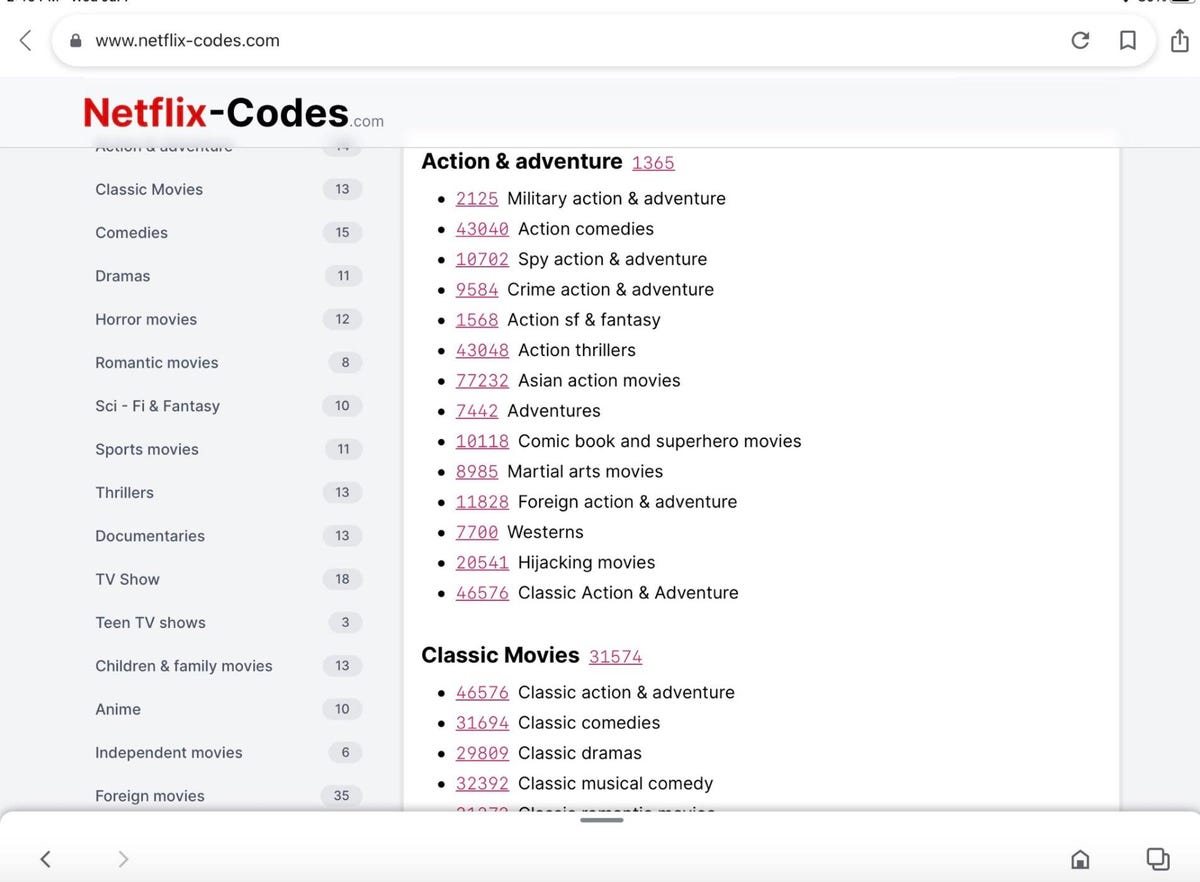
netflix-codes-1

This is what you'll see when you visit the Netflix codes website. 

Screenshot by Shelby Brown/CNET

Where to find Netflix codes

Check out netflix-codes.com for a full list. There are about 20 categories like anime, foreign movies and classic movies. Those categories are broken down into more specific subgenres. For example, horror movies -- coded 8711 -- houses 12 more codes like deep-sea horror movies, zombie horror movies, teen screams and more.

How to use Netflix codes

The easiest way is by installing the Better Browse for Netflix extension for Chrome. Here's how:

1. Go to the Chrome Web Store and search "Better Browse for Netflix."
2. Click Add to Chrome.
3. Click Add Extension
4. Log into your Netflix account in a new tab.

At the top of the Netflix home screen, you should see a new option -- Browse All -- next to My List. Click that to search manually or scroll through the subgenres available. 

netflix-codes-2

Use the code 5475 and you'll unlock a trove of romantic comedies on Netflix. 

Screenshot by Shelby Brown/CNET

Another way is through the Netflix codes website. Here's how:

1. Visit netflix-codes.com in your PC or mobile browser. 
2. Find the genre or subgenre you want to explore. 
3. Tap the code next to the genre or subgenre you want.
4. If you're on a device that has the Netflix app installed, the app should open and take you directly to the genre or subgenre you chose. If you don't have the app installed, it'll open Netflix through the browser and you can view the specific movies and shows available. 
5. Tap the title you want to watch. 

You can also use the Netflix codes manually in your browser. Here's how: 

1. Visit netflix-codes.com in your PC or mobile browser. 
2. Find the genre or subgenre you want to explore. 
3. In another tab, type in , but replace INSERTNUMBER with the specific genre or subgenre code.
4. You'll be taken to Netflix to peruse the titles available in that section. 

From there, you can either make a mental note of the movie you want to watch and go back to the app on your preferred device, or log in to watch in your browser.


Source

Tags:


Samsung's eco-friendly CES 2022 pledge: TVs, appliances will pack recycled materials by 2025


Samsung's eco-friendly CES 2022 pledge: TVs, appliances will pack recycled materials by 2025

This story is part of CES, where CNET covers the latest news on the most incredible tech coming soon.

During CES 2022, Samsung is extending sustainability measures pioneered in its mobile and audio divisions to its appliances and TVs to make its products even more eco-friendly.

This includes expanding recycled plastics in products and packaging as well as teaming up with companies like Patagonia to reduce the impact of microplastics in the oceans and environment. It continues Samsung's broader efforts to make its devices and appliances more sustainable through conventional and sometimes experimental endeavors, from solar-powered TV remotes to a blockchain reforestation project also announced during CES 2022.

"Every year, Samsung sells half a billion devices," said JH Han, head of Samsung Electronics. He added that that size carries responsibility that any changes his company makes can cause ripples across the industry. "Millions of everyday changes can make a meaningful impact for our planet."

Samsung's sustainability pledges come at a time when climate change has become a key issue across many industries including politics, business and finance. Car companies have rapidly pledged moves to electric vehicles. Meanwhile, the tech industry has begun taking on e-waste, which is exacerbated by the constant upgrades of features and capabilities in its products.

Read more: Samsung's $899 portable projector turns any surface into a smart TV at CES 2022

To offset those impacts, companies like Microsoft, Google and Meta (née Facebook) have pledged to reduce, offset or even reverse carbon usage in their worldwide offices and data centers. Apple additionally has built recycling robots, designed to rescue and reuse parts from unfixable devices, rather than sending them to the landfill. It's also touted features like recycled materials for its MacBooks, iMacs and iPhones, while pushing its suppliers to adopt green technology as well.

For Samsung, these efforts are showing up in the products you buy as it increases the amount of recycled plastic in home appliances, as well as developing new product parts, like components for washing machine tubs recycled from lunchboxes and face mask straps. Additionally, Samsung said it plans for TVs and visual displays to contain 30 times more recycled plastics than those produced last year.

Read more: CES 2022: Samsung's Odyssey Ark looks too graceful for gaming

Samsung vacuums and air purifiers will soon arrive tucked in eco-packaging, or materials that had been previously used, which the company started doing with its phones and audio products. Samsung's even exploring ways to turn that packaging into tables or cat houses. Samsung also said at CES that it wants to push its TVs and phone chargers to operate at near zero power draw while on standby, so that they consume "almost no energy" when not being used.

To help guide the company on its eco-friendly path, Samsung is teaming up with outdoor outfitter Patagonia to refine production and reduce the impact of microplastics on the environment. Other partnerships will expand Samsung's SmartThings Energy to help consumers manage the energy use of their networked devices, and even switch to more cost-efficient energy providers. Ultimately, Samsung said it hopes to eliminate single-use plastic from its smartphone packaging by 2025. It also hopes by that time to get reused materials in all home appliances and mobile products as well. 

"We must build together for tomorrow," Samsung's Han said. "This is a future we must build together."


Source

Tags:


India's Ratan Tata takes slice of phone maker Xiaomi


India's Ratan Tata takes slice of phone maker Xiaomi

163137581.jpg
Xiaomi CEO says the investment from Ratan Tata (above) "is an affirmation of the strategy we have undertaken in India so far." Harold Cunningham/Getty Images

One of the most prominent businesspeople in India now owns a small stake in one of the hottest smartphone makers in the world.

Ratan Tata, chairman emeritus of Tata Sons, the holding company for India-based conglomerate Tata Group, has made an investment in Xiaomi, the China-based handset maker announced Monday. Terms of the deal were not disclosed, but Xiaomi closed a $1.1 billion funding round in December at a $45 billion valuation. Given the valuation, it's unlikely that Tata's investment was sizable enough to give him a large equity stake in the company.

"Xiaomi is one of the fastest-growing companies in the world," Ratan Tata said in a statement. "It has brought its innovative business model and high-quality products to India with huge success."

His investment could be more important from a public relations perspective than from a cash perspective. Indeed, Xiaomi founder and CEO Lei Jun eschewed all mention of what the company would do with the cash, saying instead that Tata's investment "is an affirmation of the strategy we have undertaken in India so far."

Last week, Xiaomi unveiled a flagship smartphone for India, called the Mi 4i. The device, which comes with a 5-inch screen and octa-core processor, is widely viewed as a key first step in Xiaomi's self-professed plan to become the most dominant smartphone maker in the emerging India market. At the end of the fourth quarter, Xiaomi was ranked the fifth-largest smartphone maker in India. Samsung was tops.

The Tata name carries significant weight in India, and having Ratan Tata on Xiaomi's side could help the company and its smartphone gain more traction in the country.

Tata Group, which had $103.3 billion in revenue last year, is a massive conglomerate. The company, which has over 581,000 employees, competes in a range of industries, including communications, technology, engineering, steel and chemicals. It's one of the most well-known companies in India and a prominent player in several industries globally.

India is a crucial country for nearly all handset makers. It has a fast-growing middle class and is adopting technology at a rapid rate. With the potential to target hundreds of millions of people, India represents a massive opportunity for all companies, including those like Xiaomi that have been successful in emerging markets where there is an appetite for higher-end devices priced at a level that budget-conscious shoppers would find appealing.

Even before the Tata announcement was made, Xiaomi attracted customers to its Mi 4i. Xiaomi said in a statement Monday that over 225,000 India customers have registered to buy the Mi 4i. The device launched last week, but due to excessive demand for its products, Xiaomi often uses a registration model to provide customers products on a first-come, first-serve basis.

Whatever the company is doing, it's working. Xiaomi said in January that its pre-tax sales in 2014 topped 74.3 billion yuan ($12.1 billion), up 135 percent from 2013. Xiaomi sold 61 million handsets in 2014, an increase of 227 percent compared to the prior year. Xiaomi is now the third-largest smartphone maker in the world behind Apple and Samsung, despite only selling to a relatively small number of markets, including China, Indonesia and India.


Source

Tags:


Acer Next May 2022: 3D Screens, Predator Gaming Laptops and More


Acer Next May 2022: 3D Screens, Predator Gaming Laptops and More

Acer Next, the company's May announcement event, dropped a multitude of products on us -- mostly a raft of refreshes. We saw updates to existing models including the Spin 5, Swift 3 and Predator gaming laptops with current-generation processors and some design tweaks. One move in particular stands out, though: Acer's expanding its SpatialLabs technology to bring glasses-free stereoscopic 3D to games. It'll do this with a 15-inch 4K display, which will be offered as a standalone monitor and built in to one of its Predator Helios 300 gaming laptops.

SpatialLabs launched at last year's May Acer Next in conjunction with new hardware in Acer's Concept D line of creator-focused gear and an Unreal Engine developer program. Hence, new games supporting the technology. "Support" means the developer has created a profile for the game, which loads when you launch it via the new TrueGame application, along with the ancillary files necessary to render properly to the display. An ancillary app, SpatialLabs Go, will allow the computer to render stereoscopic 3D from most content that can be displayed full screen. The content is rendered to deliver the impression that nearer parts of the scene appear in front of the display (rather than rendering as if further objects were behind it, as the illustration above implies).

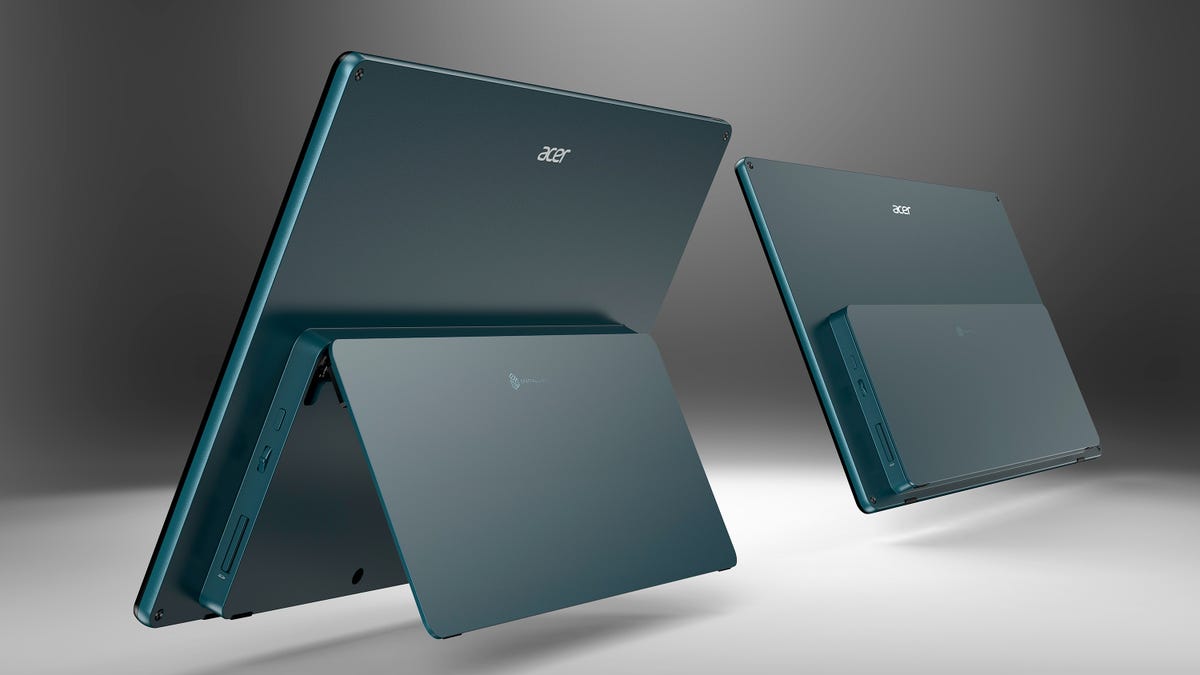
A rear view of Acer SpatialLabs View 3D monitor, showing the kickstand and rectangular bump with the ports and battery

Rear view of the SpatialLabs View portable monitor.

Acer

Acer says more than 50 games will support the display, dubbed Acer SpatialLabs View, when it becomes available this summer starting at $1,099. New games will be added to the roster on a regular basis. It doesn't sound like a display you'd want for fast-moving games, given its 60Hz refresh rate and response time of up to a whopping 30ms. (For comparison, a decent response time for a gaming monitor is closer to 5ms or less.) There will also be a commercially oriented version of the monitor, the SpatialLabs View Pro, intended for kiosks and other sales and marketing uses. 

Acer Predator Helios 300 SpatialLabs Edition with game character and motorcycle on the screen

The Predator Helios 300 SpatialLabs Edition.

Acer

The monitor can run off battery, though for how long we don't know. The battery does explain why it's relatively heavy -- at roughly 3.3 pounds (1.5 kilograms), it weighs as much as a laptop. Other specs include a maximum brightness of 400 nits, typically 323 nits, and 100% coverage of the Adobe RGB gamut.

You'll find the screen in the Predator Helios 300 SpatialLabs Edition, which also gets a bump up to a maximum of an Intel Core i9-12900H CPU, 32GB DDR5-4800 and PCIe 4 SSD. It's slated to ship in October starting at $3,400.

Acer has also added a 16-inch model to its Predator Triton 300 SE line, and brings the thin-ish 14-inch model up to date with 12th-gen Intel Core processors, LPDDR5-5200 RAM, PCIe 4 SSD and new display choices, including OLED. The smaller model ships in July starting at $1,600, and the 16-inch model will be available in August, starting at $1,750. 

The company has also revved its gaming monitors, bringing the 27-inch XB273 up to 4K at 160Hz with DisplayHDR 600 certification and the Nitro XV272 up to 1440p 144Hz (overclocked to 170Hz on DisplayPort) with a peak brightness of 400 nits. Both are expected to ship between July and September, with the Predator starting at $999 and the Nitro at $449.

Acer Aspire Vero 2022, in blue and silver, showing front and back

Acer Aspire Vero 14-inch model.

Acer

Aspire Vero

Acer's eco-friendly product line gets some new members, adding a 14-inch laptop with a Full HD screen and a new blue choice to the existing Aspire Vero 15-inch option, bumping both to 12th-gen Intel Core processors. A 24-inch Vero Veriton All-in-One desktop, 24- and 27-inch monitors (the larger model has a KVM switch and supports power delivery), keyboard and projector join the the lineup, expanding Acer's use of post-consumer recycled plastic to a wider variety of products.

Acer Veriton Vero all-in-one desktop with popup webcam plus wireless keyboard and mouse

Acer Veriton all-in-one with matching accessories.

Acer

The Veriton desktop incorporates 30% PCR materials, and some components are upgradable. It has a popup webcam, up to 12th-gen Core i9 and GeForce MX550 processors, supports up to 64GB DDR4 memory and takes advantage of some of the Intel chipset updates, such as Wi-Fi 6E.

For low-end projecting, the Vero PD2325W offers a low 1,280x800-pixel resolution and low light output of 2,200 lumens. It does have auto keystone correction (to fix vertical distortion) and can be mounted to the ceiling.

  • Acer Aspire Vero 14-inch (AV14-51) laptop ships in September starting at $750
  • Acer Aspire Vero 15-inch (AV15-52) laptop ships in September starting at $750
  • Acer Veriton Vero (VVZ4694G) AIO desktop ships in October starting at $799
  • Acer Vero monitors ship in Q3 2022. The CB273 27-inch starts at $350; the 24-inch B247Y G starts at $200.
  • Acer Vero PD2325W projector ships in Q3 2022 starting at $559
  • Acer Vero keyboard and mouse set ships in November starting at $80; the mouse alone will cost $30.

Spin and Swift and more

A new version of the Swift 3 has a 2,880x1,800-pixel OLED display (DisplayHDR True Black 500 certified) and upgrades to an H-series 12th-gen Core i7 processor -- that's the higher power CPU line -- and upgrades to LPDDR5 memory and PCIe 4 SSD.

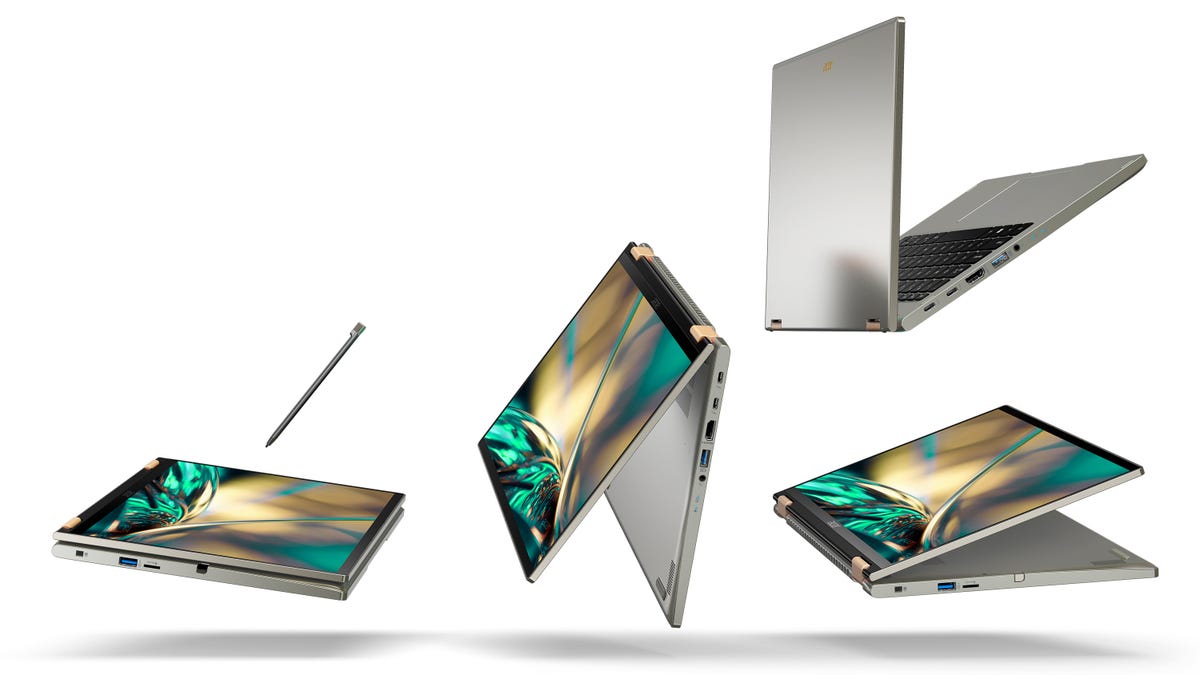
Acer Spin 5 convertible laptop shown in various positions, including tablet, kiosk, tent and clamshell

The Spin 5 has a higher-resolution display with thinner bezels.

Acer

In addition to a slight redesign that has much more attractive, thinner bezels on the screen, the 14-inch Spin 5's display gets a minor boost in resolution to 2,560x1,600 pixels. It also works with the upgraded Acer Active Stylus (Wacom AES 2.0), and gets bumped to the latest generation of core processors, LPDDR5 memory, PCIe 4 SSD, Wi-Fi 6E and more. The Spin 3's bezels have also gotten a bit narrower and now uses 12th-gen Intel CPUs as well.

  • Acer Swift 3 OLED laptop (SF314-71) ships in July starting at $900 
  • Acer Spin 5 convertible laptop (SP514-51N) ships in July starting at $1,350
  • Spin 3 convertible laptop (SP314-55/N) ships in August starting at $850
Acer ConceptD 100 tower desktop with matching monitor, keyboard and mouse
Acer

Acer also updated the $750 Chromebook Spin 714's screen and components to keep it fresh and competitive, and launched a rugged tablet, the $400 Chromebook Tab 510. The 10.1-inch tablet is built on Qualcomm's Snapdragon 7c Gen 2 Compute Platform, with a 1,920x1,00-pixel screen, 5- and 8-megapixel MIPI cameras (front and rear) and includes a dockable stylus. Acer claims an 11-hour battery life and says it meets MIL-STD 810H standards for durability. The Chromebook Spin 714 ships in August while the Tab will be available in July.

The company's lightweight business laptops, the TravelMate P4 and TravelMate Spin P4 and the more workhorse P2, jump to the vPro versions of its 12th-gen CPUs as well as AMD's Ryzen Pro (up to Ryzen 7) equivalents; you'll have both 14- and 16-inch options for the P4. The P4 and P2 also incorporate more PCR plastic into their construction.

They'll all become available in the third quarter of 2022. The P4 models start at $1,099, the Spin P4s at $1,199, and the Spin P2 at $899.

And finally, Acer boosted its Concept D 5 and 5 Pro laptops and Concept D 500 and 100 desktops with the latest generation Intel Core CPUs and Nvidia RTX GPUs. The compact, entry-level Concept D 100 still uses last-gen T series GPUs, however, and neither has been bumped to DDR5. And it looks like only the D 5 will be available in the US, at least for now; it ships in August starting at $2,500.


Source

Tags:


Coinbase Launches NFT Marketplace in Beta


Coinbase Launches NFT Marketplace in Beta

Coinbase has its NFT marketplace up and running in beta mode, the company shared in a blog post Wednesday. Last fall, the cryptocurrency exchange platform announced its entry into the NFT market and its intention to create a peer-to-peer interface for artists and buyers. When it launches in full, users will be able to buy or sell nonfungible tokens with cryptocurrency and other forms of payment.

Built on the Ethereum blockchain, the beta version of the marketplace features digital works that you can browse from artists such as Cool Cats, Doodles and Azuki. Coinbase is currently selecting beta testers from its waitlist and will not charge transaction fees for purchases. Testers are able to set up profiles and buy or sell NFTs with their crypto wallets. They can also use social tools to converse with fellow users and build communities on the platform.

Despite some high-profile losses in the NFT market, over $2.4 billion-worth of the tokens were traded on NFT exchange OpenSea in March, up from $96 million in April last year.

According to Coinbase, the marketplace will support Ethereum-based standards ERC-721 and ERC-1155. Though the service isn't available to the general public yet, everyone is invited to check out the first version of the site at nft.coinbase.com.

Fees will eventually be added to the beta version as well as other features that make it easier to get in on the action. Coinbase hasn't provided a timeline for when the marketplace will be open to all. 

However, the company said in the coming months, it's "planning to add drops, minting, token-gated communities, and the option to buy NFTs with your Coinbase account or a credit card." Additionally, more chains will be gradually added to the platform. Coinbase is welcoming feedback during this process and encourages people to reach out on Twitter.

Read moreWould You Spend $10K on NFT Stick Figures? Lots of People Have

The editorial content on this page is based solely on objective, independent assessments by our writers and is not influenced by advertising or partnerships. It has not been provided or commissioned by any third party. However, we may receive compensation when you click on links to products or services offered by our partners.


Source

Tags:


Best Laptop for 2022: The 15 Laptops We Recommend


Best Laptop for 2022: The 15 Laptops We Recommend

Choosing a new laptop, whether it's for work, home or going back to school, isn't an easy decision, but CNET's list of the best laptops for 2022 is a great place to start with our top picks across brands, operating systems, budgets and categories. Many of the models from 2021 have been updated for 2022 with the latest chips from Intel and AMD, and Apple's new M2 chips, too.   

Our top laptop choice for most people is the updated Apple MacBook Air M2. It offers a great combination of everything we look for when we're testing: reliable everyday performance, long battery life and a design that works for a broad range of users. The latest MacBook Air starts at $1,199, which is why we still recommend the 2020 MacBook Air M1 as a lower-cost alternative to the newest Air model, as it's still an all-around excellent laptop. For those looking for a more value-oriented option, Acer's Swift 3 is our current recommendation. Well-configured older versions are available for under $550, while new models start under $800, and fully loaded with an OLED display it's right around $1,200.

At CNET, our laptop experts have collective decades of experience testing and reviewing laptops, covering everything from performance to price to battery life. This hand-curated list covers the best laptops across various sizes, styles and costs, including laptop computers running on Windows, MacOS and Chrome.

If you want more laptop brands and options for a particular category, we also have specialized lists you can look at, including the best gaming laptopsbest 15-inch laptops, best two-in-ones and best Chromebooks, as well as the best laptops for college students, designers and the best MacBook Pro alternatives. If you need to stay as low as possible on the price of a new laptop computer, check out our best budget laptop and best budget gaming laptop picks.

This best laptop list is updated periodically with new models we've tested and reviewed. If you need advice on whether a particular type of laptop or two-in-one is right for you, jump to our laptop FAQ at the bottom of the list.

James Martin/CNET

Thanks to a new design, a larger display (13.6 inches versus the previous 13.3 inches), a faster M2 chip and a long-awaited upgrade to a higher-res webcam, the 2022 version of the MacBook Air remains our top choice for the most universally useful laptop in Apple's lineup, with one caveat. At $1,199, the $200 increase over the traditional $999 MacBook Air starting price is a disappointment. That's why you'll still find the M1 version of the Air retains a spot on our best laptop list. Still, we like everything else about it and is our first choice if you're considering an Air and don't mind spending more.

Read our Apple MacBook Air M2 review.

Josh Goldman/CNET

Available with either AMD Ryzen or Intel Core processors, this 14-inch laptop gives you more screen to work on than 13-inch laptops, but is still incredibly lightweight -- less than 3 pounds. The bigger display is nice, too, covering 100% sRGB color gamut (better than you typically find at its starting price under $700). It also has a backlit keyboard, a fingerprint reader and USB Type-C and HDMI ports, too. The 2022 version of the Swift 3 falls just under $1,000 with 12th-gen Intel Core i-series CPUs. But the 2021 models are still widely available for less than $600. 

Sarah Tew/CNET

The Dell XPS 13 is a perennial favorite for its size, weight and performance and just overall good looks. In 2020, Dell made the laptop even smaller, while making the laptop screen larger and increasing performance for both CPU and graphics-intensive tasks. For 2022, it made the XPS 13 even smaller and lighter, kept its sub-$999 starting price the same and dropped in the latest 12th-gen Intel processors.

While we haven't had a chance to test the new model yet, we expect it to be a strong Windows alternative to the MacBook Air. Also, if you want to save money, the 2021 XPS 13 with 11th-gen Intel chips is available for less now.

This thin, 3-pound convertible is a solid choice for anyone who needs a laptop for office or schoolwork. The all-metal chassis gives it a premium look and feel, and it has a comfortable keyboard and a responsive, smooth precision touchpad. Though it's light on extra features compared to its premium linemate, the Yoga 9i, it does have one of Lenovo's sliding shutters for its webcam that gives you privacy when you want it. And it has a long battery life to boot at 12 hours, 45 minutes in our tests. The latest version with 12th-gen Intel processors starts at $999 (although you can find it on sale for less). The 2021 models are still available, too, at reduced prices.  

Josh Goldman/CNET

Acer's Spin 513 is an update of sorts to one of the best Chromebooks from 2021, the Spin 713. It's a two-in-one convertible Chromebook with a 13.5-inch display that has a 3:2 aspect ratio. The extra vertical space means less scrolling when you're working. The screen size is also close to that of letter-size paper, making it comfortable for notetaking in tablet mode with a USI pen. Compared to the 713, it drops a couple of noncritical features like an HDMI output in favor of a more affordable price. It has amazing battery life, though, and a sturdy fanless design, making it silent -- perfect for quiet classrooms, meetings, lectures or video calls.

Joshua Goldman/CNET

Lenovo launched the Yoga line 10 years ago with Windows 8 and now, with Windows 11, the flexibility of the design has only gotten better. The company's flagship 14-inch Yoga 9i Gen 7 has an updated look with comfortable, rounded edges and 12th-gen Intel processors that give it a big multicore performance jump. A beautiful OLED display and improved audio make it excellent for work, video conferences and entertainment. Lenovo includes an active pen and a laptop sleeve to complete the premium package. 

The powerful speakers do add some vibration to the palm rests when turned up and Lenovo has cluttered the laptop with pitches for optional services and software. But, overall, the latest Yoga 9i is the two-in-one convertible laptop to beat. Unfortunately, its availability is limited at the moment so you might have to wait to buy one.

Read our Lenovo Yoga 9i Gen 7 review.

Dan Ackerman/CNET

New Apple silicon, new display, new design and all the ports we've been asking for: The latest 16-inch Apple MacBook Pro is the best Pro ever. The combination of the larger MacBook Pro's hardware and MacOS extracts the maximum performance from the components while delivering excellent battery life. The new mini-LED high-resolution display is gorgeous. And if an HDMI output and SD card reader were on your shortlist for features, you'll find those here too.

You pay for it, though: Base price for the 16-inch model of this premium laptop is $2,499.

Read our Apple MacBook Pro review.

Josh Goldman/CNET

There are plenty of 15.6-inch laptops, but 16-inch models like the Dell Inspiron 16 Plus are something of a rarity. The 16-inch display is a great size since the laptop is barely bigger than a 15.6-inch model, but you get more room for work and a roomier keyboard and touchpad along with it. For this Inspiron, Dell packed in performance parts including Nvidia discrete graphics (though it's nearly half the price if you go with Intel integrated graphics) and the display covers 100% sRGB and 81% AdobeRGB color gamuts, which is good enough if you're getting started with creating web content. Also, the laptop has a more premium fit and finish than we're used to seeing in the Inspiron line.

Read our Dell Inspiron 16 Plus review.

Dan Ackerman/CNET

Although this Microsoft Surface laptop is not the Surface Laptop, the Surface Pro continues to hit all the right notes if you're looking for a do-it-all Windows tablet that doubles as a Windows laptop. Microsoft recently overhauled it for the Surface Pro 8, which has a larger 13-inch display, 11th-gen Intel Core processors and two Thunderbolt 4 USB-C ports. The Surface Pro 7 is still around for the time being at a discount, and an updated version called the Surface Pro 7 Plus will stay in the lineup, so you'll still be able to get the classic Pro design but with new processors.

Read our Surface Pro 8 review.

Sarah Tew/CNET

There's a lot to love with the Razer Blade 14, which incorporates one of the fastest mobile CPUs available (for now, at least), the AMD Ryzen 9 5900HX, and top-end mobile graphics with the GeForce RTX 3070 or 3080. Its display can go pixel-to-pixel with the MacBook's. And its high-quality build is up there with the best MacBooks but, like an Apple, it's not necessarily the best laptop deal, even compared to other premium laptops.

Read our Razer Blade 14 review.

HP

HP's Victus 16 is a surprisingly robust and powerful gaming laptop that keeps up with the latest games at a more affordable price. Compared to HP's high-end Omen gaming laptop line, the Victus is more of an all-purpose laptop but still configured for gaming with a price starting at less than $1,000. HP offers several configurations with graphics chip options ranging from Nvidia's entry-level GeForce GTX 1650 up to a midrange RTX 3060 or AMD Radeon RX 6500M.

Read our HP Victus 16 review.

James Martin/CNET

The XPS 17 combines the same slim, premium design of its 13-inch linemate but with increased performance possibilities. It can be configured with up to a 12th-gen Intel Core i9 processor, 64GB of memory and a 6GB Nvidia GeForce RTX 3060 graphics chip. The best part: Dell trimmed up the chassis so much that you get a 17-inch display in a body that's the size of an older 15-inch laptop. You're getting a lot of power and a big screen in the smallest possible package. 

Dell XPS 17 review.

Laptop FAQs

How much does a good laptop cost?

Setting a budget is a good place to start when shopping for the best laptop for yourself. The good news is you can get a nice-looking, lightweight laptop with excellent battery life at prices under $500. If you're shopping for a laptop around $500 or less, check out our top picks here, as well as more specific buying advice for that price range.

Higher-end components like Intel Core i-series and AMD Ryzen processors and premium design touches like thin-display bezels and aluminum or magnesium bodies have made their way to laptops priced between $500 and $1,000. You can also find touchscreens and two-in-one designs that can be used as a tablet or a laptop -- and a couple other positions in between. In this price range, you'll also find faster memory and ssd storage -- and more of it -- to improve performance. 

Above $1,000 is where you'll find premium laptops and two-in-ones. If you're looking for the fastest performance, the best battery life, the slimmest, lightest designs and top-notch display quality with an adequate screen size, expect to spend at least $1,000. 

Which is better, MacOS or Windows?

Deciding between MacOS and Windows laptop for many people will come down to personal preference and budget. Apple's base model laptop, the M1 MacBook Air, starts at $999. You can sometimes find it discounted or you can get educational pricing from Apple and other retailers. But, in general, it'll be at least $1,000 for a new MacBook, and the prices just go up from there. 

For the money, though, you're getting great hardware top to bottom, inside and out. Apple recently moved to using its own processors, which resulted in across-the-board performance improvements compared to older Intel-based models. But, the company's most powerful laptop, the 16-inch MacBook Pro, still hasn't been updated to Apple silicon. 

But, again, that great hardware comes at a price. Also, you're limited to just Apple laptops. With Windows and Chromebooks (more on these below), you get an amazing variety of devices at a wide range of prices. 

Software between the two is plentiful, so unless you need to run something that's only available on one platform or the other, you should be fine to go with either. Gaming is definitely an advantage for a Windows laptop, though.

MacOS is also considered to be easier and safer to use than Windows, especially for people who want their computers to get out of the way so they can get things done. Over the years, though, Microsoft has done its best to follow suit and, with Windows 11 here, it's trying to remove any barriers. Also, while Macs might have a reputation for being safer, with the popularity of the iPhone and iPad helping to drive Mac sales, they've become bigger targets for malware.

Are Chromebooks worth it?

Yes, they are, but they're not for everyone. Google's Chrome OS has come a long way in the past 10 years and Chromebooks -- laptops that run on Chrome OS -- are great for people who do most of their work in a web browser or using mobile apps. They are secure, simple and, more often than not, a bargain. What they can't do is natively run Windows or Mac software. 

What's the best laptop for home, travel or both?

The pandemic changed how and where a lot of people work. The small, ultraportable laptops valued by people who regularly traveled may have suddenly become woefully inadequate for working from home. Or maybe instead of needing long battery life, you'd rather have a bigger display with more graphics power for gaming.

If you're going to be working on a laptop and don't need more mobility than moving it from room to room, consider a 15.6-inch laptop or larger. In general, a bigger screen makes life easier for work and is more enjoyable for entertainment, and also is better if you're using it as an extended display with an external monitor. It typically means you're getting more ports, too, so connecting an external display or storage or a keyboard and mouse are easier without requiring a hub or dock. 

For travel, stay with 13- or 14-inch laptops or two-in-ones. They'll be the lightest and smallest while still delivering excellent battery life. What's nice is that PC-makers are moving away from 16:9 widescreens toward 16:10- or 3:2-ratio displays, which gives you more vertical screen space for work without significantly increasing the footprint. These models usually don't have discrete graphics or powerful processors, though that's not always the case.

Which laptop is best for gaming or creating?

You can play games and create content on any laptop. That said, what games you play and what content you create -- and the speed at which you do them -- is going vary greatly depending on the components inside the laptop. 

For casual browser-based games or using streaming-game services like Google Stadia, Nvidia GeForce Now and Xbox Cloud Gaming, you don't need a powerful gaming laptop. And similarly, if you're just trimming video clips, cropping photos or live-streaming video from your webcam, you can get by with a modestly priced laptop or Chromebook with integrated graphics. 

For anything more demanding, you'll need to invest more money for discrete graphics like Nvidia's RTX 30-series GPUs. Increased system memory of 16GB or more, having a speedy SSD for storage and a faster processor such as an Intel Core i7 or AMD Ryzen 7 will all help you get things moving faster, too. 

The other piece you'll want to consider is the display. For gaming, look for screens with a high refresh rate of 120Hz or faster so games look smoother while playing. For content creation, look for displays that cover 100% sRGB color space. 

How we test computers

The review process for laptops, desktops, tablets and other computer-like devices consists of two parts: performance testing under controlled conditions in the CNET Labs and extensive hands-on use by our expert reviewers. This includes evaluating a device's aesthetics, ergonomics and features. A final review verdict is a combination of both those objective and subjective judgments. 

The list of benchmarking software we use changes over time as the devices we test evolve. The most important core tests we're currently running on every compatible computer include: Primate Labs Geekbench 5, Cinebench R23, PCMark 10 and 3DMark Fire Strike Ultra. 

A more detailed description of each benchmark and how we use it can be found in our How We Test Computers page. 

More for people who spend all day on their computers


Source

Tags:

Search This Blog

Menu Halaman Statis

close