Missing iPhone texts and notifications are frustrating: These fixes could help
Missing iPhone texts and notifications are frustrating: These fixes could help
Apple's iOS 15 made a number of changes to how notifications work, allowing iPhone users to prioritize important alerts and make less important notifications less intrusive. They're certainly less intrusive: Over the past few months I've been wrestling with my iPhone's settings to even see when my friends message me on WhatsApp, Signal, Instagram and other apps. In one extreme case, a friend texted me on Signal on a Friday, and I didn't even notice their text until Monday when I opened up the app -- thankfully it was nothing pressing, but I was embarrassed.
I'm not alone in this frustration. Multiple threads on Reddit are focused on trying to bring notifications back, whether due to changes in how notifications behave when Do Not Disturb is on, how notifications won't appear unless you proactively enter an app and people having such a difficult time with iOS 15's Focus feature that they're finding it easier to use apps with similar notification controls.
Third-party app developers might not be able to control these systems either. WhatsApp has an FAQ page that specifically references the way Apple controls push notifications on the iPhone. While the issue appears to originate from WhatsApp, there's little the company can recommend apart from restoring the phone to factory settings and starting over.
These issues have the potential to come to a head during the busy holiday season, since family and friends will use whatever device and messaging service is most convenient to get in touch. Notifications are the way we keep up with chats, whether your friends and family prefer iMessage, WhatsApp, Facebook Messenger or any other number of texting and video chat apps.
So let's go over some of the biggest obstacles that currently affect notifications and applicable solutions where possible.
iOS 15's Focus may need some tweaks
iOS 15's Focus mode is meant to be an evolution of Do Not Disturb. In addition to allowing users to select Do Not Disturb, which lets you silence notifications until it is turned off, it allows you to create situational profiles that are more custom tailored to your needs. For instance, I recently created a "Movies" focus that when enabled turns off notifications from all apps, phone calls and texts except for the RunPee app, which is a timer that sends a notification at the best times to leave a movie theater to take a restroom break.
Focus, while well-intentioned, does however lead to an easy way to accidentally leave your phone in a state of not receiving notifications. Focus can also be enabled to be run across your various Apple devices, making it either convenient for silencing notifications for your needs or a liability if you only wanted to silence your phone but leave your iPad and Mac computers alone.
Accessing Focus for turning it on and off is fairly easy: You open Control Center by either scrolling down from the top-right corner of an iPhone with Face ID's display or scrolling up from the bottom of an iPhone with a home button's display. This should serve as a decent first start for figuring out whether Focus is the issue at fault.
If it appears like the issues are the Focus settings themselves, you'll need to drill down by going to the iPhone's Settings app, scrolling down to Focus and entering the menu for the specific Focus you need to adjust. For instance, I noticed my Sleep focus that begins to activate around 10:50 p.m. was causing me to miss texts and video calls from friends that I do enjoy talking to before bed -- but I didn't want to leave my phone open for anyone to ring that late at night. I adjusted the Sleep focus to allow calls from specific people that I am OK with reaching me after that time. It's not elegant as now that smaller list could potentially decide to wake me up to calls at 3 a.m., but for now it's the best system for me.
The way your notifications are delivered might also have been changed depending on your Focus settings. Instead of receiving notifications individually, your Focus may be collecting them together into a Summary. Tweaks to how that summary works can be found separately by going to Settings, Notifications and tapping Scheduled Summary to make tweaks or to turn the feature off.
Notifications that are hidden might be collected for a summary, depending on your settings.
Patrick Holland/CNET
Do Not Disturb's changes may disturb how you use your phone
Do Not Disturb is now part of Focus, but it has a key tweak that appears to be messing with the way some people have previously used their phone. Before iOS 15, when turning on Do Not Disturb an iPhone wouldn't buzz or immediately display notifications while the phone was locked and the display was off. However, notifications would display if you were actively using the phone while it's in Do Not Disturb mode.
The fix isn't quite clean as of yet. Like with the previous example I gave of adjusting the settings of an individual Focus, you can adjust how the Do Not Disturb Focus behaves. In addition to selecting people you can ring your phone, you can pick specific apps that are allowed to notify you when you have Do Not Disturb on. However, then the apps you choose will notify your phone at all times when Do Not Disturb is enabled, whether your phone display is on or off.
If this bothers you, you aren't alone. A fairly active Reddit thread on r/iOS has been communicating on exactly that issue and sharing tips for workarounds until something official is hopefully baked in at a later date.
A strange solution for getting notifications back
During my own wrangling through various Reddits and Apple support pages to get my notifications working for WhatsApp, Signal and Instagram, I found a strange solution that has at least worked for myself.
In Apple's Support forums, one person discovered that turning on and off the "Announce Notifications" feature could possibly fix your phone's notifications. To access it, you go to Settings, then Notifications, then Siri, then turn Announce Notifications on. The feature is normally for allowing Siri to read your notifications out loud, such as when you are driving. But instead of leaving it on, exit out of the Settings app, then re-enter it and turn it back off.
Somehow when I do those steps, apps that aren't notifying me resume again. It doesn't make sense, but I've now run through these steps twice when I noticed the problem has resumed, and it's fixed it each time.
I'll keep updating this article as I find more solutions for getting notifications back in iOS 15. If you have found any roadblocks that have stopped you from receiving notifications or solutions to getting them back, feel free to write them in the comments.
Gaming phones like the Nubia RedMagic 7 aren't trying to compete with Samsung Galaxy devices or Google Pixel phones. They instead crank up the Android gaming experience with specs that sound like they belong in a PC. The RedMagic 7 allows you to max out games for excellent responsiveness and performance.
Features like the 6.8-inch 165Hz refresh rate AMOLED screen, 12GB of RAM and 65-watt charging speeds also have a benefit beyond just being big numbers. They give us a glimpse at features that will likely make their way over to more mainstream phones in coming years.
For the price -- $629 (£529, which is roughly AU$940) -- all of these features might sound like a steal, but there are plenty of reasons why this phone isn't for most people, stemming primarily from tweaks to Android 12 that prioritize gaming performance over user experience. The RedMagic also has a shorter software update cycle than other phones at this price. And while a cooling fan is a common feature on many gaming phones, the RedMagic 7 includes an internal one, which is vital to keep the phone from overheating during intensive gameplay.
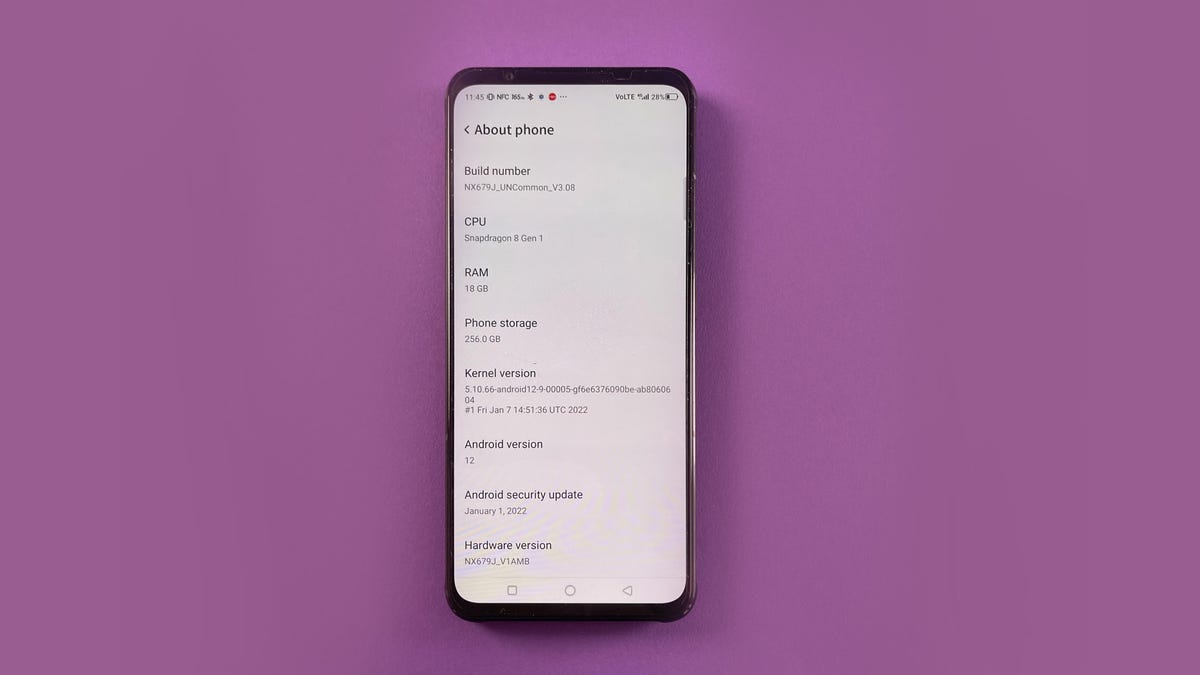
The RedMagic 7's $629 starting price includes 128GB of storage and 12GB of memory -- the latter already being a ridiculous amount for a phone. The review unit I tested is $799 and has 256GB of storage and an absurd 18GB of RAM. For perspective, the $800 Galaxy S22 has 8GB of RAM.
The RedMagic 7 comes with a 65-watt GaN charger.
Mike Sorrentino/CNET
A little bit Android, a little bit Switch
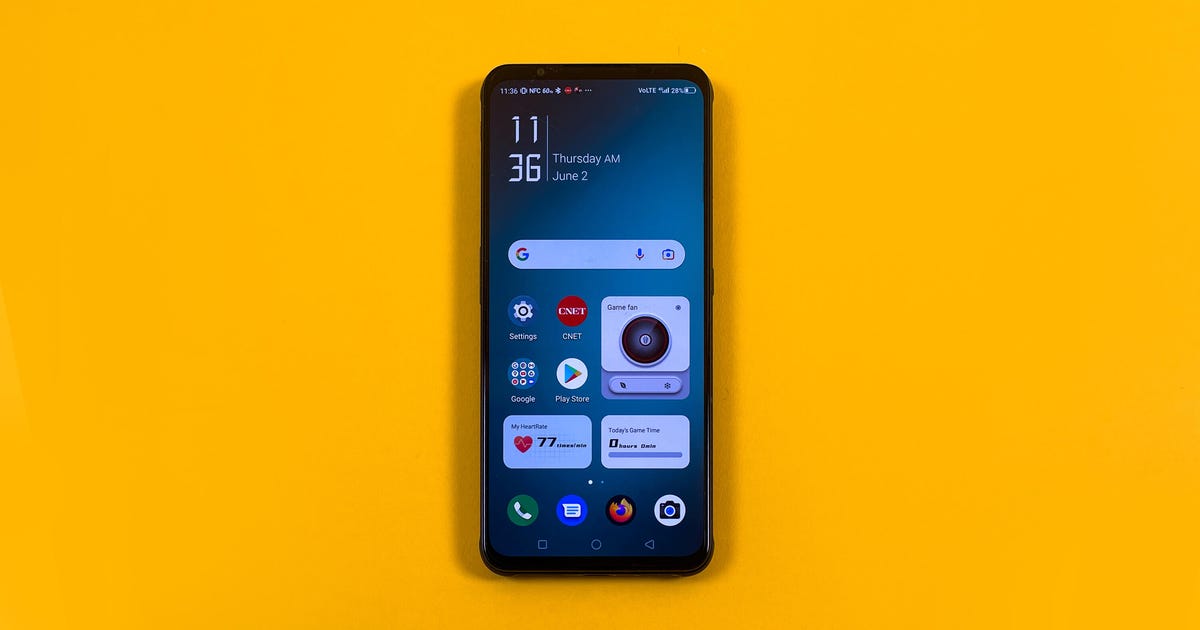
At first glance, the RedMagic 7 seems like any other Android 12 phone. You unlock it with an in-screen fingerprint sensor and are greeted with a skinned version of Android 12 that includes themed widgets like a switch for the internal cooling fan and a toggle for quickly cranking the display's refresh rate from 60Hz up to 165Hz.
However, this RedMagic OS customization makes a number of annoying default choices that aren't great for casual users. Luckily, they can be switched off pretty easily. Apps are organized into multiple home screens like on iOS. To find the app drawer, you have to turn it on in settings. Once you set it up, you can keep most apps there and organize the ones you want onto the home screens.
The default internet browser is NextWord, which is easy to switch to Chrome or Firefox. And I hope you figure this out faster than I did, but the phone puts a RedMagic watermark on all your photos. After another frustrating trip to Settings I was able to turn that off as well.
You may find yourself visiting the Settings menu a lot to change some of the defaults in the RedMagic 7.
Mike Sorrentino/CNET
OS annoyances aside, this phone is clearly aimed at gamers. A red physical switch on the top-left of the phone's transparent body boots it into a game launcher. The aptly named Game Space looks more like the menus you find on the Nintendo Switch and automatically adds games from your app library.
Gaming mode makes several tweaks to the phone's settings: It disables notifications, turns on the fan and adds menus for quick access to display refresh rates and processor performance. I set it up to show the frames per second as I played which helped determine which games supported higher refresh rates.
On the right side of the phone there's a fan exhaust and touch-sensitive areas that emulate shoulder buttons on a game controller. You can set up the "buttons" to tap specific areas of the screen during gameplay -- for instance I coupled them to the shoot button in Apex Legends Mobile and on the Use and Report buttons in Among Us.
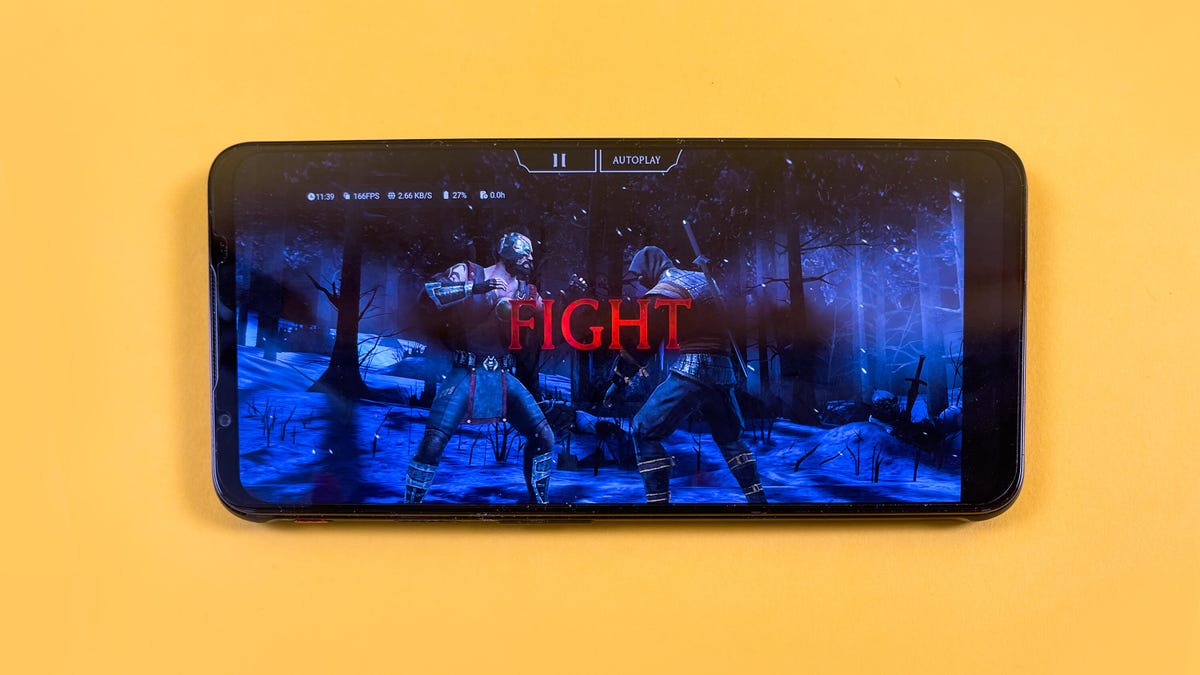
Mortal Kombat Mobile supports the 165Hz refresh rate allowed by the RedMagic 7's screen.
Mike Sorrentino/CNET
Gaming runs fast and sometimes hot
Along with the 165Hz display refresh rate, the RedMagic 7 touts a "720Hz Multi-Finger Touch Sampling Rate" -- their words. This refers to how responsive screen taps are while playing games. In lieu of having physical buttons, having a cranked-up touch rate for the screen makes a lot of sense. I found it particularly helpful for games streamed from the Google Stadia cloud service.
Cloud gaming in general is notorious for lag under even the fastest of internet connections, but with the RedMagic's 720Hz touch rate screen I was almost able to create combos in Mortal Kombat 11. It also made it possible to play Marvel's Avengers using the touchscreen over the Stadia cloud. These games are made for a physical controller, so while it's not an ideal or competitive way to play, it works fine for a quick game over good Wi-Fi.
The Game Space launcher on the RedMagic 7, which puts Android games into a more console-like menu.
Mike Sorrentino/CNET
What was more interesting were the handful of games that supported the 165Hz screen refresh rate. Mortal Kombat Mobile (separate from Mortal Kombat 11) cranks all the way up to 165Hz, making all the punches and battles look super smooth. On the other hand, Rayman Adventures, which supports 165Hz, runs at double or triple speed. I had to turn the screen refresh rate down to 60Hz to run at a normal speed.
Most games however ran at 60 frames per second regardless of what I set. While Apex Legends Mobile appeared to top out at 60fps, the game did let me max all of its settings out. Performance remained super smooth throughout a 20-minute match, but I definitely noticed the phone was physically hot to touch. The RedMagic comes with a case that makes the heat from gaming substantially more tolerable.
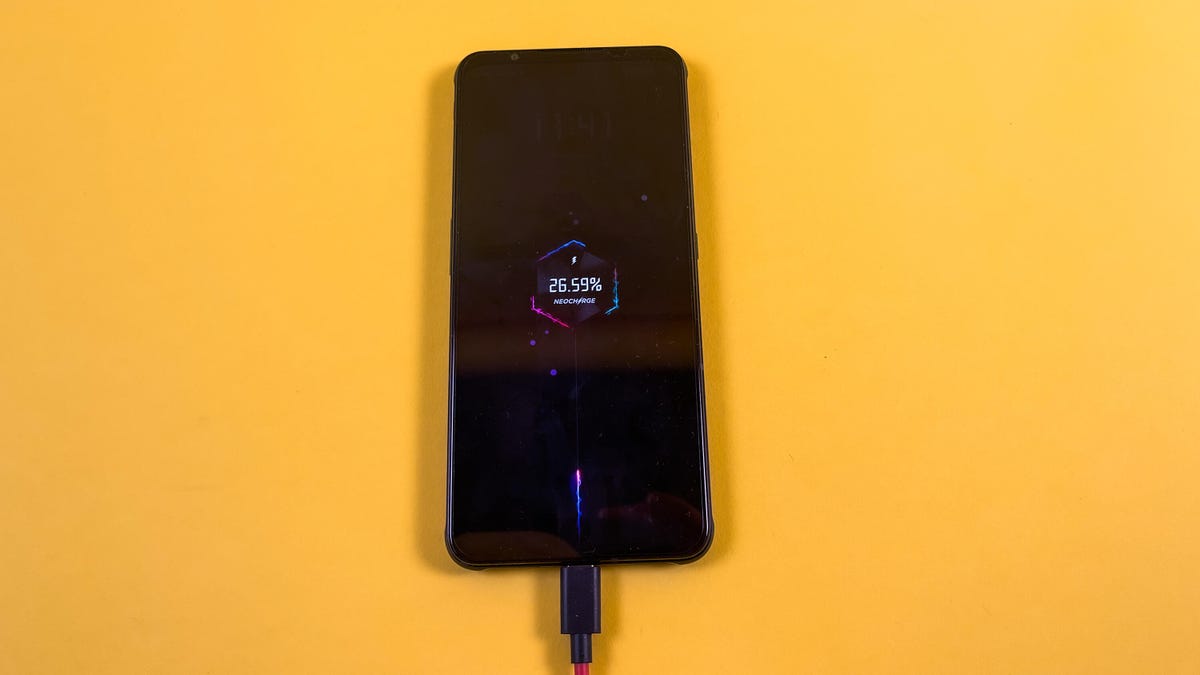
The RedMagic 7 can charge from 0% to 100% in roughly 30 minutes.
Mike Sorrentino/CNET
Fast charging that I want to see in more phones
The 65-watt GaN charger that's included with the phone is a serious perk. The dual 4,500-mAh double-cell battery can recharge from 0% to 98% in just over 30 minutes. This is a phone you definitely won't need to charge overnight. Interestingly enough when charging, an onscreen graphic shows the percentage, and the cooling fan turns on to dissipate any heat.
Battery life was great: I consistently got through an entire day, even when I kept the screen at 165Hz. Even on days where I played games for an hour or so, I had 20% to 30% left by the evening.
Another neat trick is you can power the phone straight from the power adapter, skipping the battery. This should help the battery ultimately last longer, since when available the phone won't need to draw power directly from it at all times. And during gaming, this will reduce the amount of heat the phone gives off.
I hope other phones adopt these power-charging features. A 30-minute charging time means the phone can fully charge up while you shower and get dressed in the morning.
Citi Field in New York. The RedMagic 7 applies a watermark by default that can be turned off in the settings menu.
Mike Sorrentino/CNET
Photography and software support take a back seat
The phone has a 64-megapixel main camera, an 8-megapixel ultrawide camera and 2-megapixel depth sensor. The RedMagic can handle most daytime photography situations, but it isn't going to win any awards for its photos.
Crowds inside of Citi Field, taken on the RedMagic 7.
Mike Sorrentino/CNET
In terms of image quality, photos I took at a New York Mets game were on par with lower priced phones like the Moto G Stylus 5G. Photos taken outdoors in sunlight generally looked good, while lower light situations were more difficult.
RedMagic 7's Night mode photo at New York's Citi Field.
Mike Sorrentino/CNET
The phone's Night mode helps bring out a few more additional details, focusing on subjects like the signs at the Mets' stadium, but it's not quite as detailed as other phones in this price range. If you want a phone that takes great photos, I recommend looking at the $599 Pixel 6 or the $700 Galaxy S21 FE.
The RedMagic 7 has an 8-megapixel front-facing camera.
Mike Sorrentino/CNET
The 8-megapixel front-facing camera is disappointing, even for livestreaming. Selfie photos are just OK. The front-facing camera isn't something I'd use to broadcast on Twitch. With gaming and livestreaming so interconnected, it'd be nice if the RedMagic 7 could function as a starter device towards that.
Software support on the RedMagic 7 isn't great. RedMagic says that its products tend to get one major update with a "maintenance period" that lasts between one and a half to two years.
Geekbench v.5.0 single-core
Asus ROG Phone 5 Ultimate
Note:
Longer bars indicate better performance
Geekbench v.5.0 multicore
Asus ROG Phone 5 Ultimate
Note:
Longer bars indicate better performance
Serious Android gamers only
The RedMagic 7 isn't for most people, nor is it intended to be. If you are a competitive gamer who really wants an absolutely screaming refresh rate, and doesn't mind a built-in cooling fan, then this phone is certainly an option for you. Just understand the software update tradeoffs and all the defaults you'll probably want to change out of the box.
But most other people should look elsewhere for a daily driver phone. Families considering the RedMagic as an alternative to a Switch would be better off buying a Nintendo Switch and a cheaper phone.
Nubia RedMagic 7 vs. Nubia RedMagic 6 vs. Samsung Galaxy S22 vs. Google Pixel 6
5G sub 6 (some carrier models also have 5G mmWave) support, Wi-Fi 6E, 30W fast charging, Magic Eraser, Motion mode, Real Tone, Face Unblur, Cinematic Pan, 5 years OS and security updates, IP68 rating for dust and water resistance, Gorilla Glass Victus (front), Gorilla Glass 6 (back)
Asus Vivo V272 and V222 all-in-ones come in medium and small
Asus Vivo V272 and V222 all-in-ones come in medium and small
Asus has narrowed the bezels on its Vivo line of everyday all-in-one desktops, giving the already attractive systems a more modern look for 2018.
On the inside, the 27-inch Vivo V272 ramps up to eighth-generation Intel Core i7 processor and an Nvidia GeForce MX150 GPU. While that discrete GPU promises better performance than you'd get with just the integrated graphics in the Core i7, it's a notebook part, so you can expect the system to perform more like a midrange laptop than a desktop. That's pretty common for all-in-ones, since most manufacturers insist on cramming the system into the back of the monitor where heat's a bigger problem.
It has a touch display, though with a respectable 100 percent sRGB color gamut. It's only 1,920x1,080 pixels, which means the density isn't great and will likely look a little coarse.
The company also announced a new model of its smaller -- too small? -- 22-inch Vivo AiO V222, which also looks sleeker thanks to its "frameless" small-bezel design.
Both systems incorporate Asus' SonicMaster laptop speaker system.
The company didn't announce pricing, but said the systems would be available in the first half of 2018.
PC preview : What to expect from laptops, desktops and tablets at CES this year.
CES 2018: CNET's complete coverage of tech's biggest show.
Few sports have cooler gadgets and tech than skiing and snowboarding. And there's such a wide range of equipment as well. A lot of it can enhance your experience or make recovery quicker and more efficient. The best skiing and snowboarding gadgets can make you feel like James Bond, bombing down the slopes as you're (not) being chased by your nemesis's henchmen. To help you spend more time bombing down slopes, we've collected the best high-tech ski gear on the market right now and compiled it for you below. From action cameras like a GoPro to new goggles and more, there's something for everyone.
Much of the gear here is battery-powered, including the top GoPros and other action games, as well as some ski-friendly earbuds and helmet speakers. But not everything has a power component to it. In some cases, I've included items with high-tech materials, cutting-edge designs or basic protection for iPhones and Android devices. There are also several helmets and ski goggles in the mix.
I'll add more top ski gear products to this list as I find them.
Josh Goldman/CNET
At the moment, the GoPro Hero10 is the best single-lens action camera you can get from GoPro. It's not a big upgrade over the GoProHero 9, which is available for a little less, but it has a new GP2 chip that allows high resolutions at higher frame rates -- up to 5.3K (5,312 x2,988 pixels) at 30 or 60 frames per second. It also has HyperSmooth 4.0, GoPro's highest level of image stabilization.
As with the Hero 9 Black, pricing is a little confusing for the Hero 10 Black. The camera is $550, which is more costly than the Hero 9's starting price. However, if you buy directly from GoPro.com and sign up for the GoPro subscription service -- which is included with the camera -- GoPro knocks $200 off, so it's $350 (a year of the service, which costs $50 a year or $5 a month, is included for free).
The subscription service gives you unlimited cloud backups at original quality, damaged camera replacement, discounts on GoPro accessories and gear and access to GoPro's premium live streaming platform.
Read our GoPro Hero 10 Black review.
David Carnoy/CNET
360 cams capture everything in a sphere around the camera, then later you can decide what you want to show -- and exactly how it's shown. For this type of camera, a lot of people like the GoPro Max, which is selling for around $430, but Insta360's One X2 is also impressive and some people prefer it to the GoPro.
Insta360 sells the newer and more affordable Go 2 ($300) and the earlier One R. The Snow Bundle includes a variety of mounts and accessories, everything from a chest mount to GoPro-style helmet mounts along with a pole mount.
We have a couple of videos to give you an idea of the kind of footage Insta360 cams can produce. Former CNET Senior Video Producer Nic Henry reviewed both the Go 2 (you can find the video here) and the One X2 (you can find that video here).
Read more: Insta360 Go 2 hands-on
Joshua Goldman/CNET
We could have put the GoPro Hero 9 Black on this list. It costs $50 less than the Hero 10 Black, but the truth is, if you're considering the Hero 9, you might as well get the Hero 10. However, If you can do without that top-end resolution and front-facing screen, the older Hero 8 offers a decent amount of savings and remains a good choice. It still does 4K video at 60 fps, so it's no slouch and has come down from its original list price of $350 (it's now around $280). It was a CNET Editors' Choice Award winner two years ago.
Read more: Best action cams
David Carnoy/CNET
The Aleck 006 earpieces slip into your helmet and can be used as wireless headphones for listening to music or as a headset for making calls. They offer decent sound but what makes them even more useful is if you link multiple Aleck 006 together and set up what amounts to a walkie-talkie system among friends or family members.
With real-time GPS tracking in the Aleck Go app for iOS and Android, you can also map the location of everyone in your party.
David Carnoy/CNET
Helly Hansen's flagship $750 Elevation Infinity 2.0 technical shell jacket features the company's LIFA Infinity Pro technology, its new waterproof, windproof yet breathable material that it says is the "first to-market to be made entirely without added chemicals." Typically, waterproof jackets are chemically treated, but Helly Hansen says the Infinity's "everlasting water-repellent protection never needs to be reproofed with chemical treatment after use."
For a shell jacket it offers good flexibility and doesn't feel stiff. While it has a three-layer fabric construction and offers some warmth, it's not insulated so in very cold conditions you'd need to wear another jacket underneath it, like the Odin Lifaloft Hybrid ($400).
The Elevation Infinity 2.0 is available at Backcountry and comes in black, gray fog and orange (pictured) and, like other premium Helly ski jackets, also features its Life Pocket Plus, which uses Aerogel insulation to help keep your phone from getting too cold, thus preserving its battery.
David Carnoy/CNET
Helmets with integrated lens shields or goggles have become popular in Europe in recent years, and Giro makes one of the best ones with its Orbit helmet that also comes in a version for women called the Aria (it looks very similar but has different colored trim elements). While these types of helmets tend to be expensive, they're good for people who wear glasses or just like the convenience of eye protection integrated into a helmet design -- you can rotate the articulating "shield" up onto the helmet or tilt it down over your face. It's also worth noting that the large Vivid lens (with optics by Zeiss) provides a very wide field of view.
Unlike some shields that have an open design at the bottom, this one has a foam liner and is designed to sit on your face like goggles, though the seal isn't quite as tight as a typical pair of goggles. There's good ventilation and the helmet is very comfortable to wear, with a Polartec "Power Grid" padded lining that helps with moisture management. Like many of Giro's helmets, this one also incorporates the company's custom Spherical MIPS (Multi-directional Impact Protection) technology.
The included lens shield is designed to work well in a variety of conditions (it is replaceable for $125). It does a very good job staying fog-free on nonstorm days, but I can't guarantee that it won't fog at times on big snow days, which can be challenging for most goggles (particularly if you wear glasses or prescription lens inserts with your goggles). That said, it's an excellent helmet overall.
David Carnoy/CNET
The Marauder Elite is Spy's latest and greatest model of goggles that features 60% more venting over the similarly styled Spy Ace goggles (another highly vented model). That makes it "nearly impossible to fog," according to the company. They didn't fog on me during my limited testing, but I still need to put them through a wider variety of conditions to confirm that.
The goggles' lenses adhere magnetically and can be easily swapped out (two lenses are included). These are over-the-glasses, or OTG-type, that are suitable for use with RX eyeglasses and have subtle notches in the temples to allow your glasses to fit better. Like Spy's other premium goggles, these feature the company's Happy lens tech, which it says is "scientifically tuned to boost mood and alertness while optimizing color and contrast."
They're a nice pair of goggles and although they're expensive, Spy has been having trouble keeping them in stock.
David Carnoy/CNET
When your phone gets too cold its battery drains faster, and if it's really cold, it might shut off. That's where the Phoozy comes in.
A simple sleeve or "capsule" for smartphones, the Phoozy has a Chromium Thermal Barrier Shell and SpaceTech Penetration Layer, as well as a bit of velcro to keep it closed at the top. That will help keep your phone warm on extra cold days and help preserve battery life. It will also keep your phone from overheating.
Phoozy pouches now come in a few different versions and sizes and start at $30. Just make sure to get one that's big enough to hold your phone.
Atomic
Atomic's new Redster CTD helmet is pricey but has some cool features that may someday find their way into more helmets. Inspired by Atomic's pro racing helmets, this model has sensors that assess any damage after the helmet takes a hit. You get a report on your helmet's condition via the Atomic Shocksense app for iOS and Android. Also, if you slam into something hard enough and the helmet takes heavy damage, it will automatically send SOS alerts out to your emergency contacts.
As far as protection goes, it's serious. Atomic says the Redster CTD's Atomic Multi-directional Impact Deflector (AMID) dual-density foam system absorbs shock from all angles to deliver 30% higher impact protection than International Ski Federation standards require. It's available in black, red and white.
David Carnoy/CNET
These glove liners are equipped with Seirus' Kinetic heat return system that it says amplifies your body heat 4 to 5 degrees and reflects it back to you for 20% more warmth. Of course, how warm your hands are will also depend on how warm the gloves are that go over these (they can be used as stand-alone gloves, but more for running in cold weather than skiing).
David Carnoy/CNET
After a day of shredding, your body will certainly appreciate a little percussion massage gun action. There are plenty of options available but we like the travel-friendly Theragun Mini because it won't weigh your luggage down too much and is a great little massage gun for $199 that's surprisingly powerful for its size.
Like the other new Theragun models, the Mini is equipped with Quiet Force technology that allows the device to run just as powerfully but much more quietly than the previous generation of Theraguns. The Theragun Mini has three speed settings, ranging from 1,750 rpm to 2,400 rpm, and the battery lasts for 150 minutes of continuous use.
The one notable downside to the Theragun Mini is that it only comes with one attachment, the standard ball head. You could buy other Theragun attachments a la carte because the Mini is compatible with all the same attachments that come with other models, but that brings the price up.
Florian Breitenberger
Private lessons have gotten really expensive, so why not get a virtual one?
Carv is a digital ski coach that combines some hardware that you attach to your boots with an iOS app (Android coming soon) that delivers real-time feedback about how you're skiing.
I'm still waiting to try this out but have had friends use it and really like it. The software was updated to version 2.0 with some small hardware enhancements, including a more compact battery with the same battery life.
For better or worse (probably worse), Carv has moved toward a subscription model that makes the hardware less expensive (the original kit is now $149 instead of $349), but requires you to purchase an add-on subscription for $199 a year or $298 for a two-year plan. That's still a lot less than what a single full-day private lesson would cost you at most resorts -- at least in the US.
Sarah Tew/CNET
If you don't want to pay upward of $200 for a set of Smith I/O goggles, there are plenty of more affordable alternatives, including those from Colorado-based Glade, which prides itself on making goggles that offer similar or better performance than high-end models from other companies for a lot less.
The big deal is its Adapt goggles include a Photochromic Flux lens for $129. This is a lens that changes colors according to the lighting conditions you experience. In other words, it's the chameleon of lenses, and typically photochromatic goggles cost a lot more.
Sarah Tew/CNET
The Smith 4D MAG googles are the company's current top-of-the-line model and have seen a price increase from $280 to $320. They feature a wider field of view (25% wider than the I/O Mag, according to Smith) and a 5x antifog inner lens with AirEvac Integration Technology that helps reduce fogging. Changing the lenses is easy with the MAG system. Two levers release the lens, which adheres magnetically to the goggles. One low-light and one bright-light lens are included.
Sarah Tew/CNET
If you wear glasses, the $270 I/O MAG XL goggles are a good choice, albeit a fairly expensive one.
The MAG XL is Smith's MAG lens change system featuring -- you guessed it -- magnets that let you easily swap out lenses, as well as a 5x antifog inner lens with AirEvac Integration Technology that helps reduce fogging. They come with two lenses.
The Smith I/O MAG XL goggles come in several different ChromoPop lens colors.
Sarah Tew/CNET
Seirus' flagship HeatTouch Hellfire gloves are available for $450 for men or women. The gloves haven't changed for a few years, but the battery was upgraded last year to a more slimmed-down version with increased battery life.
At the low-heat setting you can get up to 12 hours of battery life, with medium pegged at around 8 hours and high at 4 hours.
It's also available in a mitten for $450.
Sarah Tew/CNET
In the past, I've highlighted Smith's Vantage helmet, which has a visor. The Code is more oriented toward snowboarders and free riders, but a lot of mainstream skiers like its streamlined look.
Smith didn't change anything in this year's model from last year's -- except for the color options. It packs in most of Smith's latest technologies. On the inside, instead of hard foam you'll find Koroyd inserts that, from the top, look like a honeycomb with circular (not hexagonal) cylinders. The high-tech material is made of lightweight, eco-friendly polymer extruded tubes that are thermally welded together to form a strong layer of protection that also allows for good airflow. (Smith has added other materials and design elements to the helmet and is calling the whole protection package Aerocore construction.)
Beyond the fancy padding, there's the BOA FS360 fit system (with a 360-degree halo design), which helps you get a snug, "custom" fit. And new this year: a Wayfinder strap system featuring Fidlock that's basically a quick-release magnetic system that makes it easier to open and close the strap.
The helmet only comes in a MIPS version, which offers increased protection. In a MIPS Brain Protection System, the shell and liner are separated by a low-friction layer that "allows the helmet to slide relative to the head."
David Carnoy/CNET
Giro says the "modern profile" of its Jackson helmet, which comes in multiple color options, utilizes the new Passive Aggressive Venting system that's "inspired by the aerodynamic airflow of high-end autos." Well, it's a good looking helmet and also pretty lightweight and comfortable while offering MIPS (Multi-directional Impact Protection) technology.
It doesn't have the company's upgraded Spherical MIPS technology found in its Emerge helmet ($150), this model has Giro's Form 2 Fit system that allows you to dial in the fit of the helmet (it's similar to Smith's dial-in fit), which allowed me to get a more snug fit. The Emerge uses the company's Stash Fit system that allows you to remove or add layers of padding to customize your fit.
Both the Emerge and the Jackson are designed for maximum compatibility with Giro goggles but they work just fine with other goggles.
David Carnoy/CNET
Giro makes a couple of goggles in the $150 range, including the Method and Article. It describes the Method as having a "bold retro style" that's been advanced with "the most modern technology." It's a comfortable goggle with a wide field of view and good venting that helps keep the goggles fog-free in most conditions (I haven't met a goggle that's truly fog-free in all conditions).
Like the more rounded Article goggles ($170), the Method uses Giro's Vivid lens with optics by Zeiss and a second lens is included. The Method is available in a few different color options.
Beringia
If you're looking for the ultimate Merino wool base layers, these tops and bottoms from Beringia may just be it. Diomede is Beringia's proprietary fabric "that seamlessly knits multiple layers of fabric into one ultrastretchy waffle." Real-world translation: The fabric is thin, lightweight and comfortable but also warm. The only downside is that tops ($150) and bottoms ($175) are quite expensive and there's no deal if you buy both together, although you can get 15% off with your first purchase.
Beringia Diomede base layers are available in a few color options and three sizes, as well as women's versions. The top also comes with a snorkel hoodie for $25 more.
David Carnoy/CNET
Constructed from Grilamid, a lightweight but very durable frame material, the Spy Helm Tech sunglasses are a modern take on glacier sunglasses that includes removable side shields so you can block both the sun and all the "haters" at the same time, according to the company (they turn into standard wayfarer sunglasses without the side shields).
The sunglasses have hidden sweat channels in both the nose pads and inner temples for breathability and feature the company's Happy Tech lens tech that it says is "scientifically tuned to boost mood and alertness while enhancing color and contrast."
True or not, I will say they fit comfortably, the optics were very good and I was indeed happy using them.
David Carnoy/CNET
Most new phones, including the iPhone 13 models, offer a decent level of water resistance. But if you want some added protection, Lifeproof still sells its waterproof and shockproof Fre case -- and the latest version is built for MagSafe accessories.
The Fre case is also available for some Samsung Galaxy models but that version doesn't feature MagSafe, a feature that adds $10 to the case.
David Carnoy/CNET
You don't want your phone to go dead on the mountain, so it's always good to pack a battery pack.
MyCharge calls its new line of magnetic power banks Superhero Mag-Lock, implying that they're real saviors. I was impressed by their design. Not only do the batteries, which come in various capacities, have strong magnets and stick really well to the back of your iPhone 12 or 13, but they have raised coils, which are supposed to help with reducing heat levels while charging. It does seem to work.
The 3,000-mAh battery is lightweight and slim and is nice to have around for some emergency charging. However, it won't get you a full charge, so you'll probably want to step up to one of the higher-capacity options like the 6,000-mAh model that retails for $60 but is currently being discounted to $36. The 9,000-mAh version is beefy and feels like your phone is attached to a small brick (the battery and phone do fit in your hand nicely but the combo certainly isn't pocket-friendly).
All the Mag-Lock batteries charge Qi-enabled iPhones at 5W, although you can get faster charging if you go wired and use a USB-C to Lightning cable. I also liked how there's a chime when the charging starts and your phone tells you how much juice is left in the battery pack (it's tied into iOS 15). You can wirelessly charge Android devices as well, but the Mag-Lock won't stick unless you have a metal ring on the back of your phone's case. Stick-on rings are available for sale.
The MyCharge SuperHero Mag-Lock is available in a few color options and has a nice glossy finish. It currently is the best-designed magnetic power bank -- better even than Apple's.
Ibex
Ibex, which is known for its high-tech merino wool garments, describes its Wool Aire Hoodie as having "backcountry performance with frontcountry style." Available in a few colors and both men's and women's options, it's a puffy jacket that's not all that puffy but is lightweight, comfortable (it has some stretch to it) and can be used as either a midlayer on cold days or outer layer on not-so-cold days.
It's constructed of eco-friendly Bluesign-certified materials and is wind- and water-resistant. Also worth noting: It packs up into its chest pocket, which makes it travel-friendly.
David Carnoy/CNET
Bollé's Torus goggles come in a version with a standard lens for around $120 (or less), but I tried the step-up version with the company's high-contrast Volt lens, which is harder to find in stock. You get one lens with these goggles, but the Ice Blue Cat 3 lens (with a pink base tint) offers some flexibility in terms of what lighting conditions you can use it with. The goggles offer a wide field of view and good ventilation.
Amazon
Biolite has a new line of portable batteries that offer USB-C PD fast-charging (up to 18W) along with two additional USB-A ports so you can charge a couple of phones at the same time, albeit at slower speeds. There are three sizes available -- 6,000-mAh, 10,000-mAh and 20,000-mAh -- but the 6,000-mAh version (pictured on right) is probably best for skiers because it's slim, relatively lightweight and fits easily in a pocket. To charge iPhones at 18W speeds, you'll need to bring your own USB-C-to-Lightning cable to the charging party (the latest iPhones include that cable).
Although Biolite says its powerbanks are "durable," they don't have a water-resistance rating. That said, they should survive a drop in the snow just fine.
Sarah Tew/CNET
Zeal goggles have excellent optics and a wide field of view, and many feature the company's Rail Lock System that makes the lenses easy to change and the goggles easy to vent when you're in hiking mode.
The base models with standard lenses are pretty affordable, ranging from $129 to $159. Things get more expensive when you move to the Automatic Plus GB lens, which is photochromic and changes quickly with the lighting and works in any conditions. Add that Automatic Plus lens and the price goes up to $279.
I like the Portal XL (on right), which also starts at $249 for the standard two-lens option. It has the widest field of view and is an OTG type that allows you to wear glasses.
The Hemisphere, starting at $129, has a spherical frame with upper and lower ventilation and triple-layer face foam and is available in a variety of lens options. It doesn't have the RLS system, but the lens quality is quite good for the price.
David Carnoy/CNET
The Jaybird Vista 2 sports buds feature a similar design to the original Vista buds but have a couple of key upgrades: active noise canceling and a transparency mode called SurroundSense that allows you to hear the outside world, an important safety feature for skiers as well as runners and bikers.
The Vista 2 buds have an IPX68 water resistance rating, which means they're both dust-proof and fully waterproof. Jaybird says they're also sweat-proof, crush-proof and drop-proof. And the compact case is now splash-proof and dust-resistant, with an IP54 rating.
They sound quite good once you tweak the EQ settings to your liking, but in sound quality they're not quite up to the level of some other premium earbuds. Their noise-canceling, transparency mode and voice calling are decent though unspectacular (the Beats Fit Pro performs better in all departments). But if you're buying these, you're buying them for the secure fit and durability.
Sarah Tew/CNET
This is Smith's goggles-sunglasses hybrid, the Wildcat ($200). Constructed with the same materials used in Smith goggles, the Wildcat glasses provide lots of eye coverage and good airflow but have the comfort of a more lightweight pair of sunglasses. The Wildcat sunglasses come with a bright-light ChromaPop lens and a secondary clear lens for flat-light overcast days and are available in three color options.
Amazon
This product comes at the recommendation of CNET editor Justin Jaffe, who lives in New England. He writes:
"As Covid surged again this winter, I've taken up alpine touring: skinning up a mountain and skiing down. The benefits are considerable -- you can often get by without a lift pass and it delivers a much more rewarding cardio workout than pure downhill skiing. This highly adjustable USWE backpack has become an essential tool for me, providing the right amount of space for gear as well as an insulated water bladder that has never once frozen up. And there is a strap and pocket for everything, from goggles to helmet to skis. Highly recommended."
Sarah Tew/CNET
You'd think that more companies would have made Bluetooth headphones that slip inside your helmet, but Outdoor Technology is one of the few that does (some Chinese companies like Outdoor Master have gotten in on the game in the last couple of years). Their appeal has waned now that true wireless earbuds have come along, but they're still available at a discounted price, around $90.
How it works is you charge up the Chips and slide them into the earflaps on your helmet (they should work with most helmets). You want to make sure that no excess padding in your helmet is covering the Chips or else they'll get muffled and you'll lose some volume; you want them as close to your ears as possible.
The Chips 2.0 have a walkie-talkie feature that allows you to communicate with friends who are also using Chips 2.0 headphones. You create a group using the ODT Walkie-Talkie app and talk over the cell network, which means the only limit on distance is whether you're getting a phone signal. Up to 99 people can be in your private group.
I thought the sound quality was decent for Bluetooth but not great. That said, it's nice to be able to stick your helmet on and have the headphones built in with no wires to worry about. Battery life is rated at 10 hours, and the Chips are sweat- and water-resistant but not waterproof.
Outdoor Technology also sells the Chips Ultra, a true-wireless version of the Chips that costs significantly more (about $163). I don't think the Ultras are worth the money.
David Carnoy/CNET
You never know when you might need to hang up some gear, which is where the Heroclip comes in. Available in a few different sizes and colors, this souped-up rotating carabiner hook clip costs around $23.
Garmin
The original Garmin inReach Mini has been one of the more popular satellite communication devices with backcountry skiers. The new inReach Mini 2 has the same compact, lightweight form factor but adds additional features, including a more energy-efficient processor that greatly improves battery life (now up to 14 days of battery life, using default 10-minute tracking, and your location is sent to your MapShare page for friends and family to view), a higher resolution display and user interface, as well as compatibility with Garmin's Explore app and some new navigation features.
Garmin says that while most users will interact via their phones or paired Garmin devices, you can still send a check-in, read incoming messages, and reply with either a pre-canned QuickText or write a custom message from the device itself.
You do need an active satellite subscription to use the inReach Mini 2 with basic annual plans starting at $11.95 a month or $14.95 for a single month subscription.